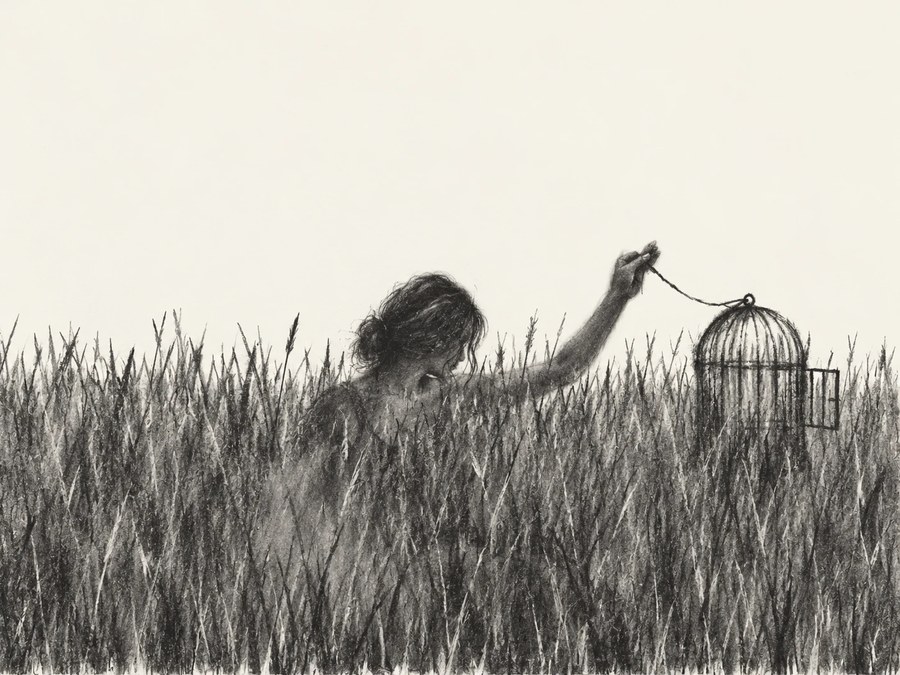
Narrative: a figure, a field, an open cage
The prompt, kept intact: "Charcoal drawing. A figure in a field both part of and apart from her surroundings--one hand tethered to an open bird cage, the other absent or resisting. The cage is less prison than pattern."
The inquiry
Narrative: inquiry
The prompt (Russell, kept intact)
"Charcoal drawing. A figure in a field both part of and apart from her surroundings--one hand tethered to an open bird cage, the other absent or resisting. The cage is less prison than pattern."
Subject and treatment (what the prompt fixes)
Subject: a woman in a field; one hand tethered to an open bird cage; the other hand absent or resisting. Treatment: charcoal. Claims the prompt makes that a drawing must show, not caption: she is both part of and apart from the field; the cage is "less prison than pattern".
What we are trying to discover
How can a drawing make one figure belong to a field and stand apart from it at once, through what is visible (edges, marks, values), and what would make a cage read as pattern rather than as a prison or a prop? Working hypotheses, none assumed:
- belonging and apartness as edges: where her contour is lost in the field she belongs; where it is hard she is apart;
- pattern as a shared mark: if the cage's bars are the same kind of mark as the grass, the cage becomes part of the field's pattern, not an object of story;
- the tether as the one continuous line in a drawing of broken ones;
- "absent" as something the drawing does (a lost hand, a cropped arm, an unfinished passage), not something the figure does;
- the bird: the prompt does not ask for one (see the default map).
The default (s0_default/DEFAULT_MAP.md)
Method
As for the still life: inquiry; set 1 (six distinct organizations); critique (habits, promising relations, caption-only ideas); set 2 with the strongest counterexample to the favourite; set 3 if useful; a passage of work with the fitting tool; critique of the return and of the intention; an argued Hold.
Tools for native thumbnails
hand/stage.py (new): an authored stage with an articulated figure (capsule mannequin with a dress, joint targets for the hands), a cage (bars, rings, dome, an open door, a hook), a tether (a sagging line), a bird, grass drawn over the render, one light with cast shadows. Hands (Kollwitz charcoal) draws the value study.
The default
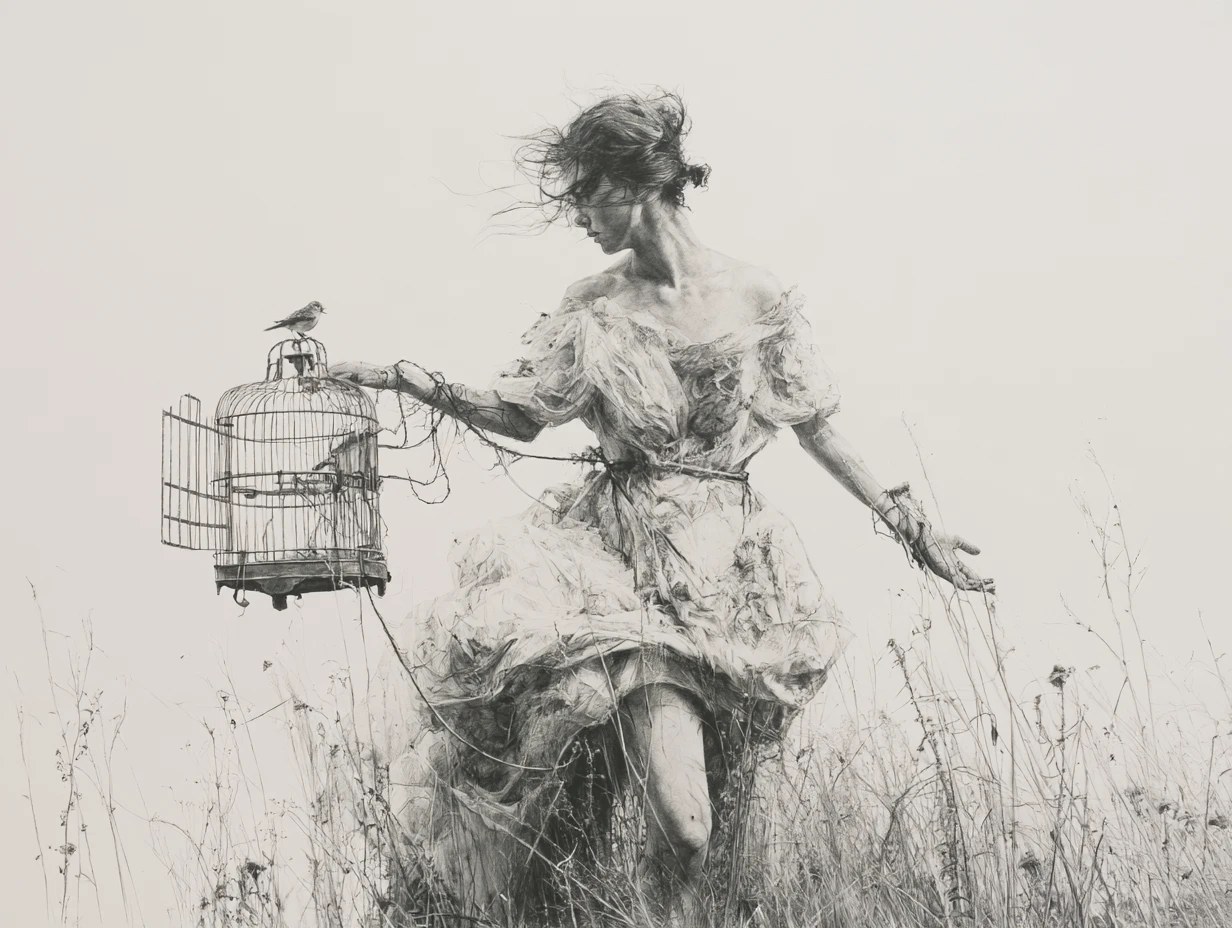
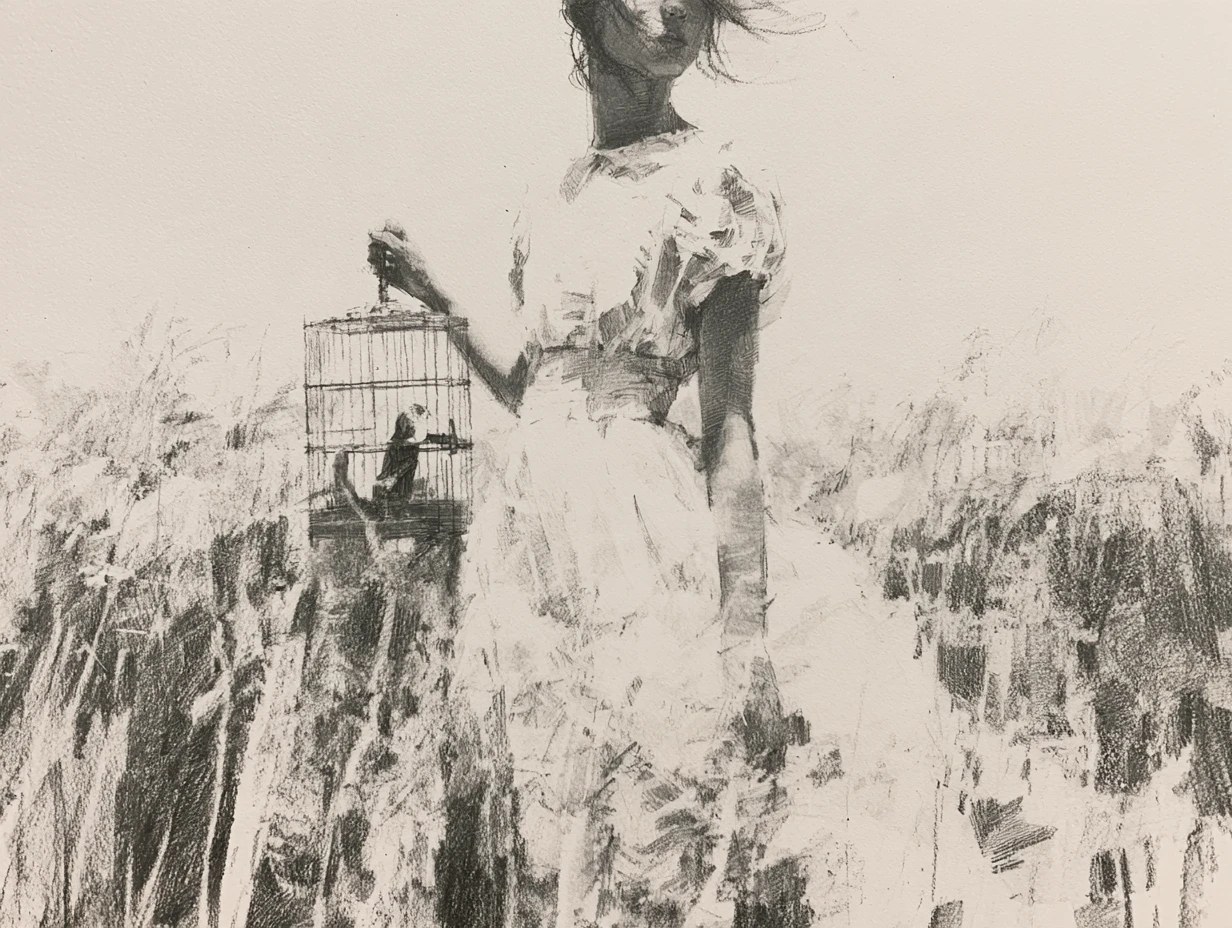
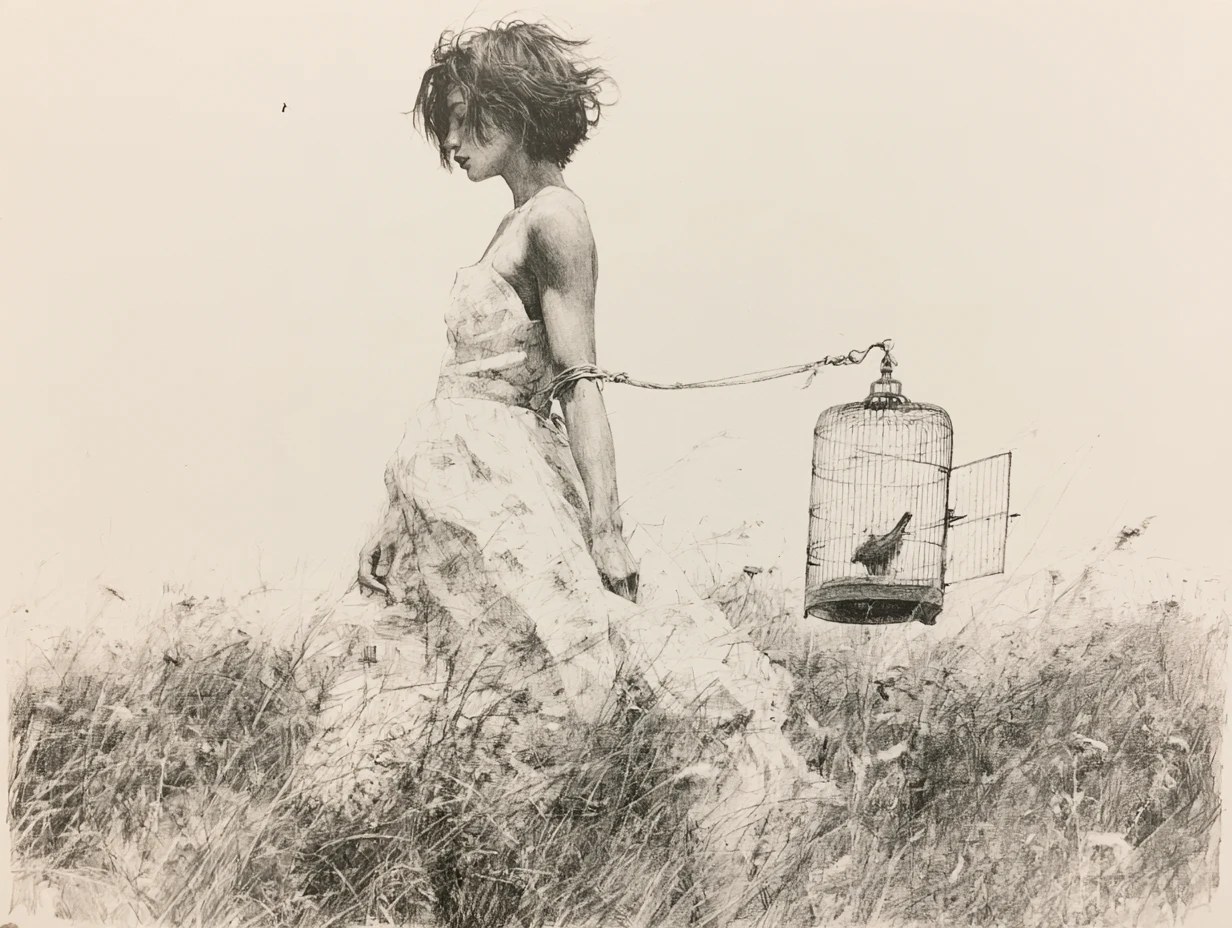
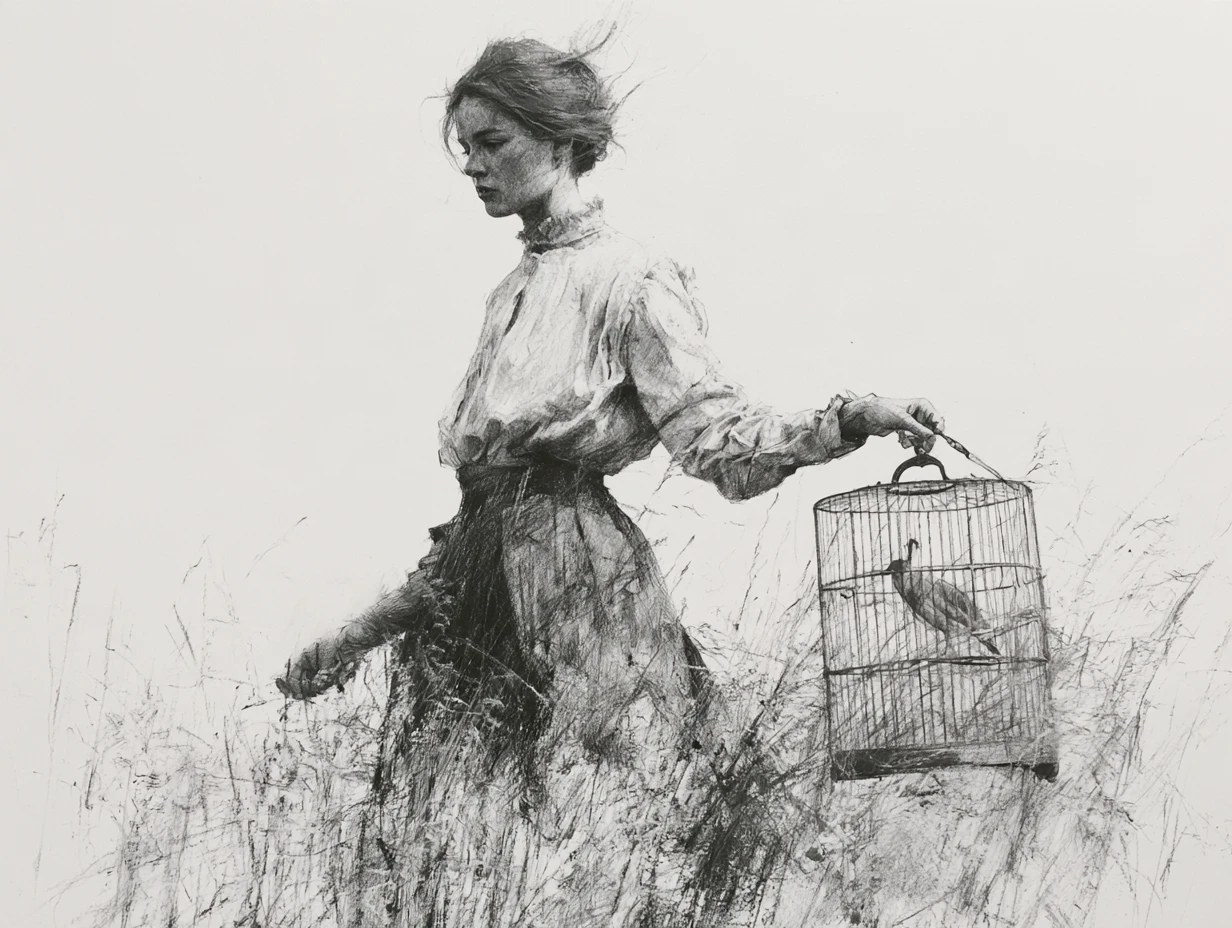
Default map: four Midjourney images of the prompt (measured/summary.md)
Seen (all four):
- a young woman in a light dress, three-quarter or profile, eyes lowered, hair blown by wind;
- the cage hangs from her hand or from a cord at arm's length, beside her, at waist to chest height; the door is open in 2 of 4;
- a bird is present in all four, inside or on the cage. The prompt does not ask for a bird;
- grass across the bottom of the frame; the figure stands in it to the knees or waist [dy median 0.194: weight sits low];
- the figure is centred [dx median -0.0002];
- high key: light paper sky, no committed black [mean_zone 7.31; black_area 0.0005; shadow_mass 0.023].
How the prompt's claims are rendered by default:
- "part of and apart from": the grass overlaps the lower body (part of); the upper body is drawn whole against the sky (apart). A horizontal split, the same in all four.
- "the other hand absent or resisting": a relaxed hand at her side or brushing the grass; no resistance and no absence.
- "less prison than pattern": not addressed; the cage is an object held, drawn with care, carrying a bird: an emblem of captivity and release.
Measured spread of the default
Default map: measured spread per batch
Median [25th-75th percentile] per key. Same readers and registry meanings as critic/vtl/registry.py and critic/color/registry_color.py; tonal/marks thresholds are provisional.
| group | key | mj |
|---|---|---|
| placement | dx | -0.000155 [-0.0107-0.0103] |
| placement | dy | 0.194 [0.176-0.21] |
| placement | dr | 0.118 [0.107-0.129] |
| placement | dx_ton | 0.000581 [0.000178-0.00245] |
| placement | dy_ton | -0.0249 [-0.0265--0.0246] |
| structure | rv | 0.876 [0.864-0.877] |
| structure | mu | 0.835 [0.798-0.854] |
| structure | sdi | 0.208 [0.196-0.225] |
| structure | vcli_g | 3.02 [2.96-3.09] |
| structure | sci | 2.31 [2.29-2.39] |
| structure | drc | -0.0616 [-0.0818--0.0477] |
| structure | n_islands | 6 [6-6.5] |
| structure | drain_margin | 0.0181 [0.0111-0.0385] |
| tone | mean_zone | 7.31 [7.16-7.39] |
| tone | shadow_mass | 0.0225 [0.0194-0.0278] |
| tone | highlight_mass | 0.785 [0.772-0.794] |
| tone | midtone_share | 0.179 [0.158-0.204] |
| tone | range_p2_p98 | 58.9 [57.9-61.9] |
| tone | gini_mass | 0.512 [0.469-0.538] |
| tone | white_area | 0.593 [0.531-0.603] |
| tone | black_area | 0.000482 [0.000417-0.00152] |
| tone | withheld | 0.531 [0.489-0.55] |
| marks | stratification | 0.415 [0.376-0.448] |
| marks | unanimity | 0.441 [0.414-0.46] |
| marks | pressure_cv_mean | 1.35 [1.11-1.37] |
| marks | detail_democracy_cv | 1.09 [1.01-1.11] |
| marks | withheld_share | 0.454 [0.426-0.457] |
| colour | col_okc_C_mean | 0.0138 [0.00828-0.0196] |
| colour | col_light_sdi | 0.294 [0.204-0.383] |
| colour | col_dark_sdi | 0.338 [0.295-0.391] |
| colour | col_focal_count | 12 [10.5-13.2] |
| colour | col_primary_focal_dominance | 0.323 [0.2-0.478] |
| colour | col_border_salience | 0.0821 [0.0761-0.0877] |
vcli_label
- mj: collapse into noise 3/4, earned tension 1/4
regime
- mj: gradient-field / controlled instability 4/4
col_regime_tags
- mj: edge-activated field 4/4, quiet field with sharp accents 4/4, high-light ground 4/4, narrow hue field 4/4, low-chroma field 4/4, distributed salience 1/4, discrete chroma objects 1/4, diagonal force 1/4, compact light 1/4, dispersed dark 1/4
A new stage for figures: stage.py
The still-life stage could not make a figure, so a second one was built: an articulated mannequin with a dress (standing, walking, kneeling, lying; hand targets; an arm can be left out), a cage with bars, rings, a dome, a hook and an open door, a sagging tether, an optional bird, and grass drawn over the render whose tips can end along a chosen ragged line. Two rendering faults were fixed before it was trusted: the ground is intersected exactly, and soft shadows are stepped finely enough not to band into rings.
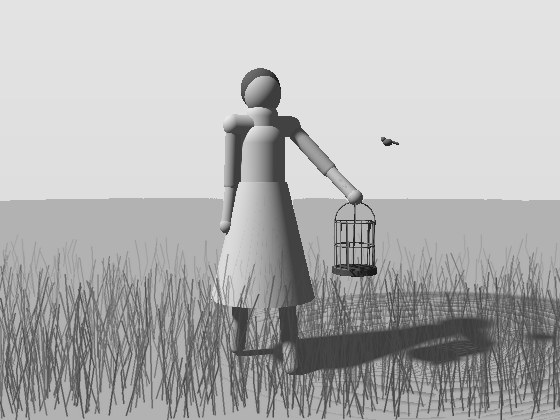
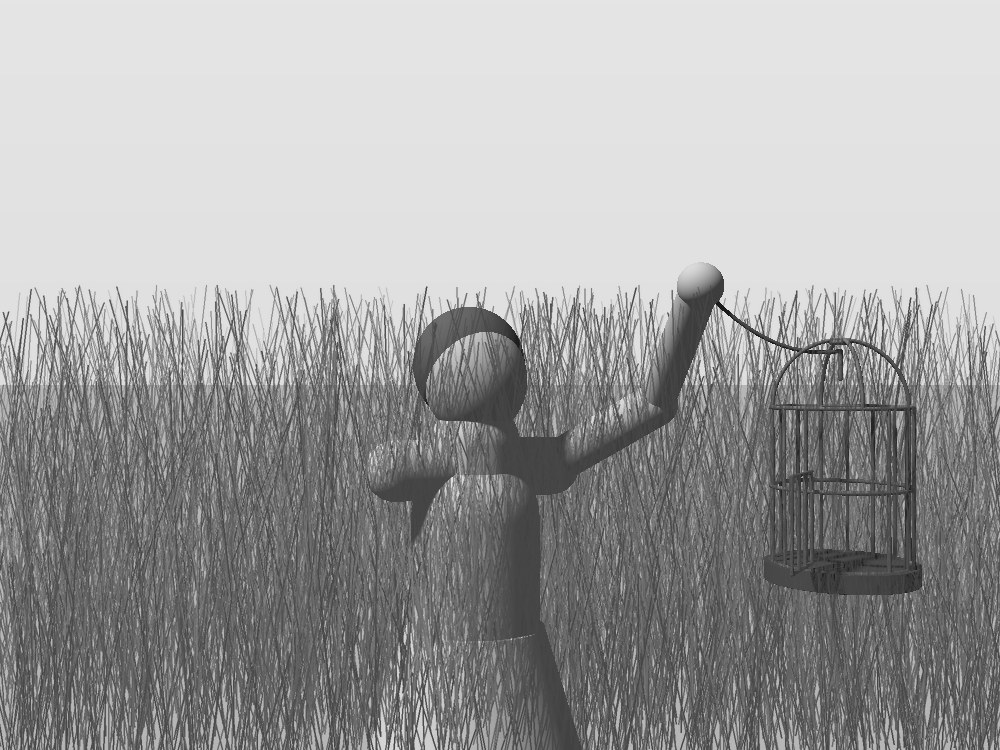
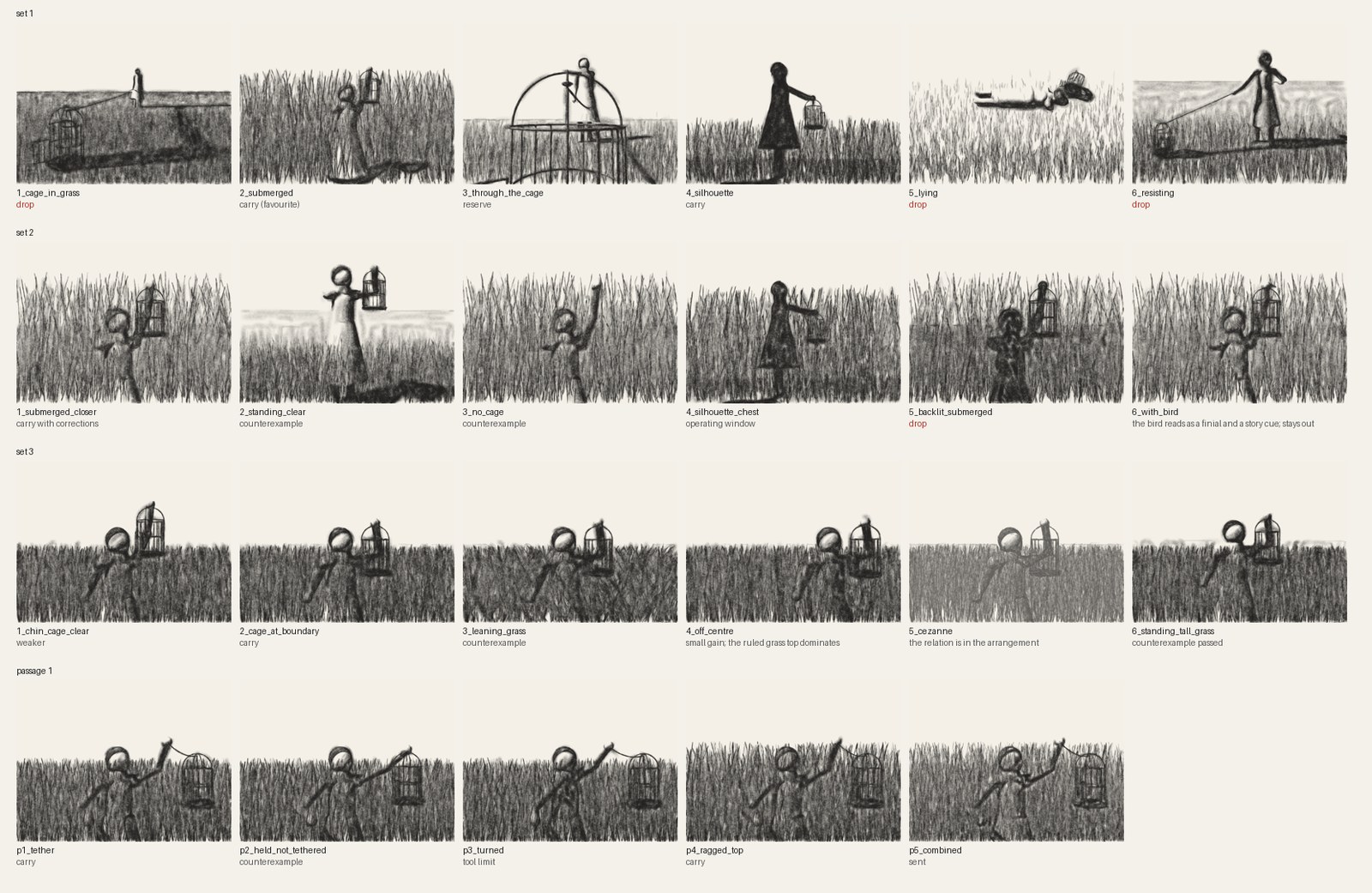
Set 1: six organizations
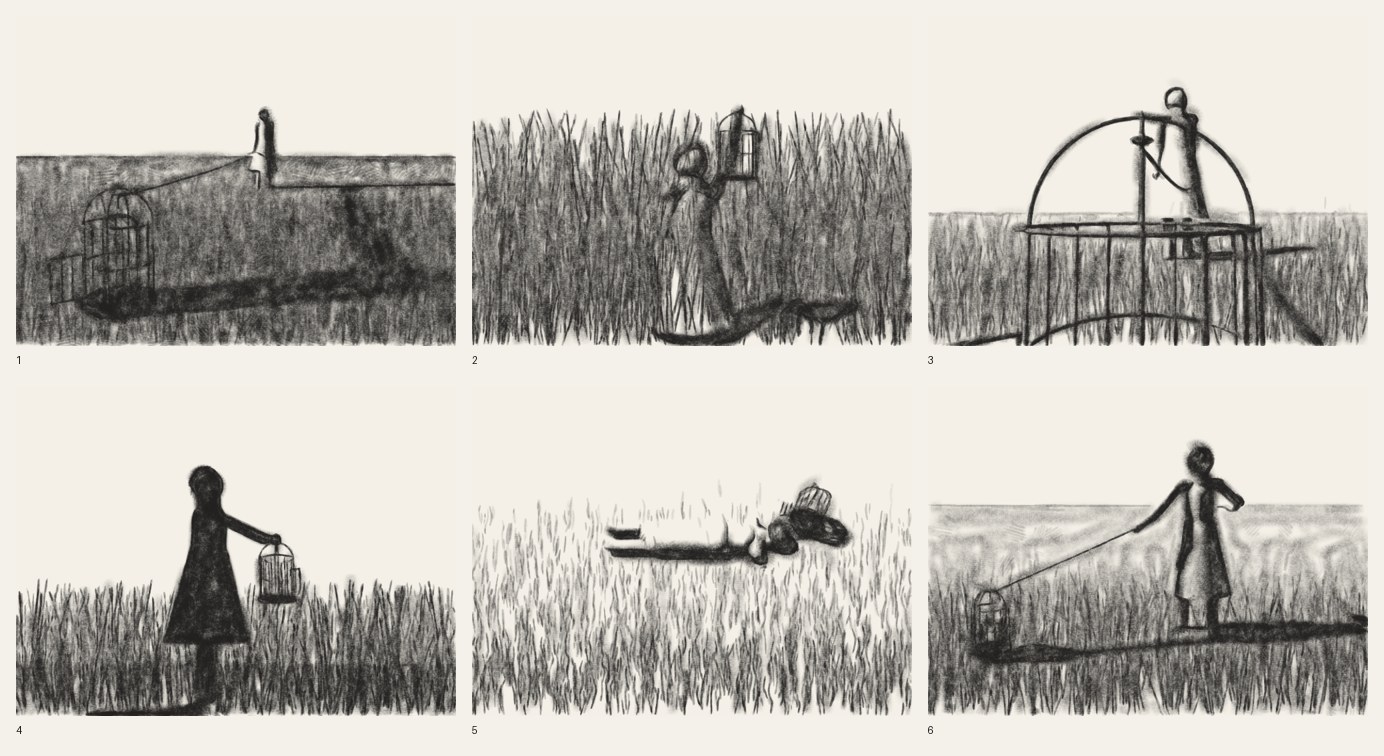
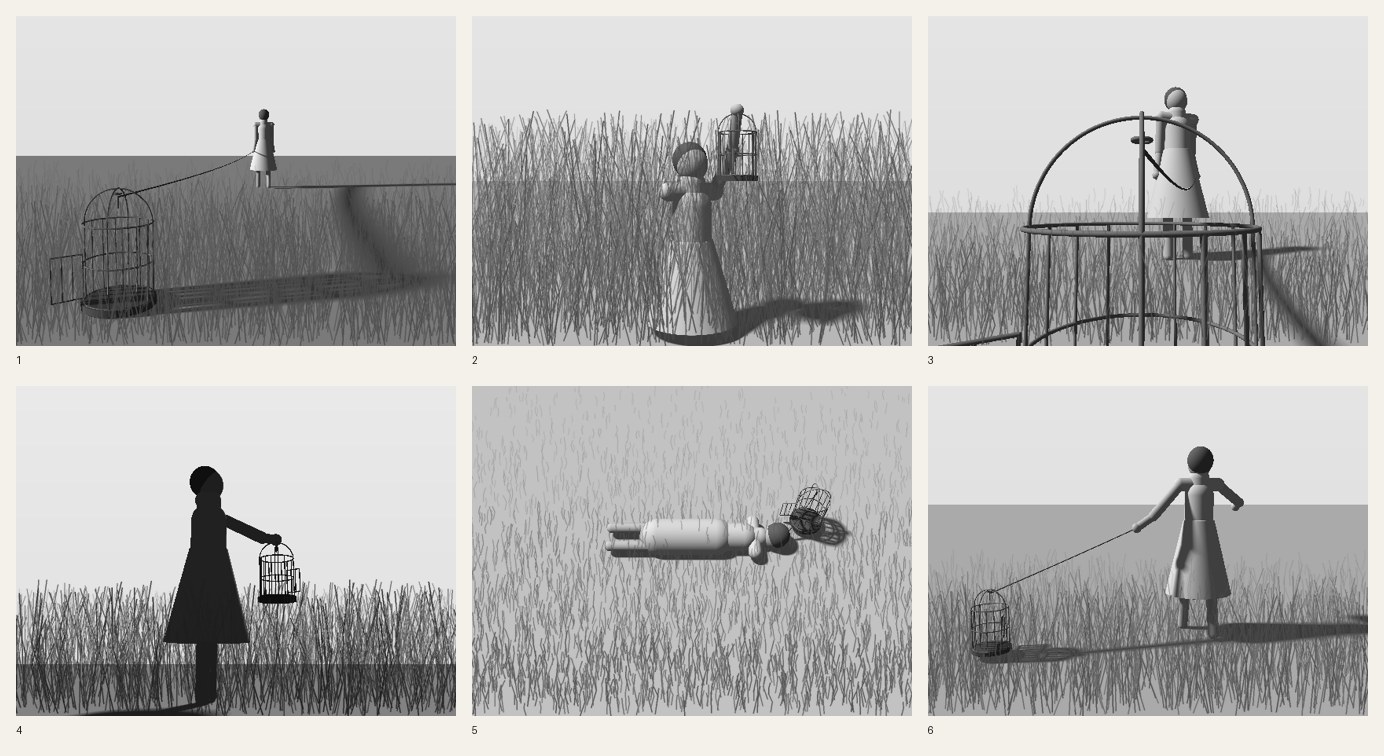
| drawing | question | decision |
|---|---|---|
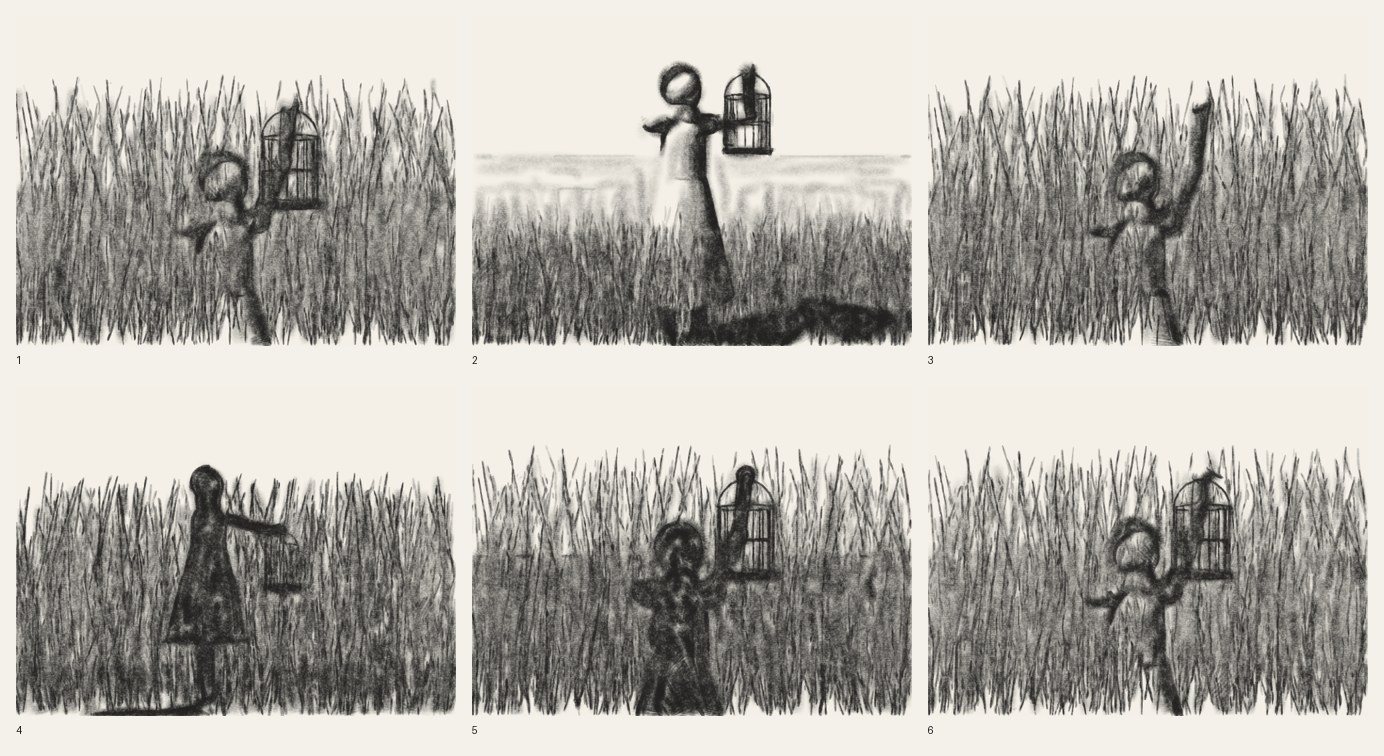
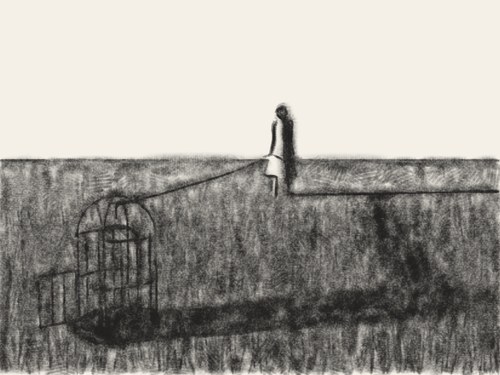 | 1_cage_in_grass The cage set down among the grass, its bars continuous with the blades; she is far off, walking away, joined only by a long tether. Can the cage become part of the field's pattern? | drop: cage and grass are two mark families; the pattern idea needed the caption |
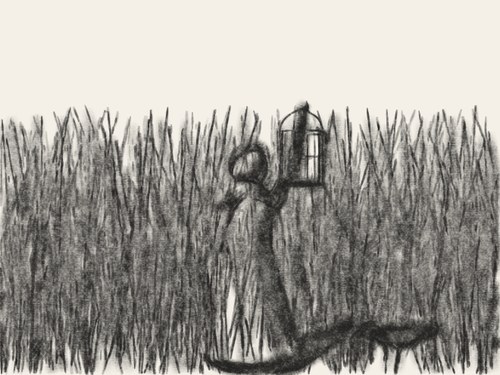 | 2_submerged Submerged: she kneels in tall grass, only head and shoulders above it, the cage raised high against the sky; the other arm is gone into the grass. Part of the field below, apart above? | carry (favourite): she is made of the field's marks; the cage is the one constructed pattern, held into empty sky |
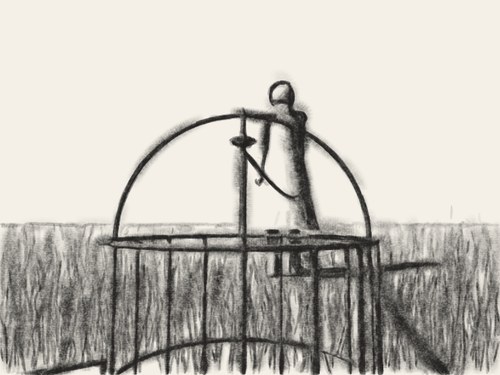 | 3_through_the_cage Through the cage: the cage close to us fills the frame; she stands beyond it, seen through the bars, the tether running from her hand to it. The cage as a pattern laid over her. | reserve: bars cross her and the field, but the cage reads as a pavilion |
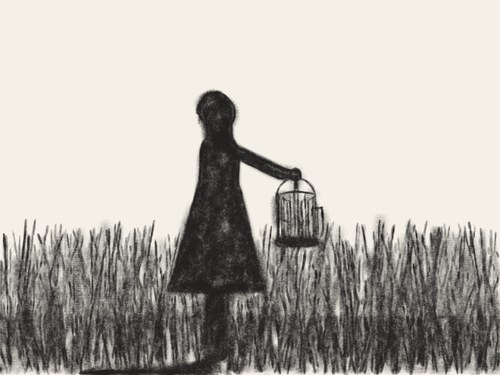 | 4_silhouette Against the light: low view, backlit; she and the cage are dark shapes on a bright sky, the cage arm out, the other arm absent. Is apartness a silhouette? | carry: one dark shape; bars rhyme with blades |
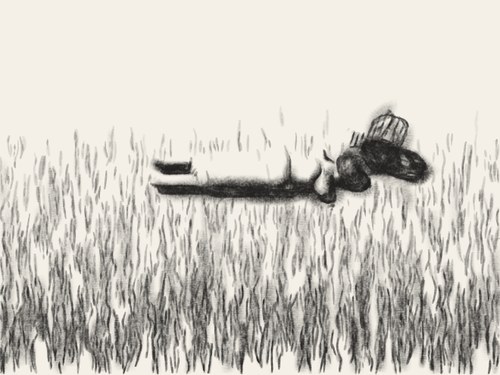 | 5_lying Lying in the field, the cage upright beside her head, the tether slack. Seen from above: part of the field, literally. Is that more than a caption? | drop: reads as a body in grass; the cage becomes a clue |
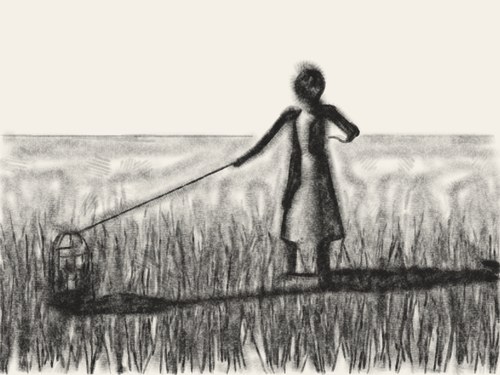 | 6_resisting Resisting: she walks away; the tether runs taut from her trailing hand back to the cage on the ground; the other arm reaches forward. Can resistance be visible as a line under strain? | drop: the forward arm reads as a wave; resistance not visible |
Critique of set1
Set 1 critique (drawings first, questions second)
Read by the orchestrating assistant. set1/contact.png (drawings), contact_studies.png (value studies).
Repeated habits
- A strip composition: in all six the field is a band of vertical hatching under a blank sky, with a hard horizontal edge between them (1, 3, 6 most). This is the default's own structure (grass below, figure against sky above), so the "part of / apart from" split is again a horizontal line. My habit and the default's agree; that is a warning.
- The grass is one texture everywhere: even vertical strokes at one density. A field as wallpaper.
- The figure stands upright near the middle in four of six.
- Hands leaves the lit side of the dress as paper, so a lit figure loses her contour (most in 2).
Promising relations (pointing to what is visible)
- 2 (submerged): her lit body goes to paper and is crossed by the same strokes as the grass. She is made of the field's marks; only her dark hair and the cage read as separate. The cage is the one constructed pattern, and it is held up into empty sky. "Part of" happens in the marks, without a caption.
- 4 (silhouette): she and the cage are one dark shape; the cage's verticals repeat the grass blades' verticals, at the same scale, above the grass line. The rhyme between bars and blades is visible: the cage as pattern.
- 3 (through the cage): the bars cross both the field and her. But the cage, seen this close, reads as a structure she stands in (a pavilion), a different noun.
Ideas that only work because of the caption
- 1 (cage in grass): the cage is drawn as clean lines and the grass as texture: two different mark families. "Bars continuous with blades" did not happen. The cage reads as a cage dropped in a field.
- 5 (lying): reads as a body in grass, a stronger and darker story than the prompt asks for; the cage becomes a clue. Drop.
- 6 (resisting): the taut line reads, but the forward arm reads as a wave, not resistance. Resistance is not visible.
Decisions
- 2 carry (favourite). 4 carry. 3 reserve. 1, 5, 6 drop.
Set 2 plan
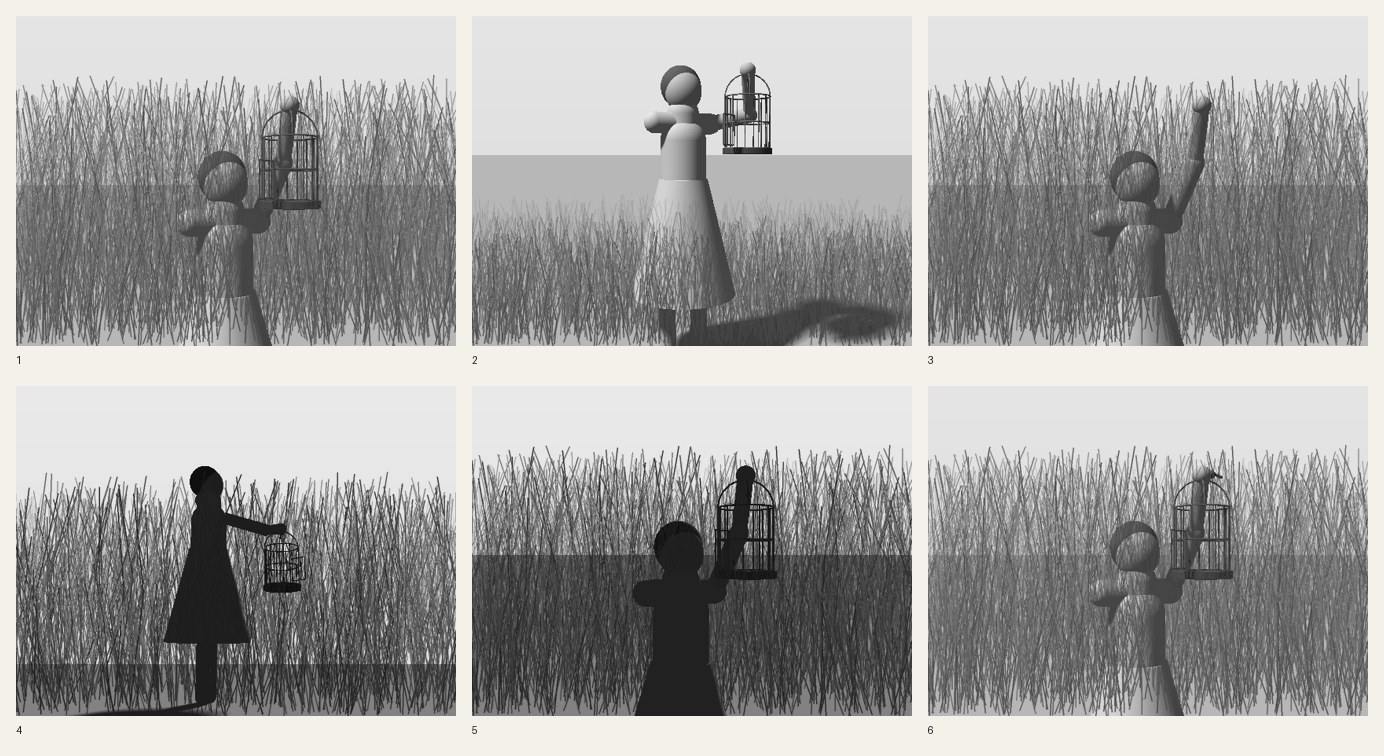
2-1 develop 2: closer; grass crossing more of her; the cage high, door open. 2-2 counterexample: the same, but standing clear of the grass (the default's arrangement). What is lost? 2-3 counterexample: the same submerged figure with no cage, the hand raised empty. Is the cage doing something specific, or is it a prop? 2-4 develop 4: silhouette with the grass up to her chest; the cage at the grass top so bars and blades meet. 2-5 combine 2 and 4: backlit and submerged: her body dark among dark grass, the cage dark against the sky. 2-6 the bird: the favourite plus a bird on the cage, as every default image had. What does the bird do?
Set 2: develop, and the counterexamples
| drawing | question | decision |
|---|---|---|
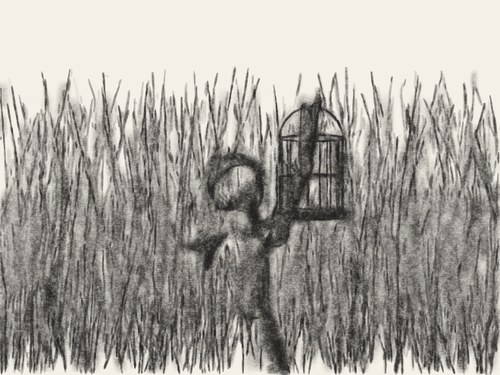 | 1_submerged_closer Develop 2: closer; grass crossing more of her; the cage high, door open. | carry with corrections: grass above her head removes the 'apart' |
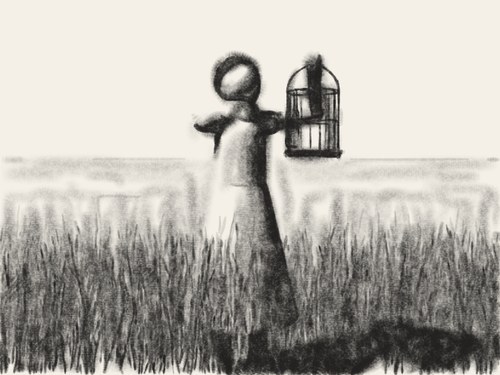 | 2_standing_clear Counterexample: the same figure standing clear of the grass, as in the default. What is lost? | counterexample: different marks from the field; a scarecrow; apart only |
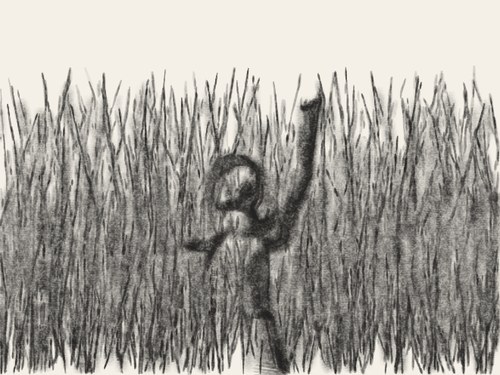 | 3_no_cage Counterexample: submerged, the hand raised empty, no cage. Is the cage doing something specific? | counterexample: the raised empty arm reads as distress; the cage turns a signal into carrying |
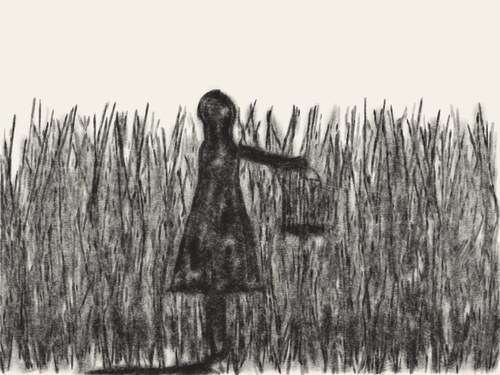 | 4_silhouette_chest Develop 4: silhouette with grass to her chest; the cage at the grass top so bars and blades meet. | operating window: at the grass top the cage dissolves and becomes illegible |
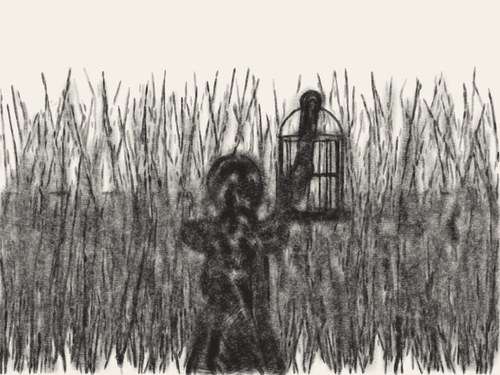 | 5_backlit_submerged Combine 2 and 4: backlit and submerged: her body dark among dark grass, the cage dark against the sky. | drop: one dark mass |
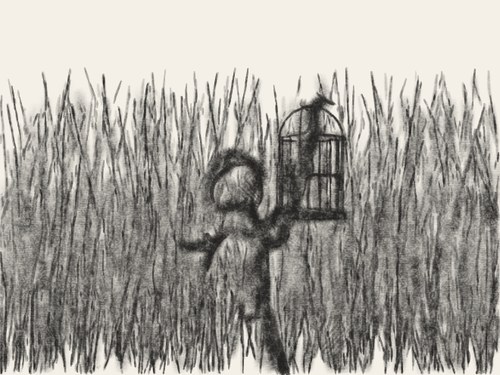 | 6_with_bird The bird: the favourite plus a bird on the cage, as in every default image. What does the bird do? | the bird reads as a finial and a story cue; stays out |
Critique of set2
Set 2 critique
The favourite against its counterexamples
- 2-1 (submerged, closer): the grass crosses her completely; she is a dim figure made of the field's strokes; the cage, held up, is the one regular structure. But the grass now rises above her head: she is only "part of". Apartness has gone with the sky.
- 2-2 (standing clear, as the default): she is drawn in different marks from the field (paper with a contour) and reads as a scarecrow. The cage reads as an object held out. What is lost: the shared marks. When she stands clear she belongs to the sky, not the field: this is the default's split, and it makes her apart only.
- 2-3 (no cage): the raised empty arm in tall grass reads as distress: a hand raised from a crop, someone calling. The cage changes the gesture from a signal to carrying. So the cage is doing specific work: it gives the raised arm a reason and keeps the picture from becoming a rescue. Not a prop.
- 2-6 (bird on the cage): at thumbnail size the bird reads as a finial on the dome. Its only effect is a story cue (freedom, release). Nothing structural. The bird stays out: the prompt does not ask for it, and every default has it.
The silhouette line
- 2-4 (cage at the grass top, silhouette): the cage dissolves into the blades and becomes illegible. "Pattern" taken too far: the cage disappears rather than becoming pattern. This marks an operating window: the cage needs part of itself clear of the grass to read.
- 2-5 (backlit, submerged): one dark mass; nothing reads. Drop the backlit line.
A problem the set exposed
"The other hand absent": with the left arm removed (drop_l), the shoulder reads as a stump (2-1, 2-3, 2-6): an amputation, a wrong and loud reading. Absence has to be made by the drawing (an arm lost into the grass), not by the body.
Decision
Carry 2-1 with three corrections, as set 3: the grass top at her chin (so the head is apart from the field and the body part of it); the left arm present, lowered into the grass (absent by being lost); and the cage at the boundary between field and sky, its dome clear and its base among the blades (between 2-1 and 2-4's illegible extreme).
Set 3: the cage at the boundary
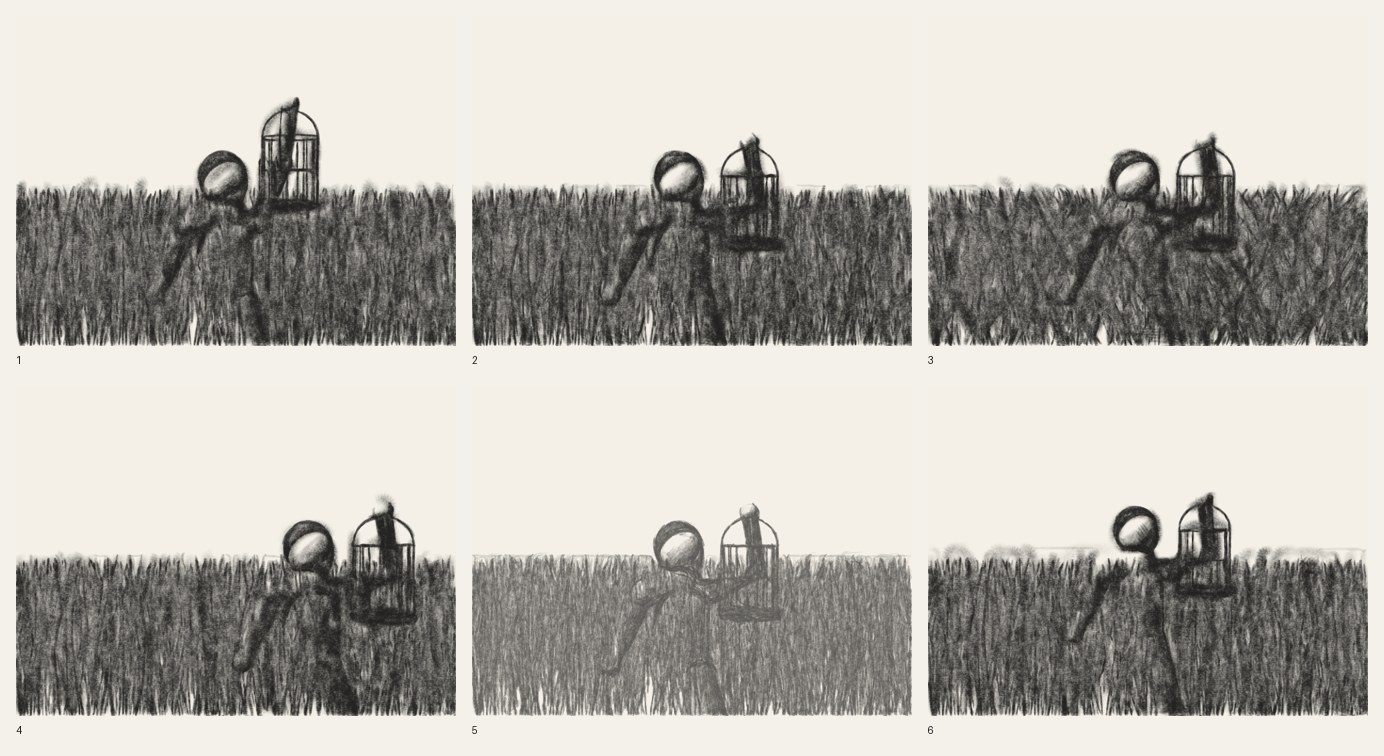
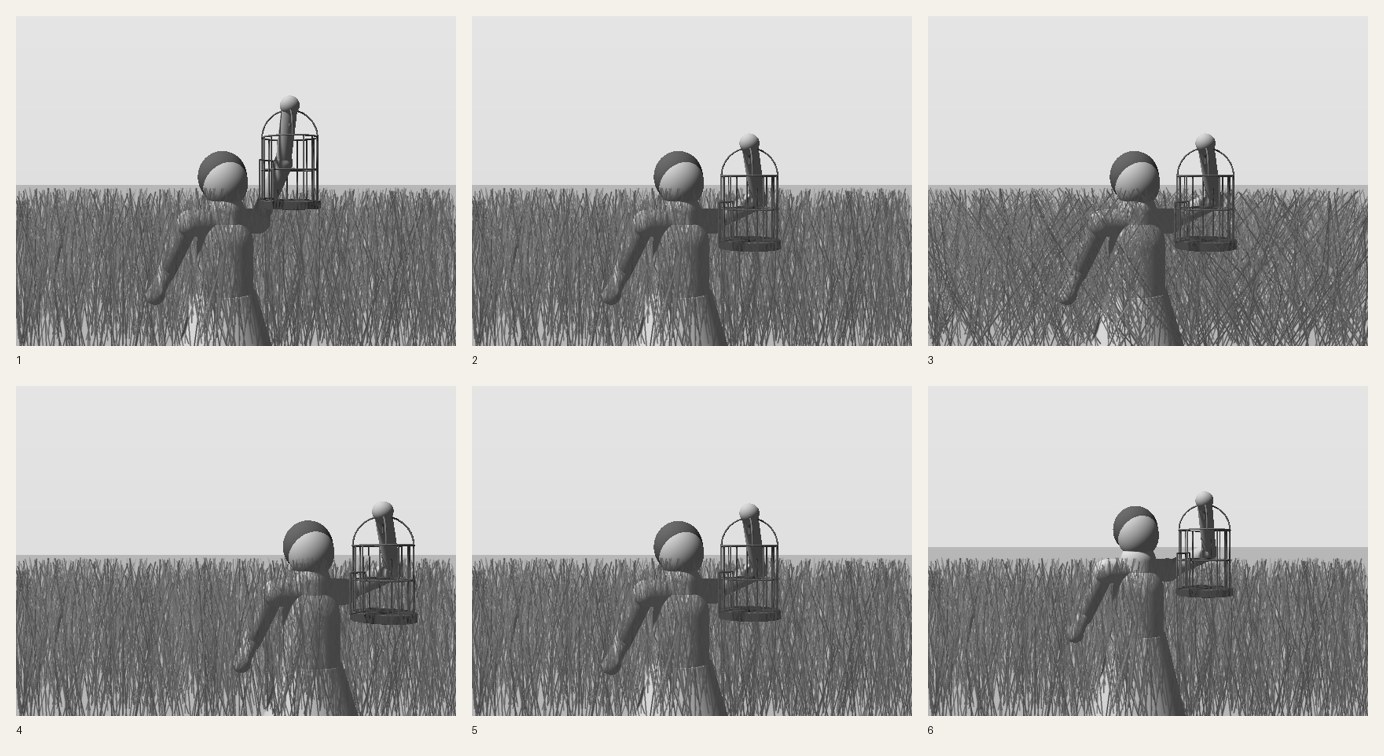
| drawing | question | decision |
|---|---|---|
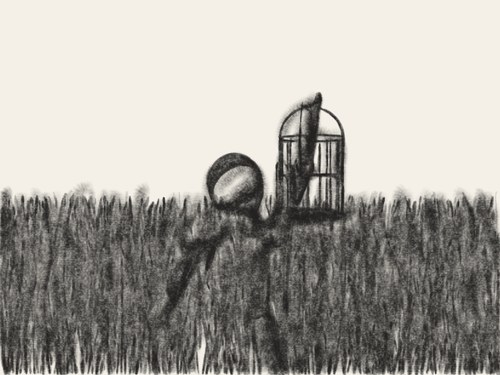 | 1_chin_cage_clear The corrections, cage clear: grass to her chin, the left arm lowered and lost in the grass, the cage held up into the sky. | weaker: the cage is an object held up, apart from the field |
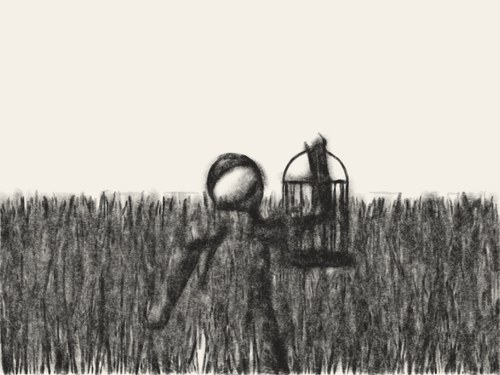 | 2_cage_at_boundary The cage at the boundary: its dome clear against the sky, its base among the blades. | carry: dome clear, bars continue the blades: pattern made of the field |
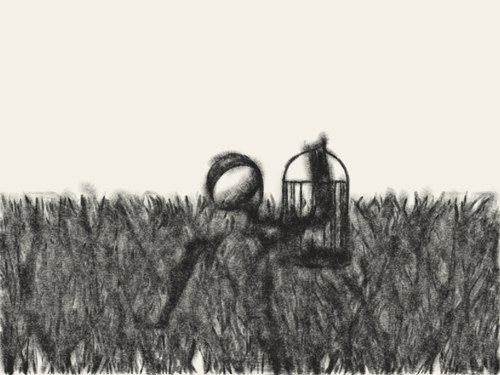 | 3_leaning_grass Counterexample: the same, with the grass leaning hard so the blades no longer run parallel to the bars. Does the rhyme depend on the parallels? | counterexample: crossed blades separate the cage; the rhyme needs the parallels |
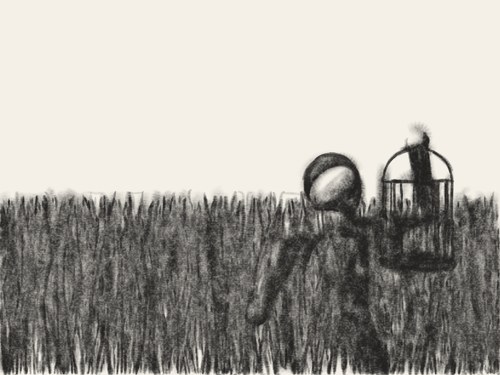 | 4_off_centre Off-centre: the same, framed with her at the right and cropped; the cage nearer the middle. | small gain; the ruled grass top dominates |
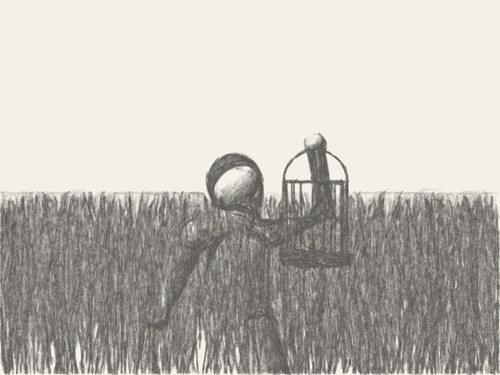 | 5_cezanne The boundary scene in Cezanne's graphite hand: is the relation in the arrangement or in the Kollwitz marks? | the relation is in the arrangement |
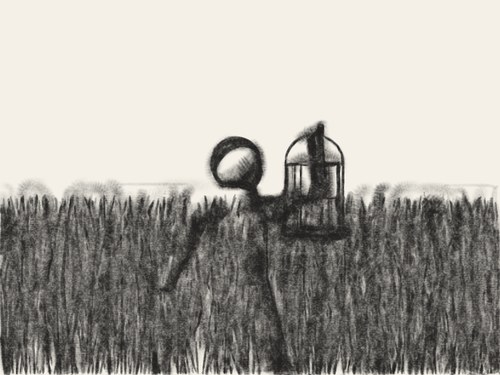 | 6_standing_tall_grass Counterexample to kneeling: standing in grass to her chin. Is submersion a pose or a frame? | counterexample passed: submersion is the frame, not the pose |
Critique of set3
Set 3 critique
- 3-2 (the cage at the boundary): the dome and top ring stand clear against the sky; below the grass line the bars continue the blades. The cage reads as the place where the field's verticals become ordered: pattern made of the field, visible without the caption.
- 3-3 (grass leaning hard, counterexample): with the blades crossing, the cage's verticals no longer belong to the field and the cage separates. The rhyme depends on the parallels. Confirms 3-2.
- 3-5 (Cezanne graphite): lighter and greyer; the relation still reads. It is in the arrangement.
- 3-6 (standing in grass to the chin, counterexample to kneeling): the relation holds standing. Submersion is the frame, not the pose.
- 3-1 (cage clear above the grass): the cage is an object held up, apart from the field. Weaker than 3-2.
- 3-4 (off-centre): small gain; the ruled grass top dominates it.
Faults across the set
- The grass top is a ruled line (the strip habit again, now crossing her at the chin).
- Her forearm passes through the cage (the cage hangs from the hand in front of the arm): it reads as an arm in a cage, an accident.
- The lowered left arm reads as a dark stick, not lost.
- The prompt says "tethered", and no thumbnail has used a tether between hand and cage.
- The mannequin head reads as an egg with a cap: the stage's figure is too crude to carry a face.
Decision
Direction: the cage at the boundary (3-2, 3-6). Passage 1 question: how should the boundary between field and sky be made (ragged, drawn) so that it crosses her and the cage, with the cage hung from her hand by a tether and the other arm lost into the grass?
Passage 1: the boundary, the tether, the lost arm
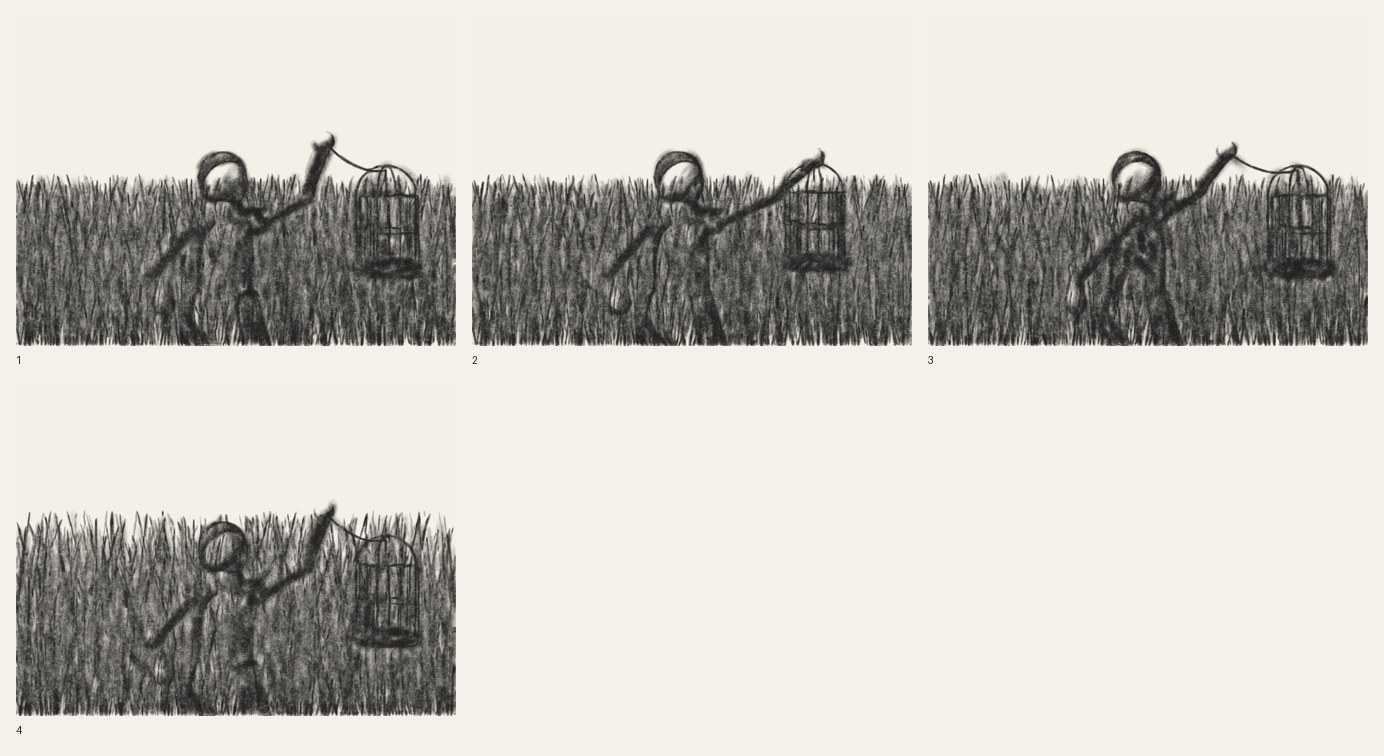
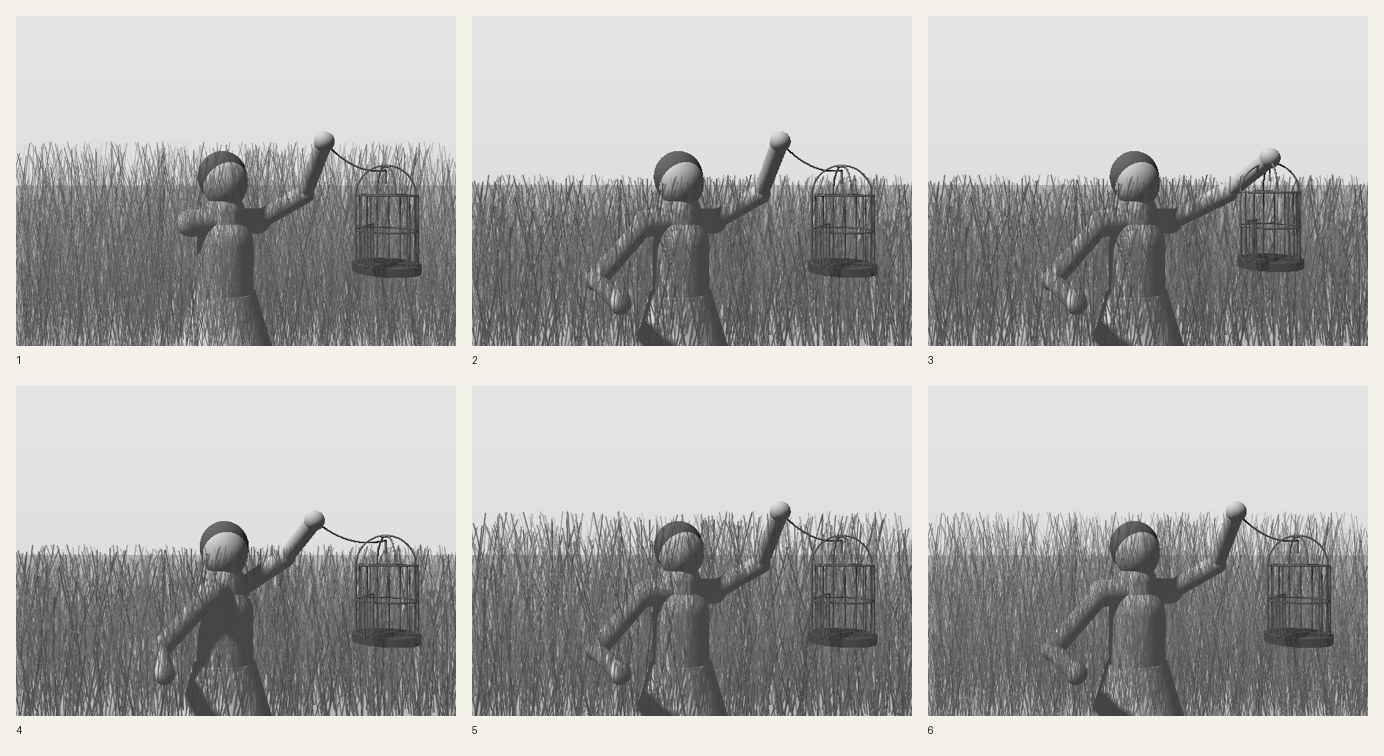
| drawing | question | decision |
|---|---|---|
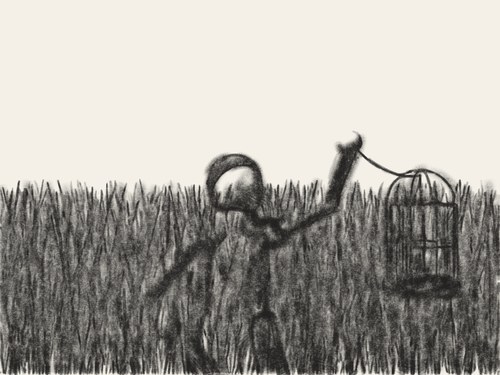 | p1_tether Tethered: the cage hangs from her raised hand by a short line, clear of her arm, straddling a ragged grass top; the left arm reaches down into the grass. | carry: a gap of sky between hand and cage |
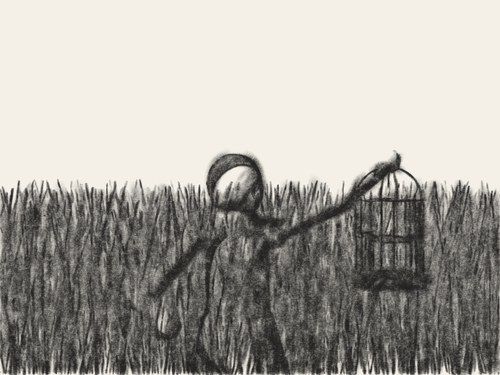 | p2_held_not_tethered Counterexample: the cage held directly in the hand at the same place. Does the tether add something visible? | counterexample: held reads as carried; the tether is a visible interval |
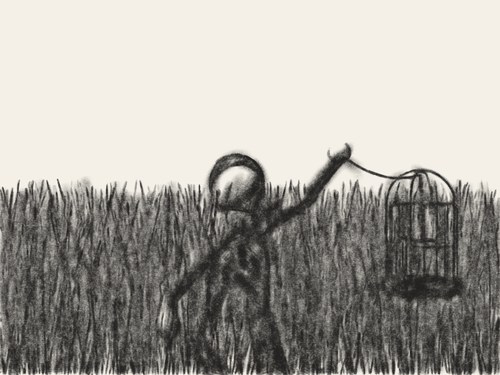 | p3_turned Turned: her body toward the cage, her head turned away from us (hair, no face). | tool limit: the mannequin cannot carry a head |
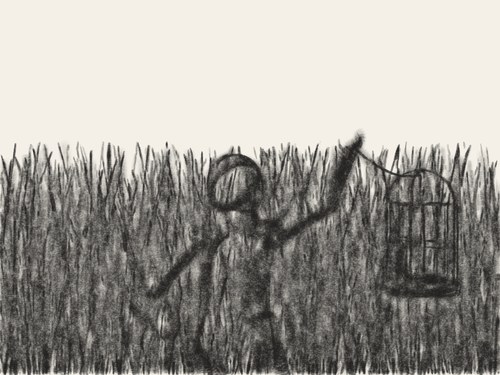 | p4_ragged_top A much more ragged grass top, so the boundary is drawn, not ruled. | carry: the boundary reads as drawn |
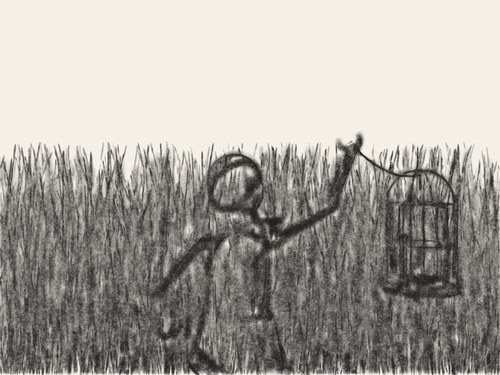 | p5_combined Combined, full size: tether, ragged grass top; then the left arm taken back with the eraser (absence as a drawn act). | sent: tether, ragged top; left arm taken back into the grass (R) |
Critique of passage1
Passage 1: the boundary (native drawing, Kollwitz charcoal)
Question: how should the boundary between field and sky be made so that it crosses her and the cage, with the cage hung from her hand by a tether and the other arm lost into the grass?
The attempts
- p1 tether: the cage hangs from her raised hand on a short line, clear of the arm, its dome above the grass top and its bars running into the blades.
- p2 held, no tether (counterexample): the cage at the hand reads as carried. The tether adds something visible: a gap of sky between hand and cage, so the connection is a line, not a grip. "Tethered" is drawn, not captioned.
- p3 head turned away: no visible change; the stage's mannequin cannot carry a head or a face. A tool limit.
- p4 ragged grass top: the boundary reads as drawn rather than ruled.
- p5 combined at full size (d), then the left forearm taken back with the kneaded eraser (L), then grass re-laid over the ghost by Hands continuing on the canvas (R, 161 strokes). The arm now dissolves into the field partway down: absence as something the drawing does.
What the passage found
- The cage belongs to the field where its bars continue the blades, and stands apart where its dome meets the sky. The boundary crosses the cage as it crosses her (at the chin): she and the cage are cut by the same line.
- Tethered is a visible interval (sky between hand and cage), not a grip.
- The other hand absent: an arm drawn and then taken back into the grass reads as lost, not removed (a removed arm read as a stump in set 2).
The return, and the original intention
Still worth pursuing. The inquiry's terms survive: part of / apart from is now a single boundary that crosses both figure and cage. Two objections the critic should not soften:
- The figure is a mannequin. The relation is legible; the woman is not. This needs reconstruction, the job a generator does well: the right tool for the next step.
- "Resisting" (the prompt's alternative) was dropped after set 1 (6 read as a wave). The drawing commits to "absent".
Handoff: remaining faults (for the generator)
Keep: the grass top crossing her at the chin and crossing the cage (dome clear against sky, lower bars among the blades, parallel to them); the cage hung from her raised hand by a short tether with sky between hand and cage; the left arm fading into the grass partway down; the open door; no bird; the large empty sky. Fix: the mannequin (a woman, kneeling or low in the grass, her head turned or lowered); the cage drawn as charcoal, not a wire diagram; the pale eraser patch where the arm was (a ghost, not a hole); the grass varied in density and value (it is one even texture). Do not: add a bird; lift the cage clear of the grass or sink it entirely; draw the lost arm back; centre her; give her a face that looks at us.
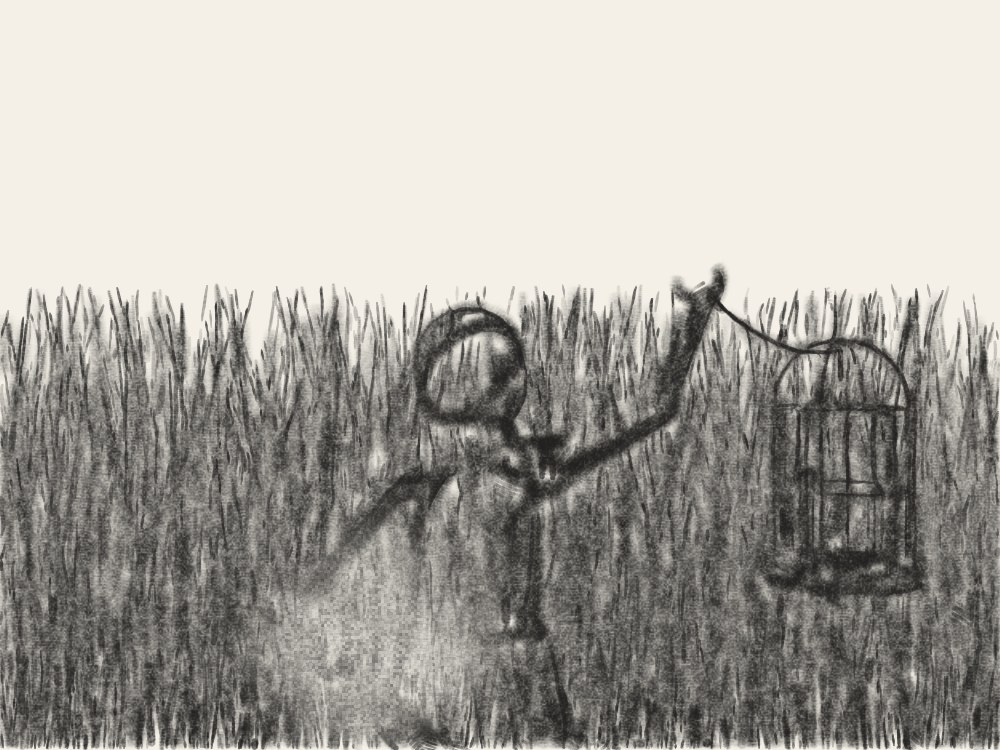
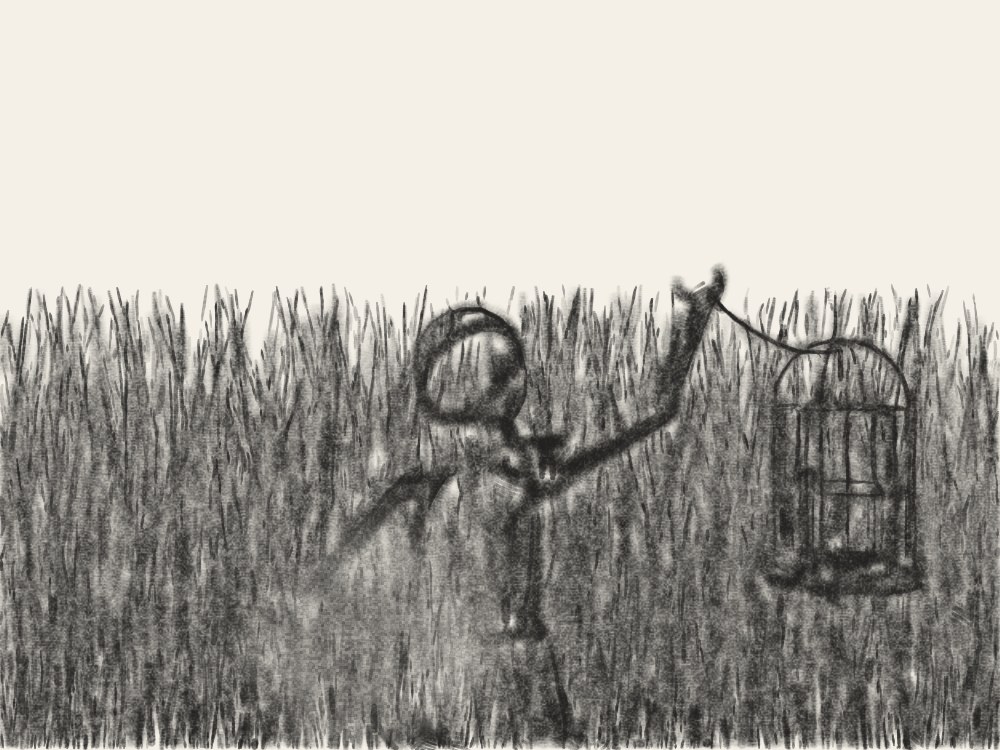
Loop 1: two versions from ChatGPT
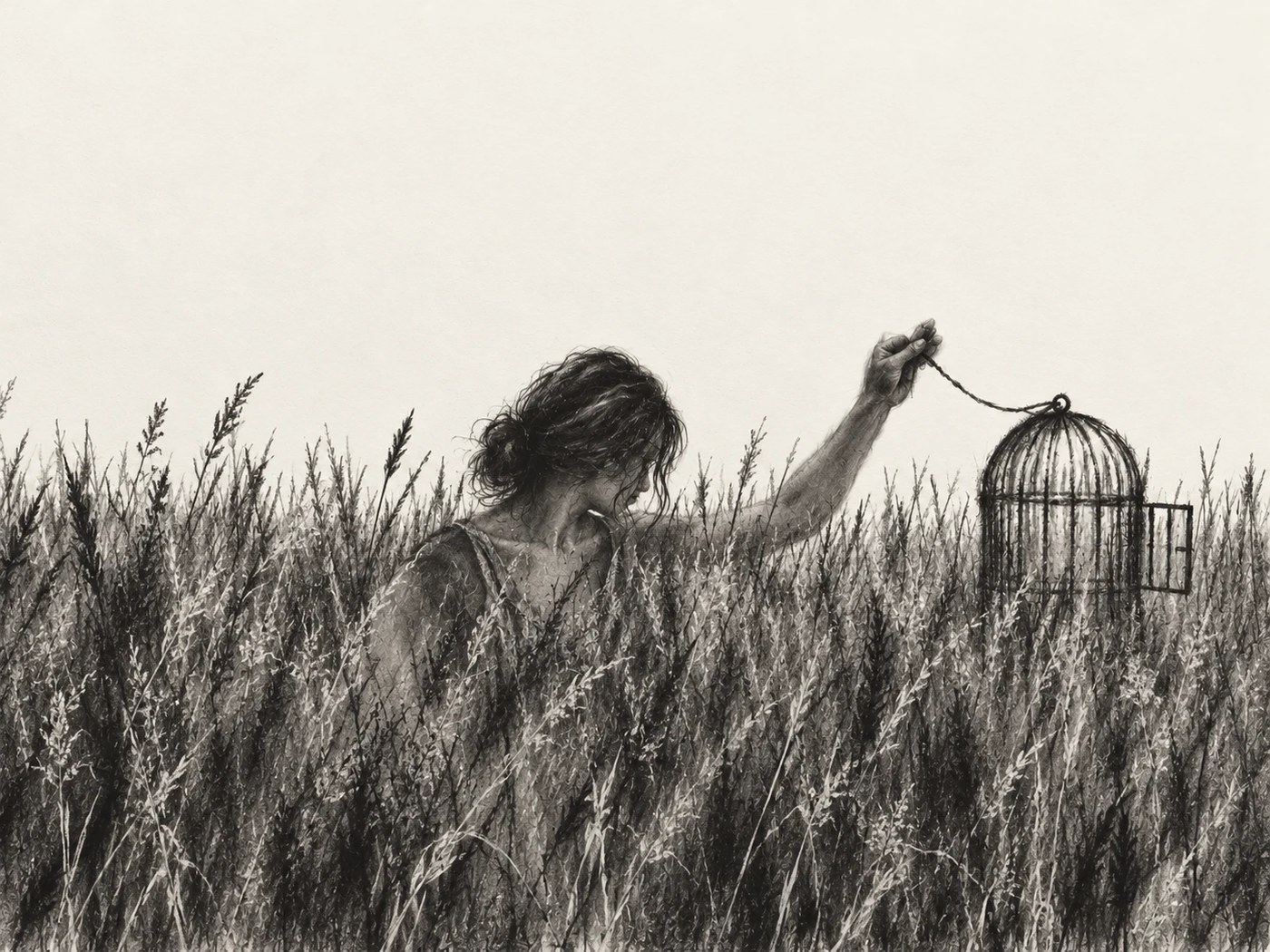
Hold, argued
Hold: narrative (figure, field, open cage)
Called by the critic/artist (Claude) on 2026-10-08. Held image: loop1/gpt1a.png (ChatGPT, from REFERENCE_for_gpt.png and the passage-1 handoff), without further edits. Version b (gpt1b, the higher-fidelity one) is the alternative it is held against.
What became specific to this work
One boundary, the top of the grass, crosses the woman and the cage in the same way: below it both are made of the field's dark vertical strokes; above it her head and raised arm, and the cage's dome, stand against an empty sky. The cage's bars run parallel to the blades and continue them: the cage is where the field's verticals become ordered. The tether is an interval of sky between hand and cage, so the connection is a drawn line, not a grip. Her other arm is not there: it is lost in the grass, and nothing marks where it went.
Which alternatives revealed it
- The default map: the same horizontal split used to separate her (grass over the legs, the whole upper body against the sky).
- 2-2 (standing clear): she becomes a scarecrow in different marks from the field: apart only.
- 2-3 (no cage): the raised empty arm reads as distress; the cage turns a signal into carrying.
- 2-4 (the cage at the grass top, wholly among the blades): the cage dissolves; part of it must meet the sky.
- 2-6 (bird): a finial and a story cue; the held image has none.
- 3-3 (leaning grass): crossed blades separate the cage from the field.
- p2 (held, no tether): carried, not tethered.
- set 2 (arm removed): a stump; absence had to be a loss into the field.
- gpt1b (the same image at higher fidelity): pale seed-headed blades lean and cross the bars (stroke energy within 15 degrees of vertical near the cage: 0.69, against 0.80 in gpt1a; whole field 0.58 against 0.76), and her face, now in profile, becomes the first thing read. Fidelity spent on the face and the grasses' species took the rhyme away.
What remains unresolved, and why preserving it matters
- Whether she is lifting the cage out of the field or the field is holding it down: the tether is slack enough for either. It is the one action in the picture that does not resolve, and the prompt's "less prison than pattern" depends on it not resolving into release.
- Where the other arm is.
The strongest remaining objection
The composition is still the default's horizontal split, a band of field under a band of sky, and she sits close to the middle [dx 0.009]. What changed is what the line does (it crosses both her and the cage instead of separating her from the field), not where it is. A stronger drawing might break the band. Second: the image is ChatGPT's marks; the native work in this run is the inquiry, the 22 thumbnails and the reference, not a pass on the held image. Third, minor: a pale fleck at her collarbone reads as a highlight or a flaw.
Measured (for the record, not the argument)
gpt1a: focus shift at 64px 0.03; quiet share 0.47; black 0.004; hard edges 0.28 of edges; VCLI-G 3.13, SCI 2.26; route OMEGA (the numeric route cannot compute Hold).
The lineage
The ledger: 12 steps, every pull between platforms
| # | tool | platform | by | what happened |
|---|---|---|---|---|
| 1 | midjourney | midjourney | russell | four images: the default map (s0_default/DEFAULT_MAP.md) prompt: Charcoal drawing. A figure in a field both part of and apart from her surroundings--one hand tethered to an open bird cage, the other absent or resisting. The cage is less prison than pattern. |
| 2 | critic | local | claude | default map measured; inquiry written |
| 3 | stage+hands | local | claude | new figure stage (hand/stage.py) tested |
| 4 | stage+hands | local | claude | set1 drawn (native: hand/stage.py studies, Hands Kollwitz charcoal); critique and decisions in set1/CRITIQUE.md and each scene.json |
| 5 | stage+hands | local | claude | set2 drawn (native: hand/stage.py studies, Hands Kollwitz charcoal); critique and decisions in set2/CRITIQUE.md and each scene.json |
| 6 | stage+hands | local | claude | set3 drawn (native: hand/stage.py studies, Hands Kollwitz charcoal); critique and decisions in set3/CRITIQUE.md and each scene.json |
| 7 | stage+hands | local | claude | passage1 drawn (native: hand/stage.py studies, Hands Kollwitz charcoal); critique and decisions in passage1/CRITIQUE.md and each scene.json |
| 8 | eraser+hands | local | claude | left forearm taken back (lift), grass re-laid over the ghost (Hands --init, 161 strokes): the reference to send |
| 9 | chatgpt | chatgpt | russell | Russell took the reference and the handoff to ChatGPT: two versions, b with higher fidelity |
| 10 | critic | local | claude | both read; stroke orientation near the cage: a 0.80 vertical, b 0.69 (b's blades cross the bars) |
| 11 | hold | local | claude | Hold on gpt1a, argued (HOLD.md); gpt1b the revealing alternative |
| 12 | video | local | claude | lineage video, default to Hold |