Still life: teacup and apple
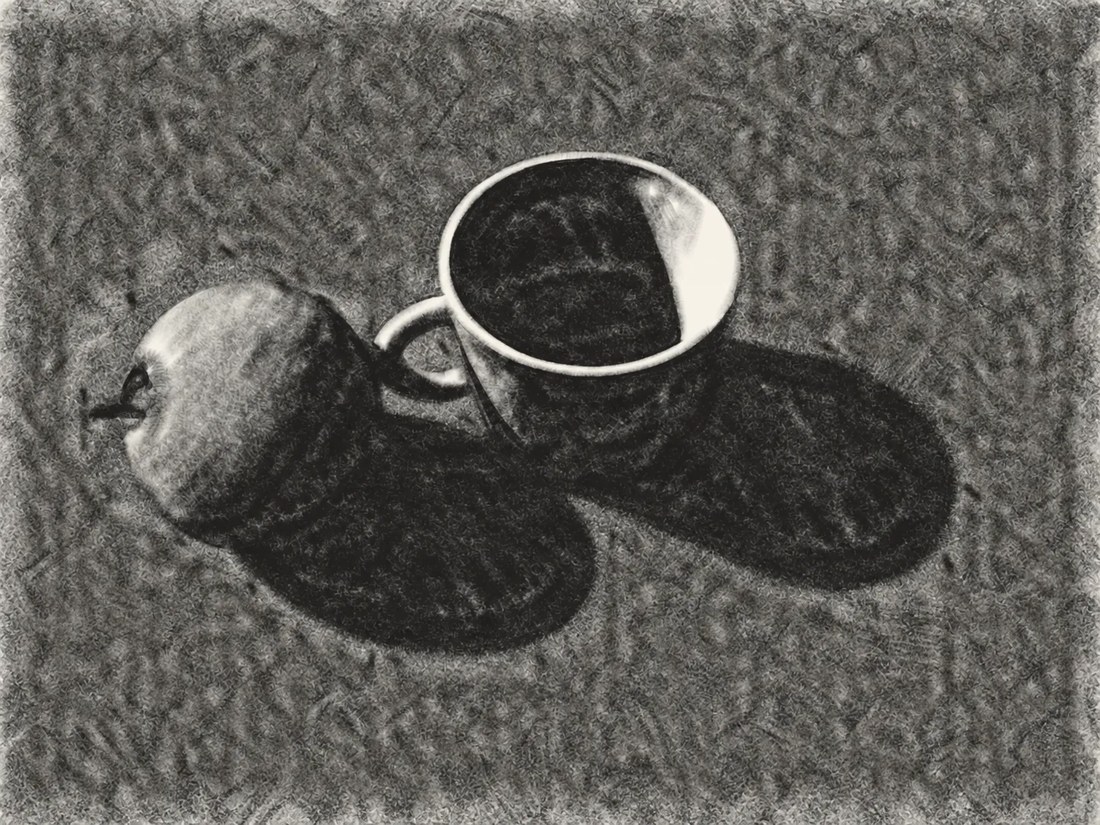
The prompt, kept intact: "A moody chiaroscuro charcoal drawing of a ceramic teacup and apples on paper, dramatic side-lighting casting shadows, raw charcoal marks, rendered in a loose, melancholic academic style." The inquiry: what could make these ordinary objects worth attending to together?
The inquiry
Still life: inquiry
The prompt (Russell, kept intact)
"A moody chiaroscuro charcoal drawing of a ceramic teacup and apples on paper, dramatic side-lighting casting shadows, raw charcoal marks, rendered in a loose, melancholic academic style."
Subject and treatment (what the prompt fixes)
Subject: a ceramic teacup and apples. Treatment: charcoal on paper, chiaroscuro, dramatic side light with cast shadows, raw marks, loose, academic, melancholic.
What we are trying to discover (what the prompt does not fix)
What could make these ordinary objects worth attending to together? Working hypotheses, each to be tested in drawings, none assumed:
- a made, hollow thing (the cup holds a dark) beside grown, solid things (the apples are full);
- the objects are related only by what the light does between them (a shadow, a shared dark);
- one object conceals, interrupts or depends on another;
- "melancholy" comes from separation or near-absence (the obvious hypothesis: test it, do not assume it).
The default (s0_default/DEFAULT_MAP.md)
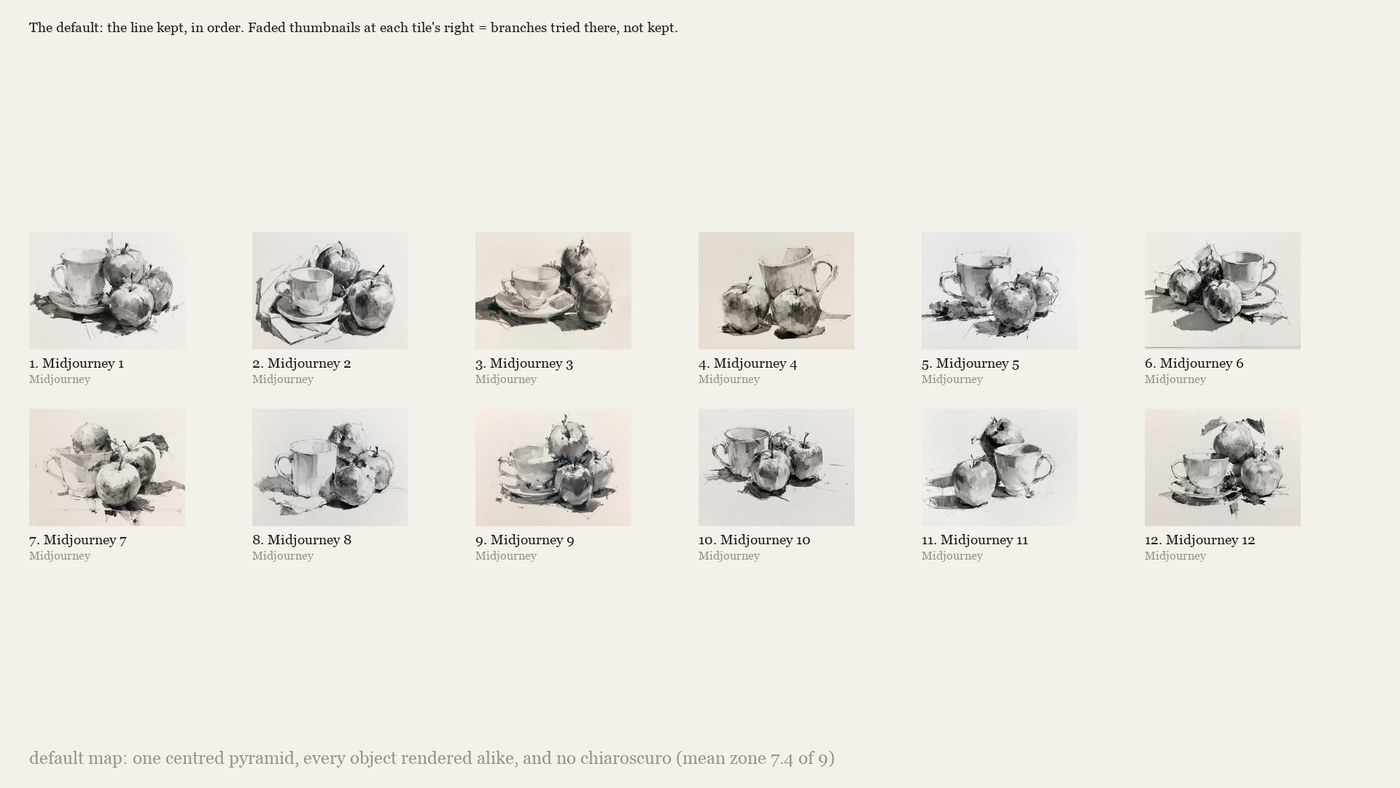
What the prompt produces when nobody inquires: twelve Midjourney images.
Method (Russell, 2026-10-08)
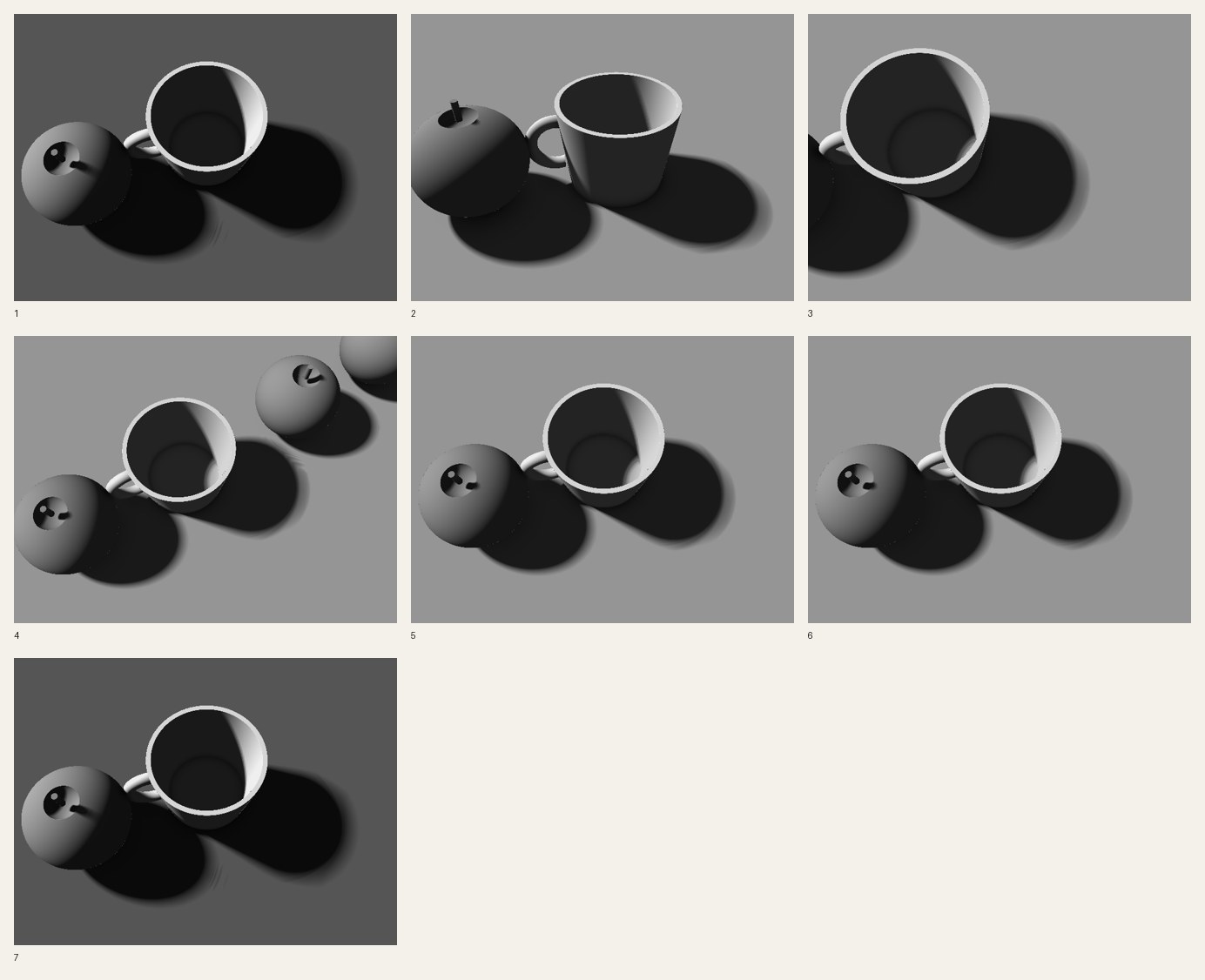
Thumbnail workshop, criticism between sets, uninterrupted drawing within a set; each thumbnail carries a question and gets a decision. Set 1: six native drawings, distinct organizations, not variations of one layout. Critique: repeated habits, promising relationships, ideas that only work because the caption explains them. Set 2: six: develop two or three possibilities, including a counterexample to the favourite. Set 3 if useful. Then a passage of work on one consequential question with the fitting tool (native drawing, generator, source research, or looking). The critic may recommend abandoning a direction or returning to an earlier branch. Hold must be argued (see HOLD.md template when it comes).
Tools for native thumbnails
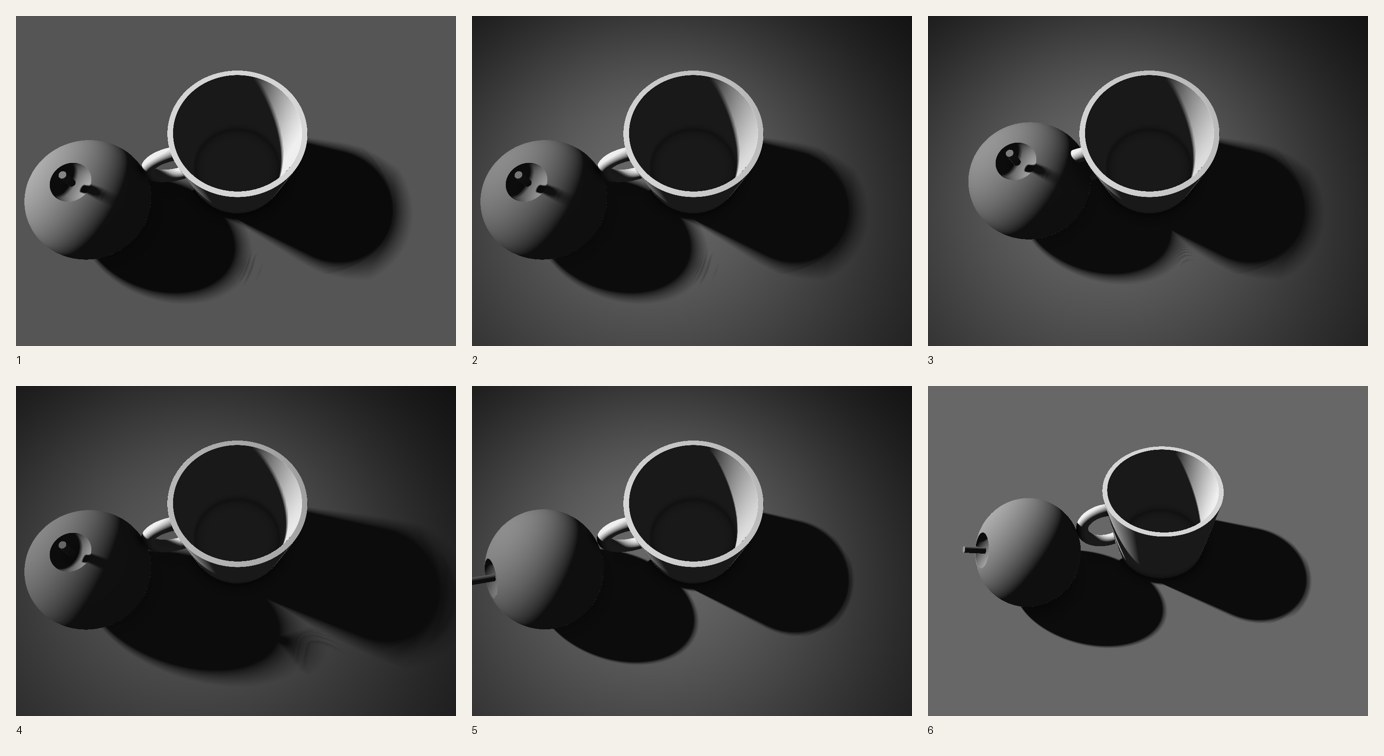
hand/scene.py (authored geometry: table, wall, apples, cups, one directional light, cast shadows) -> value study -> Hands (Kollwitz charcoal) at 660 px. The scene is a structure source, not a generator; Hands decides marks and which values to leave as paper.
The default
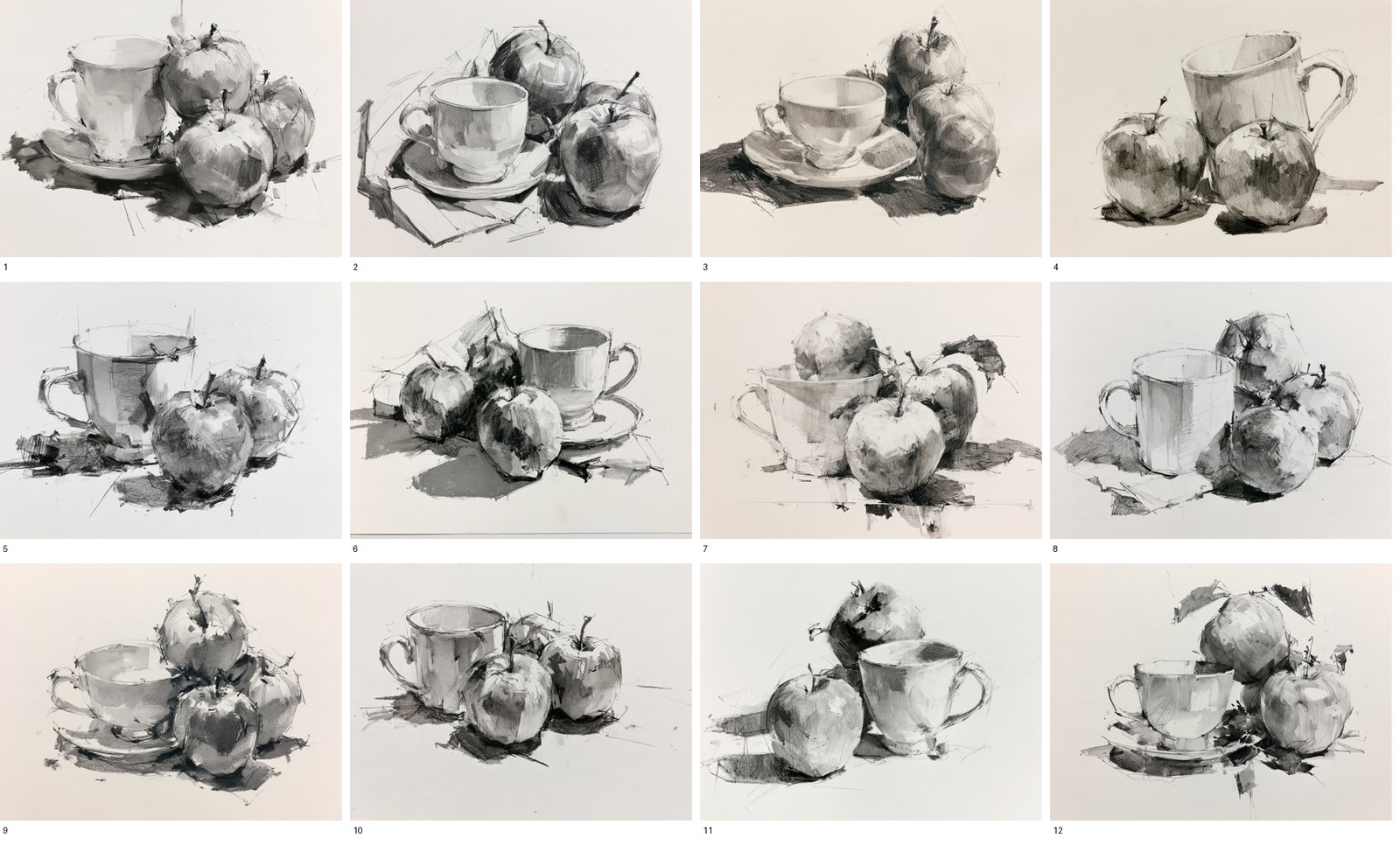
Default map: twelve Midjourney images of the prompt (contact.png, measured/summary.md)
Seen (all twelve):
- one touching cluster: the cup and 2-4 apples overlap in a pyramid; nothing is separated;
- centred: the cluster sits in the middle of the frame [dx median -0.005, IQR -0.033..0.024];
- the cup is a type: three-quarter view, handle out to the side; the cup is on the left in 9 of 12;
- eye level slightly above the table; the table edge is a few scribbles; the background is blank paper;
- every object rendered to the same degree (each apple modelled, stem shown).
Not delivered from the prompt:
- chiaroscuro: the sheet stays light [mean_zone 7.36 of 9; highlight_mass 0.763; shadow_mass 0.052; black_area 0.008]. "Dramatic side-lighting" appears as a short cast shadow under each object.
- melancholy: no measured key for it; to my eye nothing in the organization carries it.
Labels: vcli_label "earned tension" 12/12 (the kernel's texture compensation, seen before in the MJ seated-figure map).
Default map: measured spread per batch
Median [25th-75th percentile] per key. Same readers and registry meanings as critic/vtl/registry.py and critic/color/registry_color.py; tonal/marks thresholds are provisional.
| group | key | mj |
|---|---|---|
| placement | dx | -0.00503 [-0.0333-0.0236] |
| placement | dy | 0.039 [0.0188-0.0533] |
| placement | dr | 0.034 [0.0276-0.0508] |
| placement | dx_ton | 0.000771 [-0.000936-0.0068] |
| placement | dy_ton | -0.012 [-0.0153--0.0106] |
| structure | rv | 0.925 [0.917-0.935] |
| structure | mu | 0.811 [0.801-0.826] |
| structure | sdi | 0.195 [0.187-0.199] |
| structure | vcli_g | 3.08 [2.95-3.14] |
| structure | sci | 2.8 [2.78-2.86] |
| structure | drc | -0.0154 [-0.0282--0.00453] |
| structure | n_islands | 8 [6.75-9] |
| structure | drain_margin | 0.0265 [0.0138-0.0679] |
| tone | mean_zone | 7.36 [7.29-7.44] |
| tone | shadow_mass | 0.0523 [0.0461-0.0644] |
| tone | highlight_mass | 0.763 [0.742-0.791] |
| tone | midtone_share | 0.172 [0.147-0.186] |
| tone | range_p2_p98 | 77.6 [75.9-79.9] |
| tone | gini_mass | 0.502 [0.489-0.518] |
| tone | white_area | 0.641 [0.614-0.652] |
| tone | black_area | 0.00776 [0.0071-0.0098] |
| tone | withheld | 0.573 [0.548-0.588] |
| marks | stratification | 0.446 [0.404-0.47] |
| marks | unanimity | 0.172 [0.129-0.257] |
| marks | pressure_cv_mean | 0.829 [0.76-0.895] |
| marks | detail_democracy_cv | 0.992 [0.932-1.06] |
| marks | withheld_share | 0.00166 [0-0.0389] |
| colour | col_okc_C_mean | 0.00842 [0.0063-0.0125] |
| colour | col_light_sdi | 0.313 [0.258-0.359] |
| colour | col_dark_sdi | 0.286 [0.268-0.301] |
| colour | col_focal_count | 15.5 [13.8-17] |
| colour | col_primary_focal_dominance | 0.209 [0.168-0.261] |
| colour | col_border_salience | 0.0203 [0.016-0.0251] |
vcli_label
- mj: earned tension 12/12
regime
- mj: gradient-field / controlled instability 12/12
col_regime_tags
- mj: quiet field with sharp accents 12/12, high-light ground 12/12, low-chroma field 12/12, diagonal force 12/12, narrow hue field 7/12, distributed salience 6/12, dispersed light 4/12, compact dark 4/12, color rides structure 4/12, edge-activated field 3/12, color-structure decoupled 3/12, compact light 1/12, dispersed dark 1/12
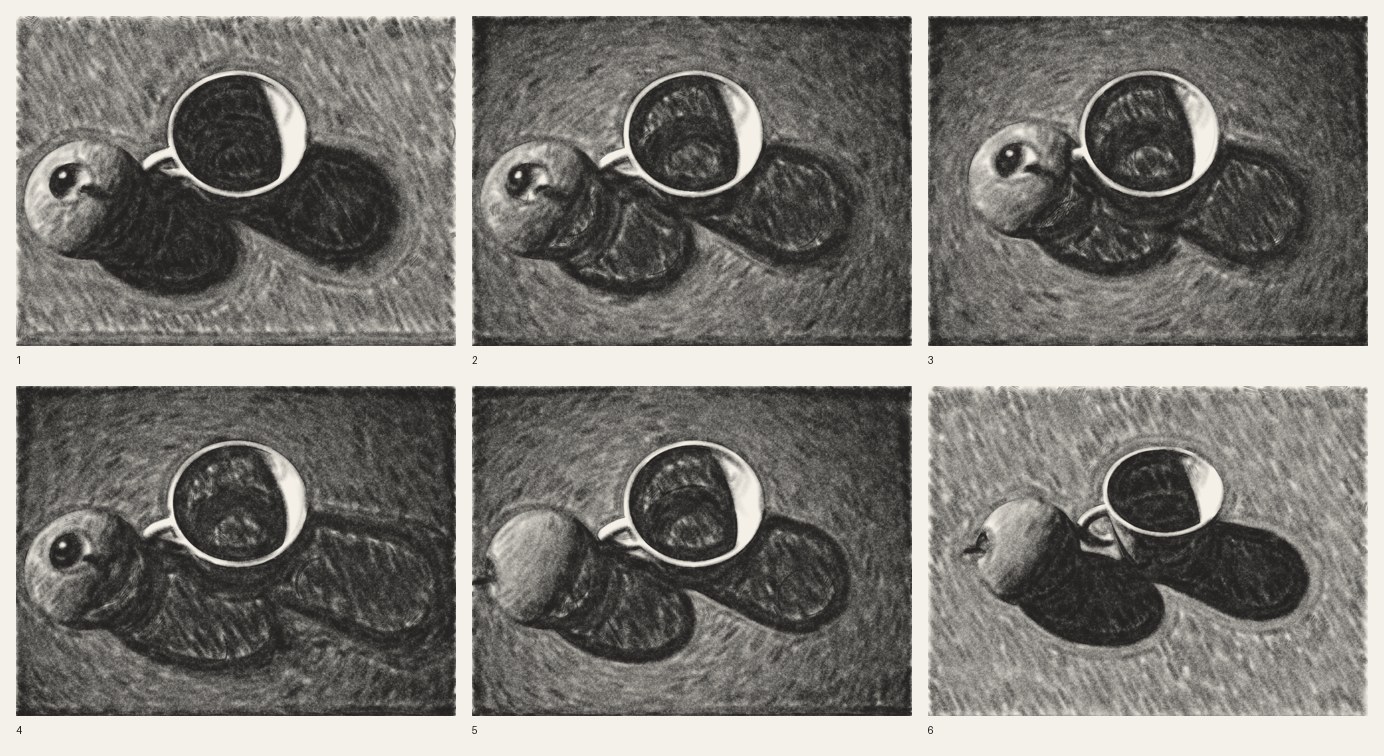
Set 1: six organizations
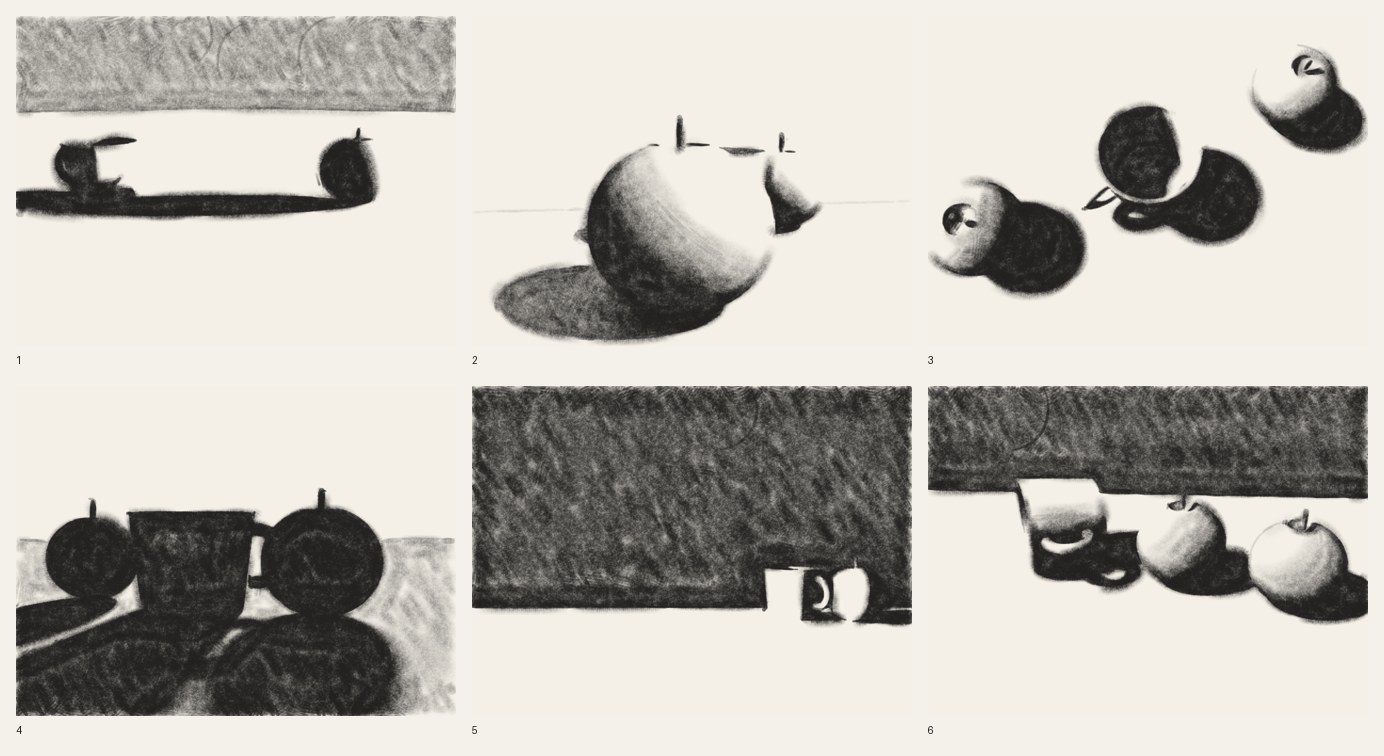
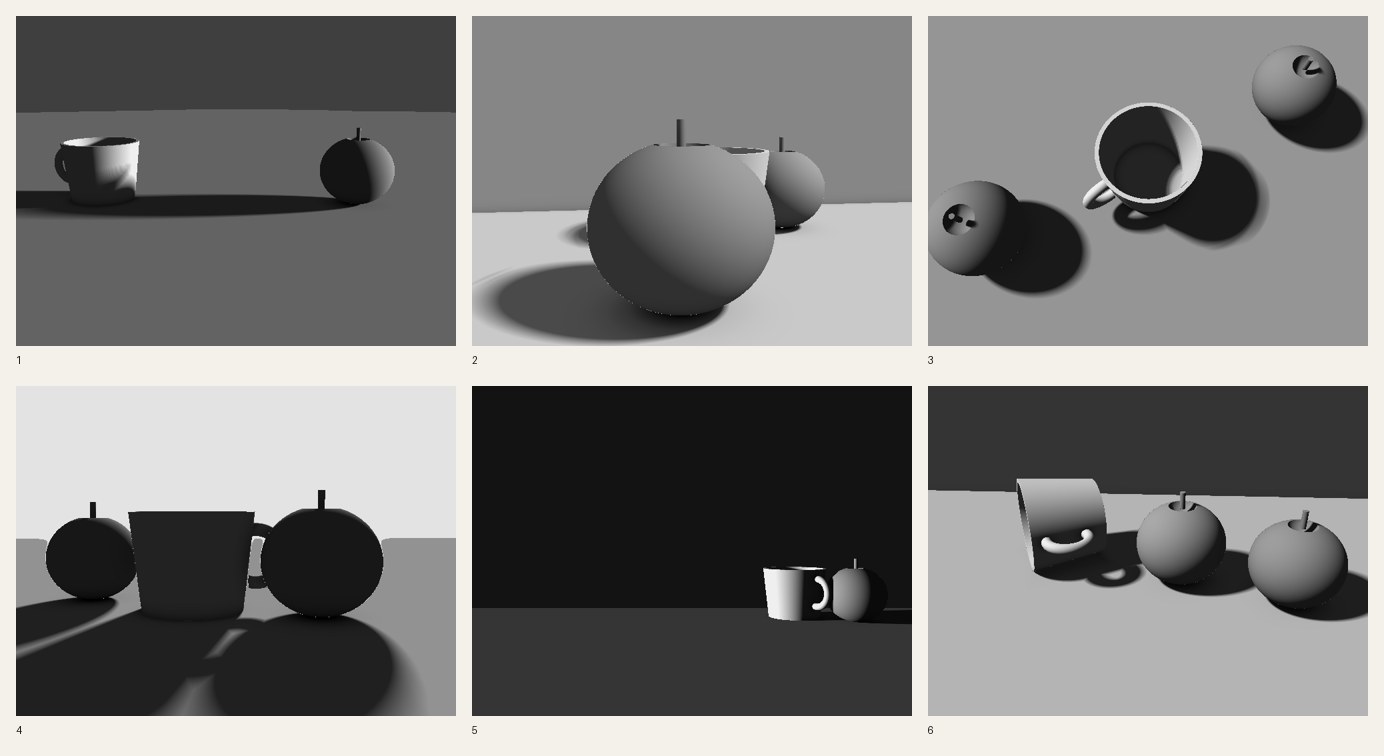
| drawing | question | decision |
|---|---|---|
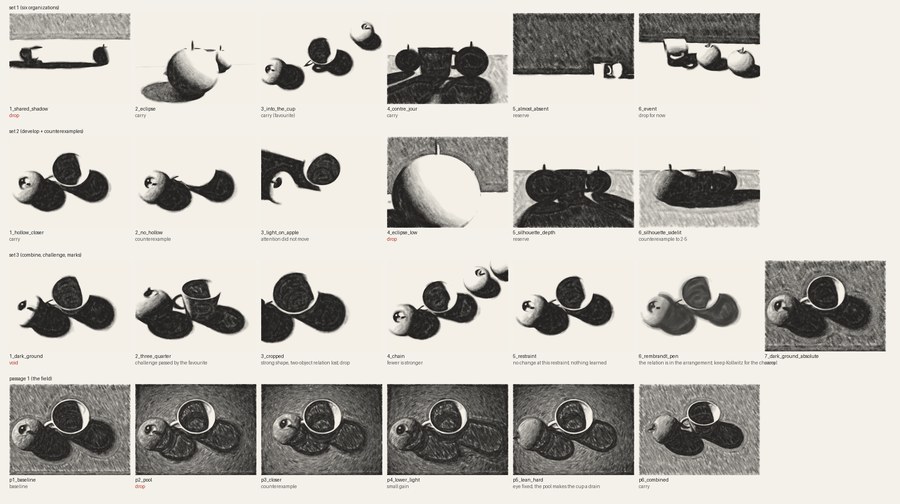
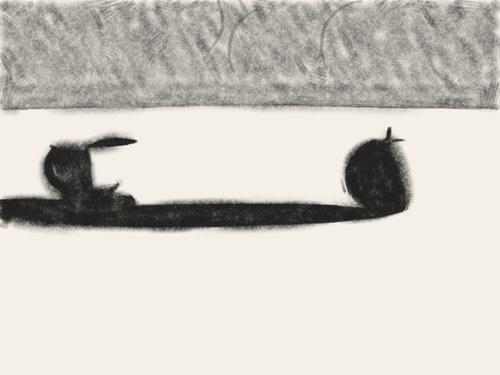 | 1_shared_shadow Separated objects, bound only by a shadow: can a cast shadow, not adjacency, make the cup and an apple belong together? | drop: reads as a bar; the relation appeared in 4 instead |
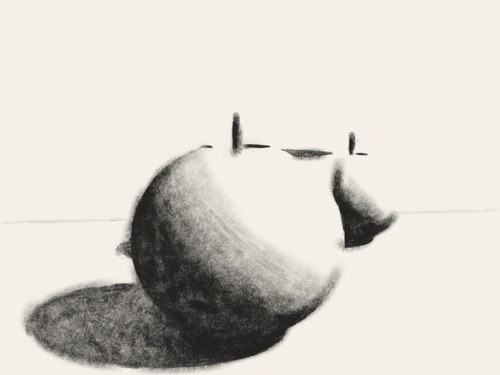 | 2_eclipse Concealment: an apple close to us nearly hides the cup. Does the cup become more present when we see only its rim and handle? | carry: concealment and scale |
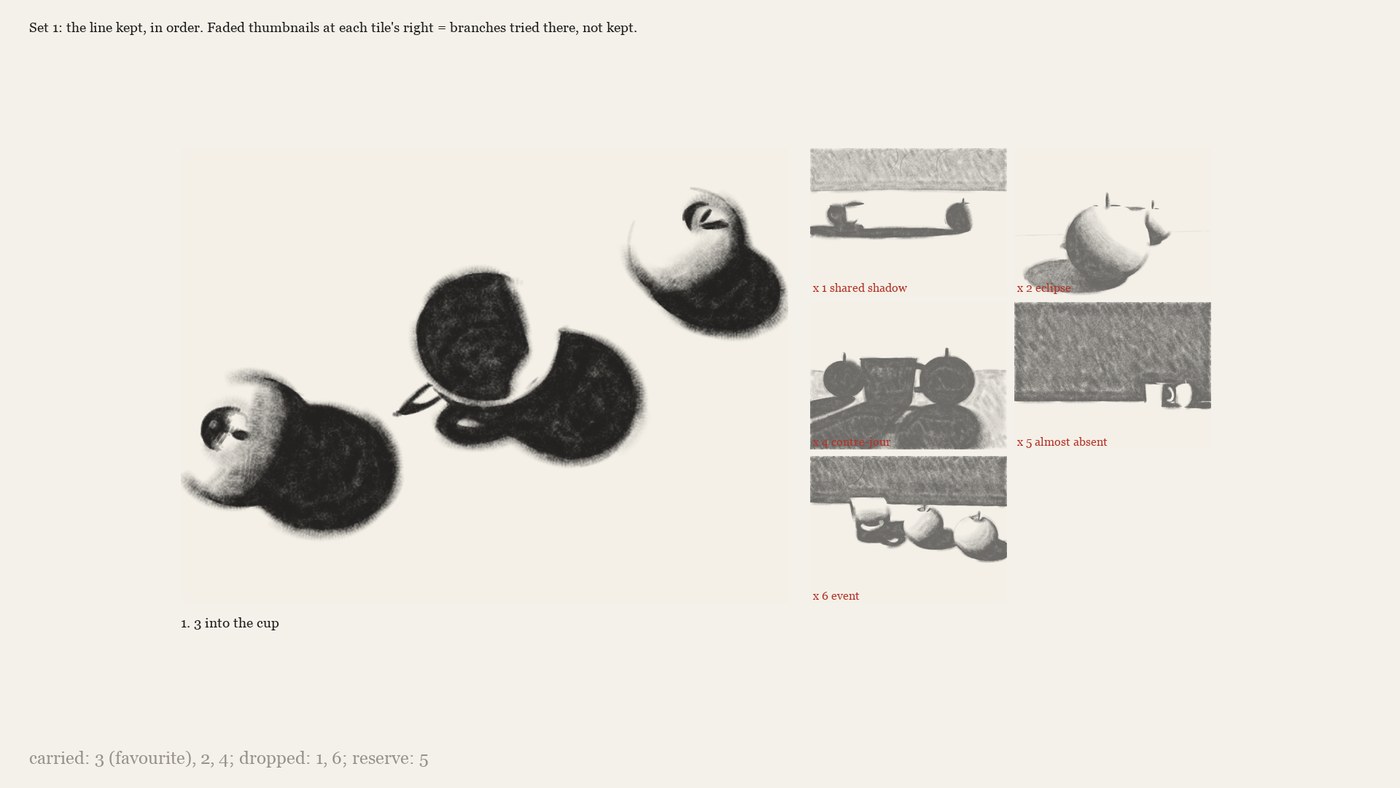
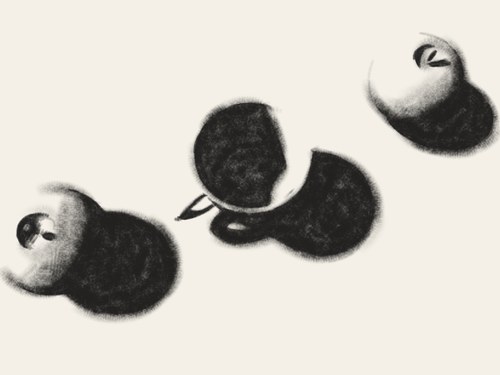 | 3_into_the_cup The hollow as subject: from above, is the cup's interior (a dark held inside a light) enough, with the apples pushed to the edges? | carry (favourite): the hollow, its shadow and the handle make one dark; apples rhyme as rims around darks |
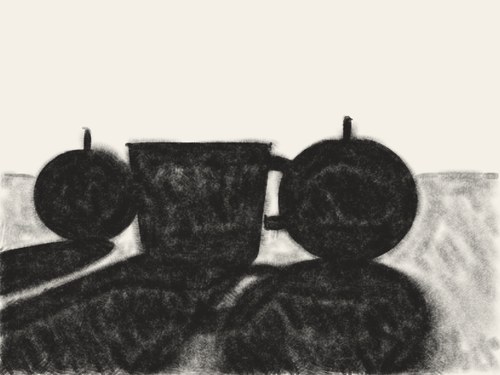 | 4_contre_jour Light from behind: the objects as dark shapes edged with light. Does chiaroscuro as silhouette lose the objects or sharpen them? | carry: silhouette row with merged shadow |
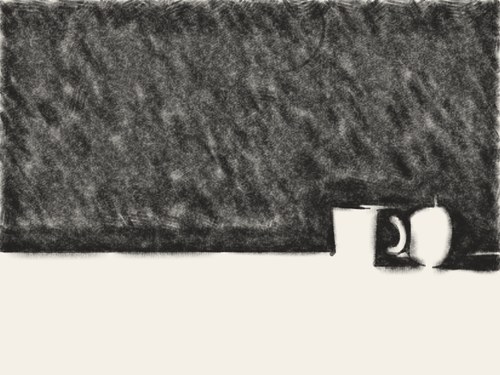 | 5_almost_absent Near-absence: small objects low in a dark field, one sliver of light reaching only part of them. Can almost nothing hold attention? | reserve: the field reads as a flat block |
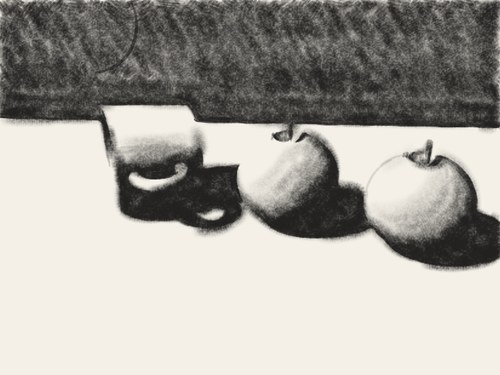 | 6_event An event: the cup on its side, apples rolled away, one leaving the frame. Does something having happened earn attention, or only a caption? | drop for now: tilted cup geometry wrong (tool fault); idea untested |
Critique of set1
Set 1 critique (read as pictures first, captions second)
Read by the orchestrating assistant. Images: set1/contact.png (drawings), contact_studies.png (value studies).
Repeated habits (mine and the tools')
- A hard horizontal band: where a wall meets the table (1, 5, 6) Hands fills the dark plane as a flat rectangle with a ruled lower edge. The band is the most assertive shape in three of six, and none of them asked for it.
- Objects in a row: 1, 4 and 6 line the objects up across the frame at even intervals, and 3 lines them on a diagonal. I replaced Midjourney's pyramid with a frieze: a different default, still a default.
- The lit side of a white cup becomes paper and the cup loses its contour (1, 6). The cup is legible only through its darks: interior, handle, shadow side.
- All six are seen from a fixed, centred camera; only 3 crops an object.
Promising relationships (pointing to what is visible)
- 3: the cup's dark interior, its cast shadow and the handle form one dark shape; each apple is a light crescent on its own dark oval. The three objects rhyme as "a light rim around a dark", and the cup's dark is inside it while the apples' darks are outside them. Visible without the caption.
- 2: the cup is reduced to a light chip and a sliver of rim above the apple's contour. The apple's mass and the cup's small notch make a scale relation the default never has (the default renders each object to the same degree).
- 4: three dark shapes on a light ground, and their shadows run toward us and merge into one floor of dark. The shared shadow that 1 was meant to show happens here instead. The handle's opening is the only light inside the dark row.
Ideas that work only because the caption explains them
- 1 ("bound by a shadow"): without the caption it is a dark bar with two small marks at its ends; the cup cannot be read. Fails.
- 6 ("an event"): the cup on its side does not read as a cup (the stage's tilted-cup geometry is wrong: a tool fault), and the apple meant to be leaving the frame is out of it entirely. Fails; the idea was not tested.
- 5 ("near-absence in a dark field"): the field reads as a flat dark block with a notch, not as darkness in a space; the objects are tiny but readable. The idea depends on the caption.
Decisions
- 3: carry. It is the favourite, so set 2 must include its strongest counterexample.
- 2: carry (concealment and scale).
- 4: carry (silhouette, merged shadow); test against ordinary side light.
- 1: drop. Its intended relation appeared, unasked, in 4.
- 5: hold in reserve; the dark-field idea is not dead, the wall-band rendering is.
- 6: drop for now; the tilted cup needs a fix in hand/scene.py before it can be tested.
Set 2 plan (six)
2-1 develop 3: closer; one apple only, its shadow touching the cup's shadow. 2-2 counterexample to 3: the same scene with the cup replaced by a solid of similar size (no hollow). If the hollow is what makes 3 specific, 2-2 loses it. 2-3 counterexample to 3: light moved so one apple takes the light and the cup sits in shadow (change which object receives attention). 2-4 develop 2: lower and closer; the apple fills half the frame; the cup only as a rim arc and its shadow; a darker ground. 2-5 develop 4: break the frieze: overlap in depth, shadows toward us, the handle's opening the only light inside the dark mass. 2-6 counterexample to 4: the same placement as 2-5, lit from the side.
Set 2: develop, and the counterexamples
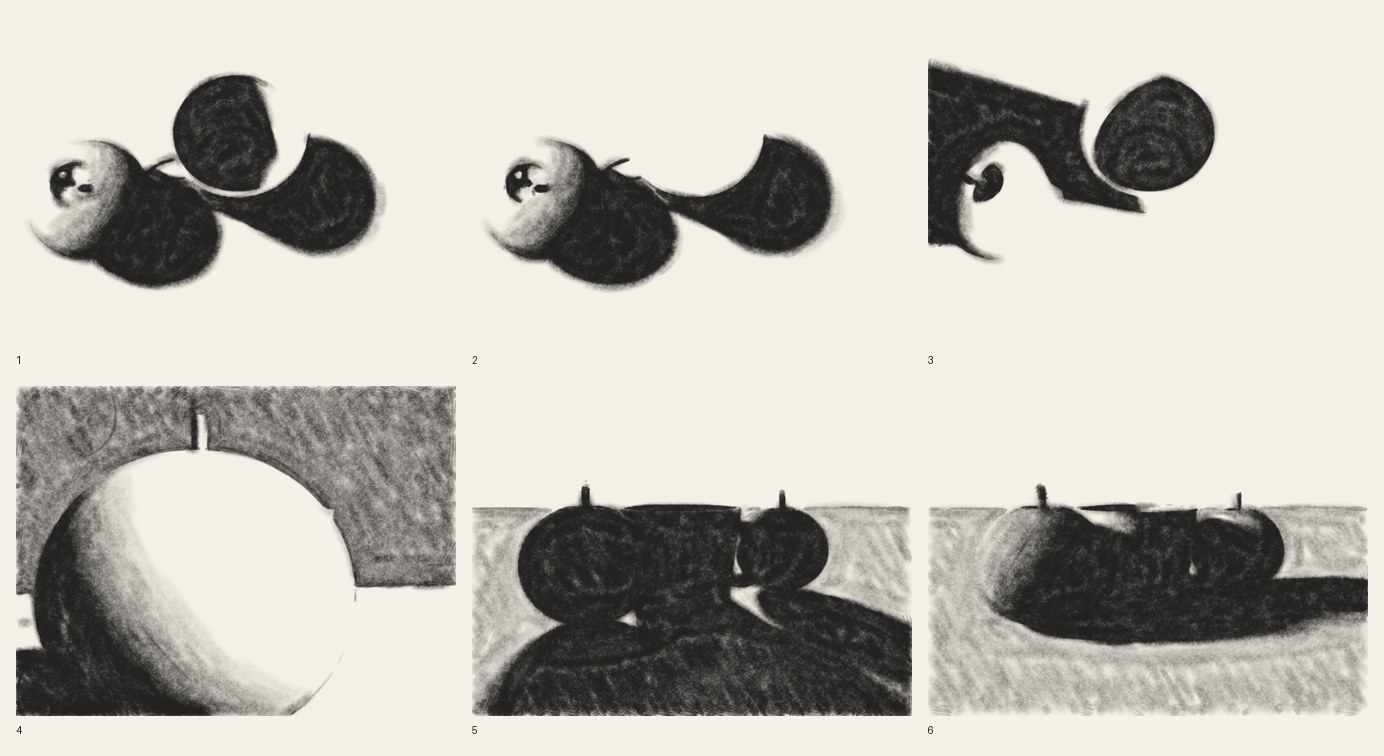
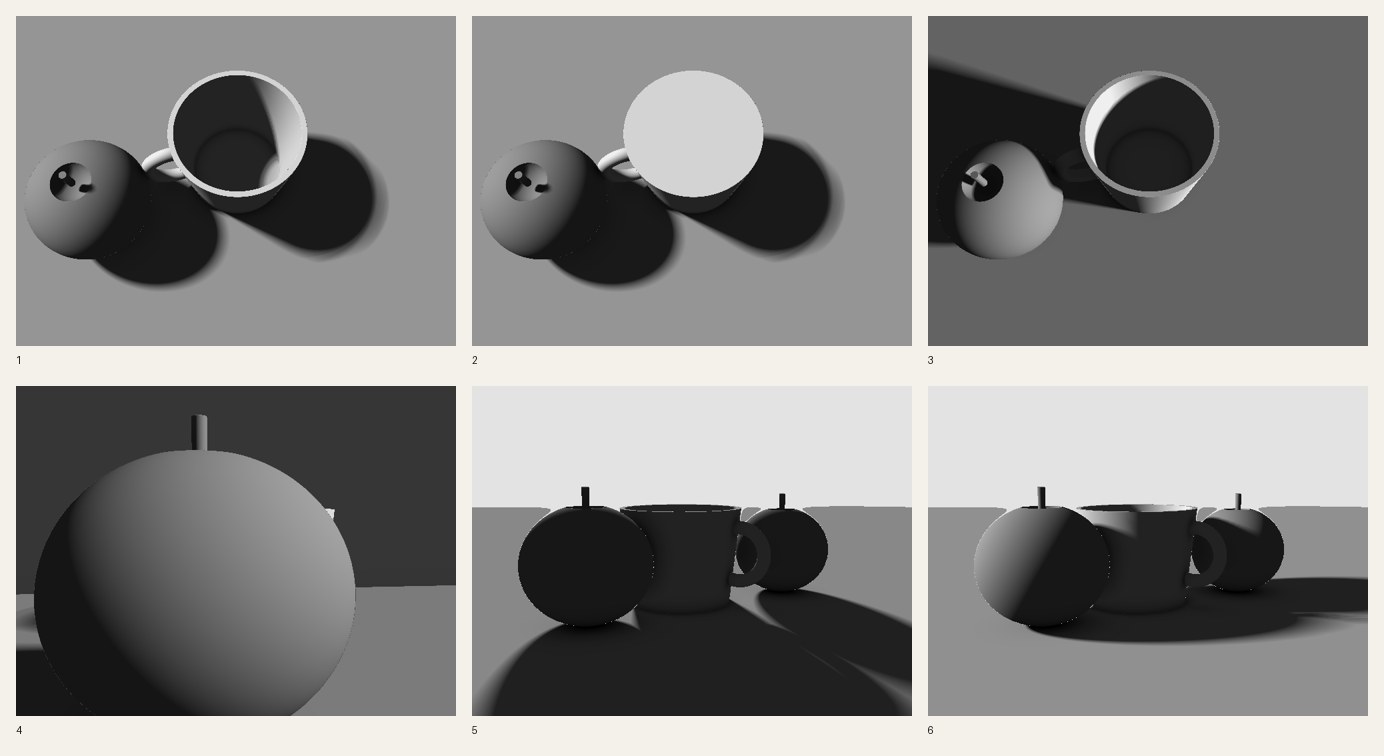
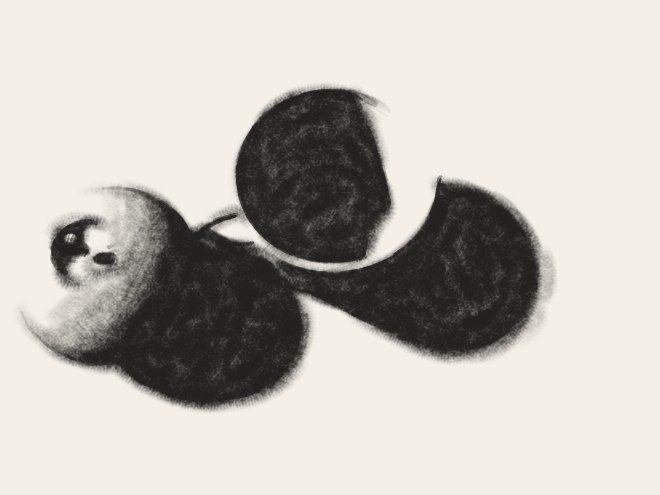
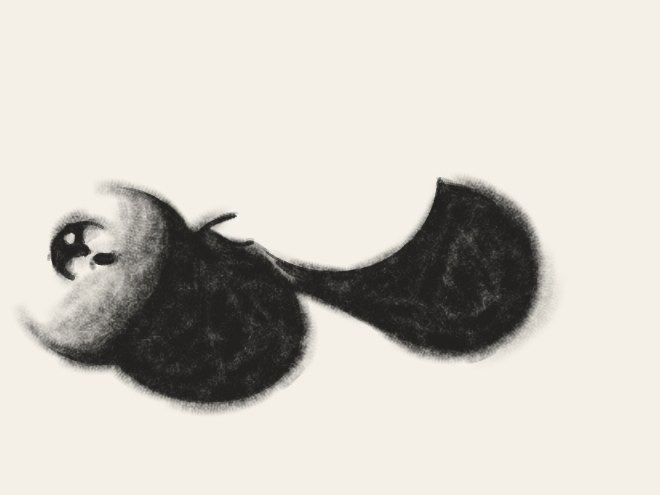
| drawing | question | decision |
|---|---|---|
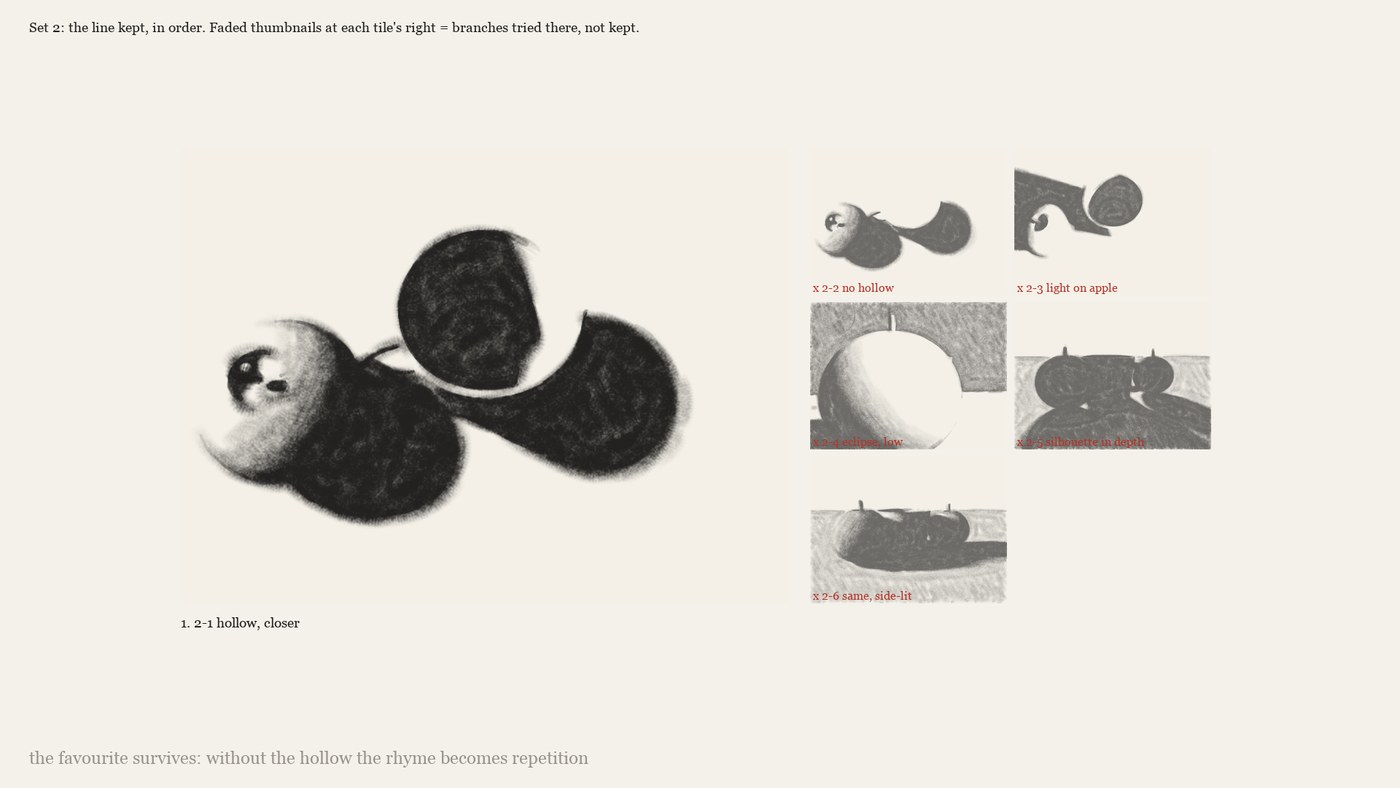
 | 1_hollow_closer Develop 3: closer, one apple only, its shadow touching the cup's shadow. Does the rhyme (light rim around a dark) hold with two objects? | carry: chain of three darks; the cup's dark inside its rim, the apple's outside |
 | 2_no_hollow Counterexample to the favourite: the 2-1 scene with the cup capped (same size, same handle, no hollow). What, specifically, is lost? | counterexample: loses the inside dark, the rhyme becomes repetition, the cup dissolves into paper; reserve as 'object known by the light it blocks' |
 | 3_light_on_apple Counterexample to the favourite: same objects, the light low from the right so the apple takes it and the cup's mouth sits in shadow. Does attention move, and does the cup still hold? | attention did not move: the cup's interior holds the eye regardless of the light; hard shadow band |
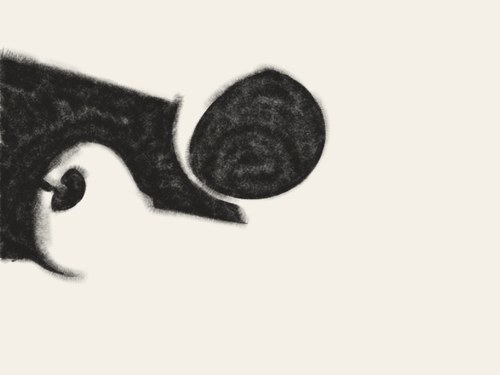
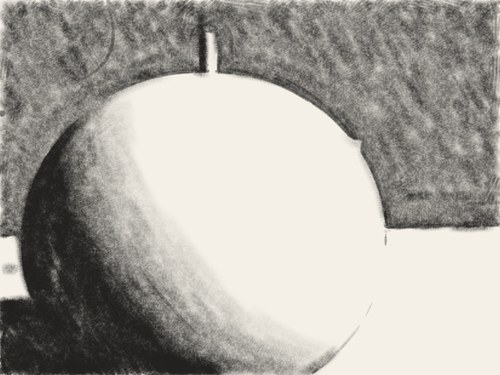 | 4_eclipse_low Develop 2: lower and closer; the apple fills half the frame; the cup only as a rim arc and its shadow, on a darker ground. | drop: the cup is hidden completely; a one-object portrait |
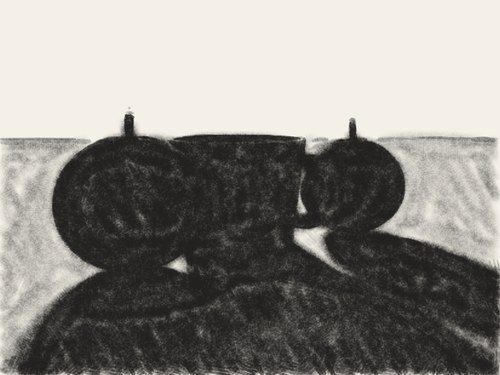 | 5_silhouette_depth Develop 4: break the frieze. Backlit, overlapping in depth, shadows toward us; is the handle's opening the only light inside the dark mass? | reserve: the shadows arrive before the objects; still a frontal row |
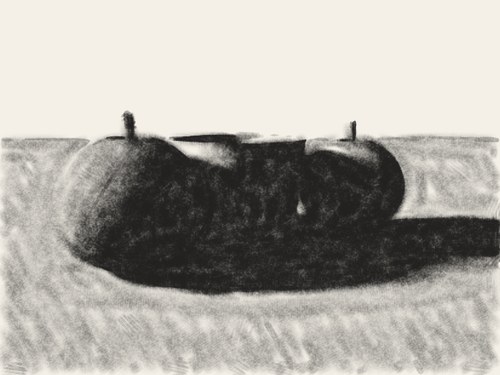 | 6_silhouette_sidelit Counterexample to 2-5: the same placement lit from the side. Does the backlight add something specific, or only darkness? | counterexample to 2-5: more legible, less specific |
Critique of set2
Set 2 critique
Read by the orchestrating assistant: drawings (contact.png) first, then studies and questions.
The favourite against its counterexamples
- 2-1 (develop): the apple's shadow, the cup's interior and the cup's shadow make a chain of three darks. The cup's dark sits inside its rim; the apple's dark lies outside it, on the table. Readable as a cup and an apple without the caption.
- 2-2 (no hollow): with the cup capped, its top is left as paper and the cup disappears from the drawing. What remains is the apple and a dark lobe with a round bite taken out of it. What is lost, specifically: the inside dark. Every dark in 2-2 is a shadow, outside its object, so the rhyme of 2-1 (a dark inside one object, a dark outside the other) becomes repetition. The favourite survives this test. What 2-2 reveals instead: an object present only as the light it blocks (the bite in the shadow). Without the caption it does not read as a cup. Reserve.
- 2-3 (light moved to the apple): attention did not move. The cup's interior became one dark disc with a thin light rim and still holds the eye; the apple, mostly in shadow, became a small glyph. The cast shadow from the low light runs to the frame edge as a hard-edged band (the band habit from set 1, now made by a shadow). The hollow holds attention even when the light favours the apple: the cup's dark does not depend on the light's direction the way the apple's does.
The other lines
- 2-4 (eclipse, lower and closer): the cup is hidden completely; what remains is a single lit apple against a dark wall, a one-object portrait. Concealment went past the point where the cup is present. Drop this line.
- 2-5 vs 2-6 (backlight vs side light, same placement): 2-6 reads more readily as objects (the near apple lit, everything else one dark mass with a long shadow). 2-5 puts the shadows in front of the objects, as a dark floor coming toward us, with light slivers between them and the light in the handle's opening. Backlight adds a specific thing (the shadows arrive before the objects), but both are still frontal rows. Reserve; it does not beat the hollow.
Decision
Continue the hollow (2-1). Reserve 2-2 (object known by the light it blocks) and 2-5 (shadows first). Not yet tested: whether the hollow survives a less diagrammatic view than straight down, a dark ground (the prompt's chiaroscuro: so far every favourite is dark shapes on light paper), a crop, and a change of marks.
Set 3 plan (six): combine and challenge, and test mark/value
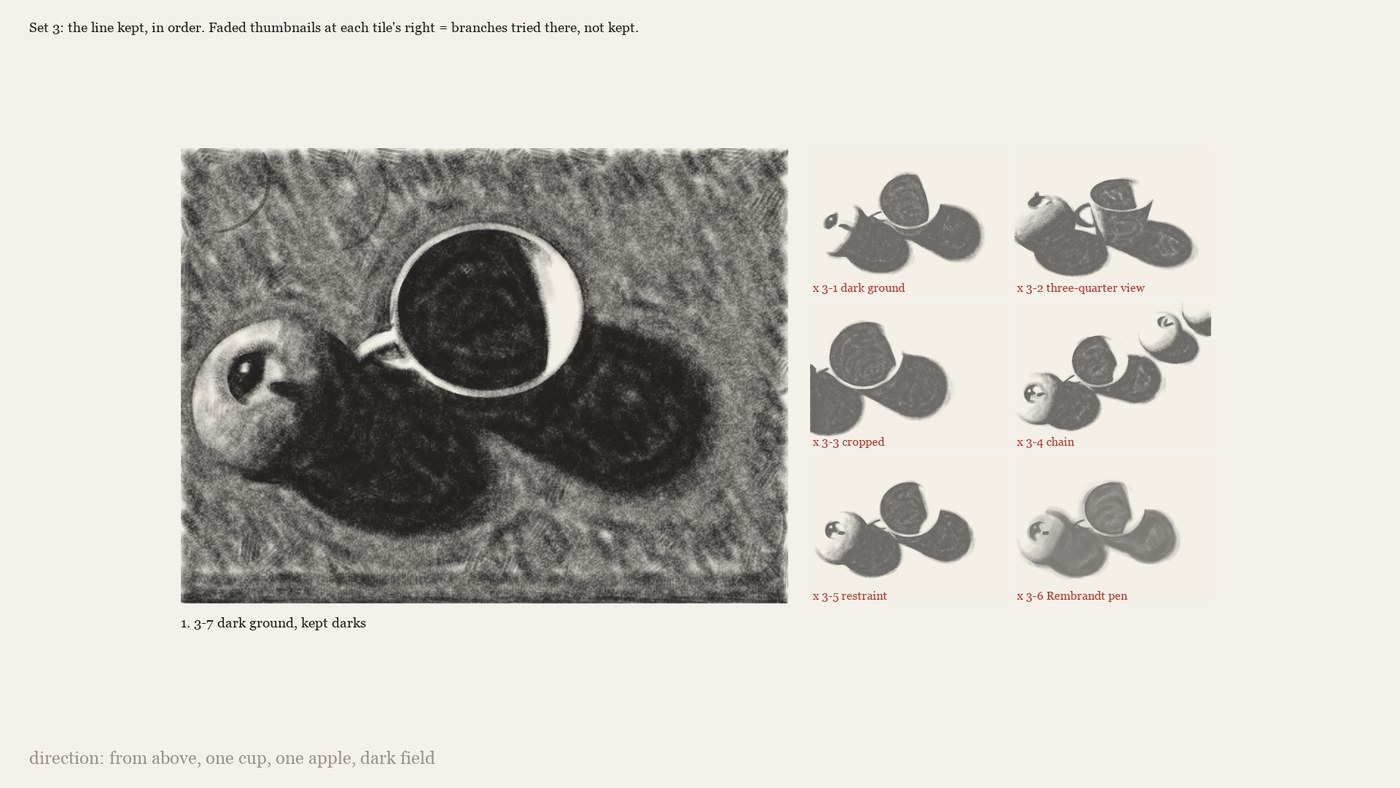
3-1 the hollow on a dark ground (table 0.22): light shapes in a dark field. Does the inside/outside rhyme survive when the field is dark? 3-2 the hollow from a three-quarter view (camera about 45 degrees): is top-down a gimmick the relation depends on? 3-3 the hollow cropped: the cup cut by the frame edge, the apple whole. 3-4 the chain extended: apple, cup, apple, the chain of darks leaving the frame. 3-5 2-1 with high restraint (0.8): does the relation survive economy of marks? 3-6 2-1 in another hand (Rembrandt pen): is the relation in the arrangement, or in Kollwitz's charcoal?
Set 3: combine, challenge, marks
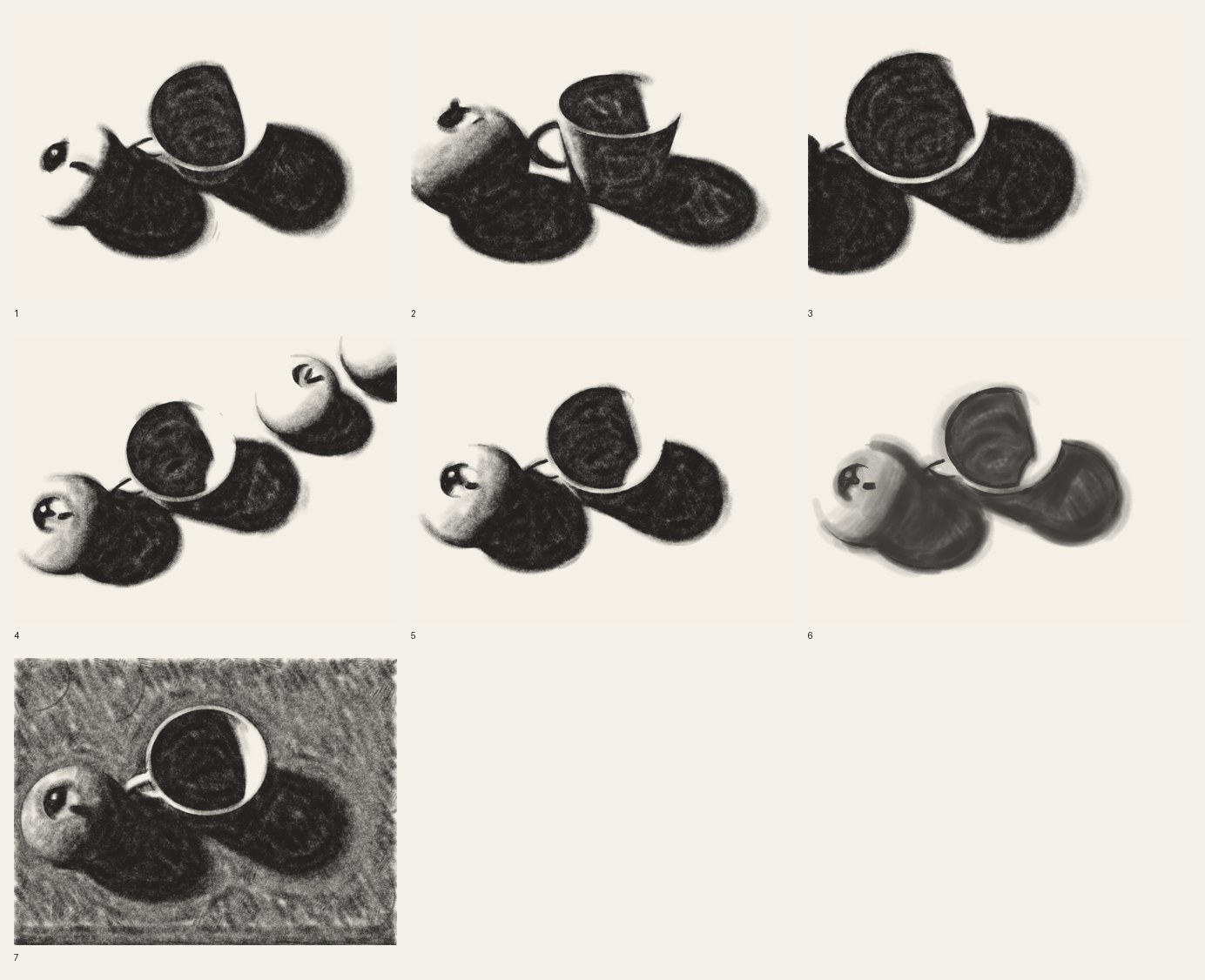
| drawing | question | decision |
|---|---|---|
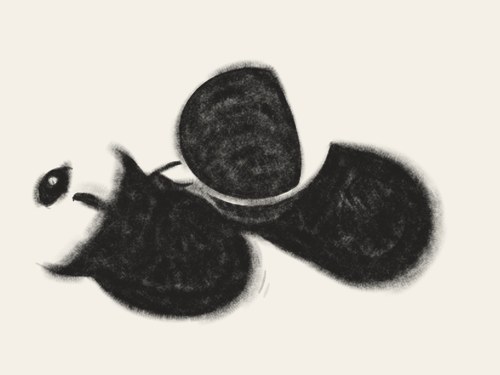 | 1_dark_ground The hollow on a dark ground: does the inside/outside rhyme survive when the field itself is dark? | void: Hands keyed the dark ground to paper (tool fact); re-run as 3-7 |
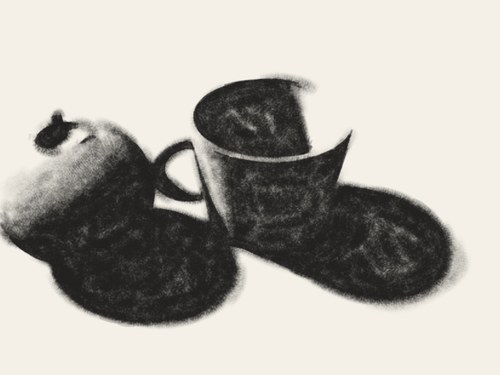 | 2_three_quarter The hollow from a three-quarter view: is straight-down a gimmick the relation depends on? | challenge passed by the favourite: straight-down is what lets the rim separate inside and outside darks |
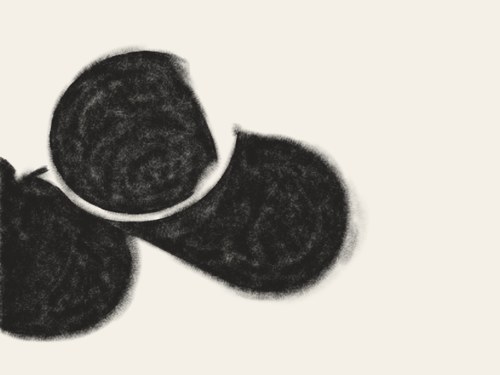 | 3_cropped The hollow cropped: the cup cut by the frame edge, the apple whole. | strong shape, two-object relation lost; drop |
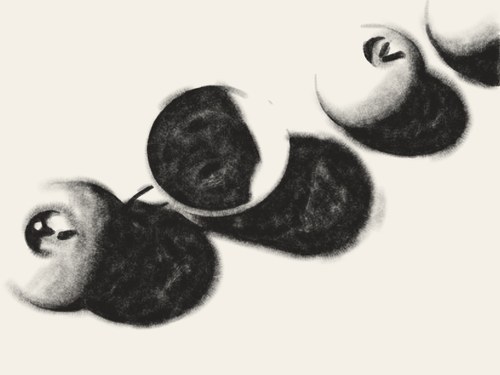 | 4_chain The chain extended: apple, cup, apple; the chain of darks leaves the frame. | fewer is stronger: one apple |
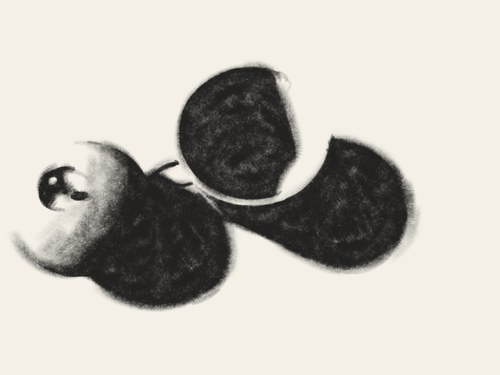 | 5_restraint 2-1 with high restraint (0.8): does the relation survive economy of marks? | no change at this restraint; nothing learned |
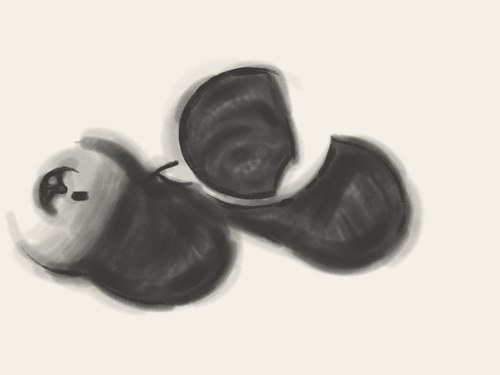 | 6_rembrandt_pen 2-1 in Rembrandt's pen hand: is the relation in the arrangement or in the charcoal? | the relation is in the arrangement; keep Kollwitz for the charcoal |
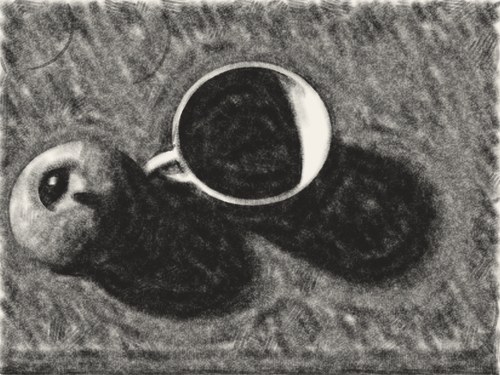 | 7_dark_ground_absolute 3-1 again with the target's own darks kept (--absolute): does the inside/outside rhyme survive in a dark field? | carry: the chosen direction; dark field, light ring around a black, apple crescent |
Critique of set3
Set 3 critique
Read by the orchestrating assistant (contact.png now includes 3-7).
- 3-1 (dark ground): the test did not happen. Hands keys the tone covering most of a target to paper, so the dark table came out white. A tool fact, not an artistic answer. Fixed with run.mjs --absolute (a white band added below while drawing, then cropped; vendored engine unchanged) and re-run as 3-7.
- 3-7 (dark ground, absolute): the field is dark; the cup's rim becomes the brightest shape, a light ring around a black; the apple is a lit crescent; both shadows sink into the field. The inside/outside rhyme survives in a new form: both objects are now lights in a dark, and the cup's light encloses its dark while the apple's light only edges its own. This is the first thumbnail that carries the prompt's chiaroscuro. Faults: the field is one uniform diagonal texture everywhere (it competes with the objects); a pale seam along the bottom edge where the white band met the image; the frame edges are lighter than the field.
- 3-2 (three-quarter view): the cup reads more as a cup, but its inside dark joins its shadow side and its cast shadow into one mass. Straight-down is not a gimmick: it is what lets the rim separate the inside dark from the outside dark.
- 3-3 (crop): the cup and its shadow become a large two-lobed dark with a thin light rim; the apple is a dark at the edge. Strong as a shape, but the two-object relation is gone.
- 3-4 (chain of four): more apples make a pattern of repeated dark ovals; the cup's difference is diluted. Fewer is stronger: one apple.
- 3-5 (restraint 0.8): almost identical to 2-1; this restraint range changes little here. Nothing learned about economy.
- 3-6 (Rembrandt pen): greyer and softer, and the relation still reads: it is in the arrangement, not only in the charcoal. Kollwitz stays, for the prompt's charcoal.
Decision
Direction: seen from above, one cup, one apple, dark field (3-7). Consequential question for a passage of work: how should the field be made (value, falloff, marks) so that the light ring reads as the cup holding the dark, not as a hole in the table, and so the field stops competing with the objects? Tool: native drawing (it is a question of marks and tonal construction). Larger (1000 px).
Passage 1: the field
| drawing | question | decision |
|---|---|---|
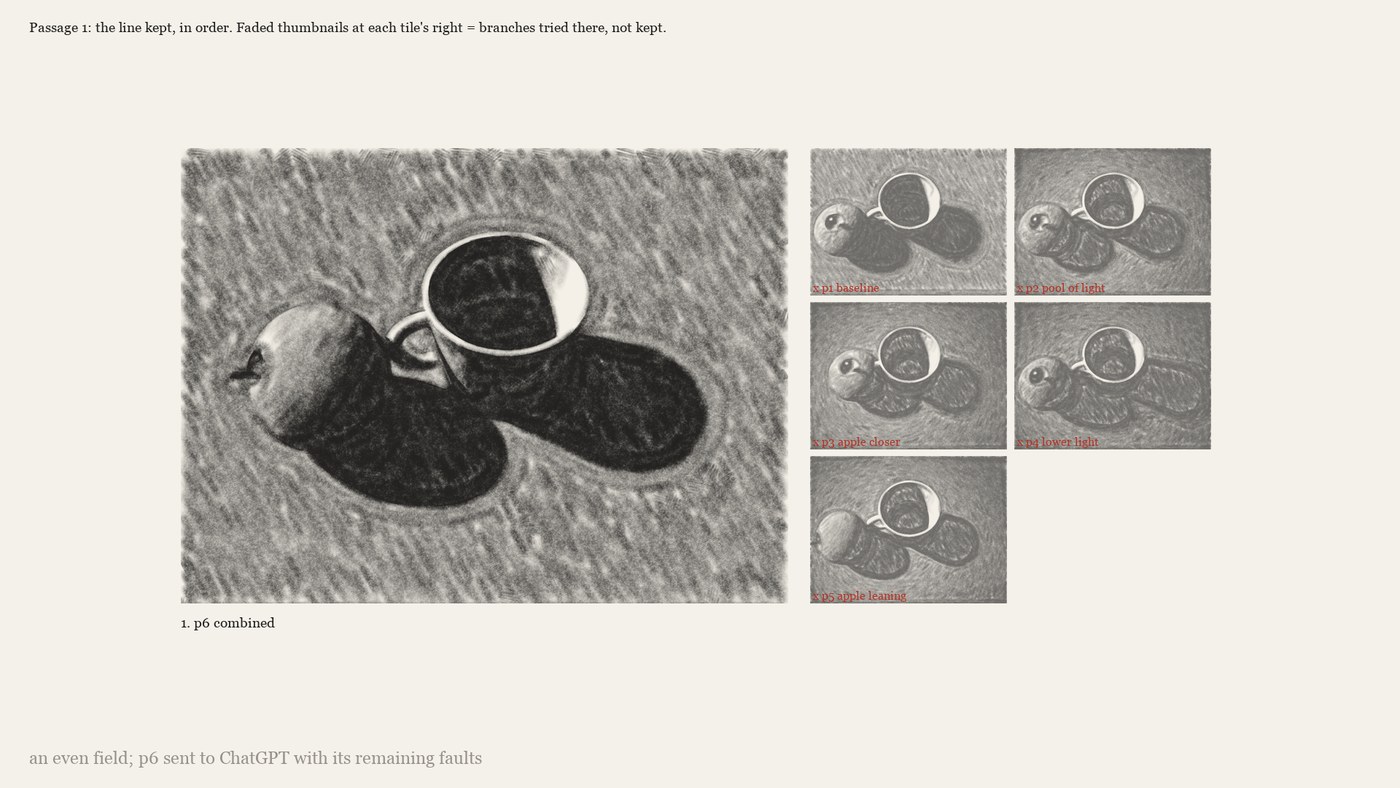
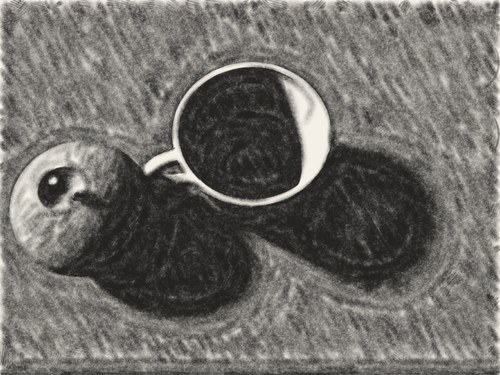 | p1_baseline 3-7 at full size: what does the field do at this scale? | baseline: even field, pale band around shadows |
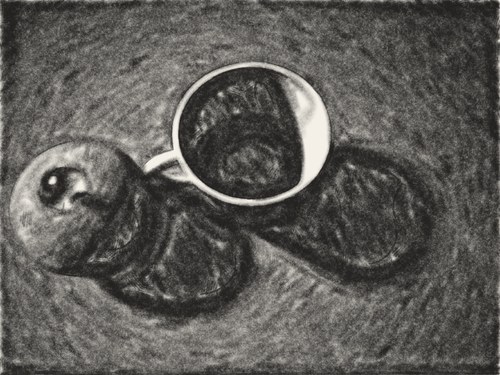 | p2_pool A pool of light: the field falls away to dark at the edges, so the field is no longer one even texture. | drop: the field curves around the cup; apple from above reads as an eye |
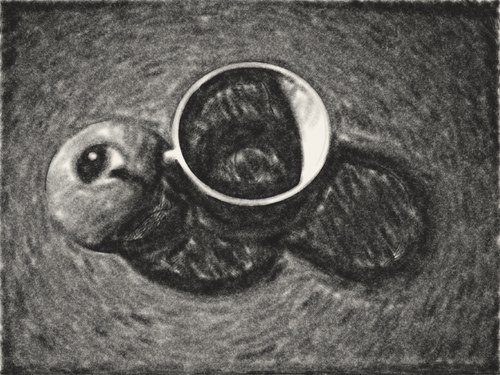 | p3_closer Counterexample inside the passage: the apple closer, its shadow joining the cup's. Does the separation matter? | counterexample: shadows merge, apple attached; separation needed |
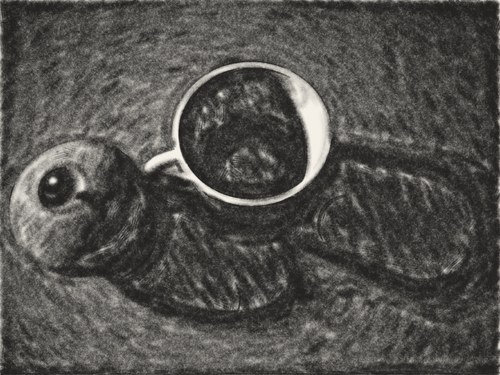 | p4_lower_light Lower light: the cup's inner wall takes a crescent of light, so the dark inside has its own light. | small gain: the dark inside gets its own light |
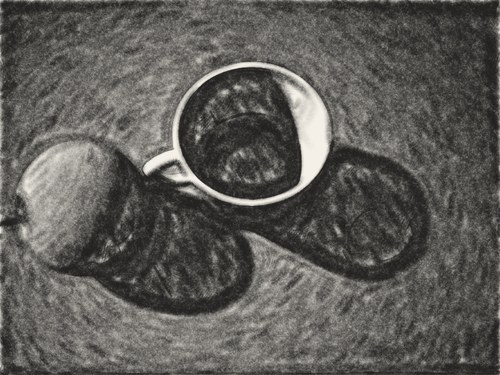 | p5_lean_hard p2 with the apple leaning (stem off-axis, no 'eye') and hard shadow edges (no pale halo). | eye fixed; the pool makes the cup a drain |
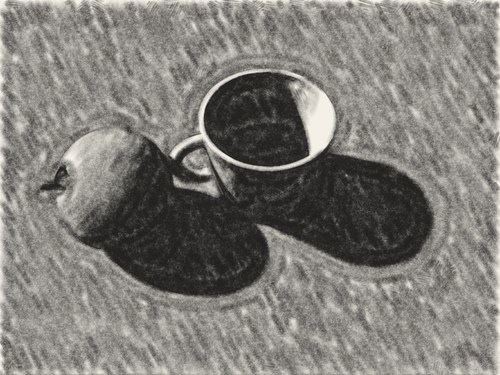 | p6_combined Combine: even field (no pool), camera about 20 degrees off vertical so the apple shows its side, apple leaning, hard shadows, fuller fill (restraint 0.25). | carry: even field, 20 degrees off vertical, apple reads; halos remain (tool) |
Critique of passage1
Passage 1: the field (native drawing, 1000 px, Kollwitz charcoal, --absolute)
Question: how should the field be made so the light ring reads as the cup holding the dark, not as a hole in the table, and so the field stops competing?
The attempts (uninterrupted; a look between each, no full critique)
- p1 baseline (3-7 at full size): even diagonal field; each shadow is outlined by a pale band.
- p2 pool of light (field falls to dark at the edges): the marks follow the falloff and curve around the cup. Full size shows a new fault: seen from straight above, the apple's dimple and stem read as an eyeball.
- p3 apple closer (counterexample inside the passage): the two shadows merge and the apple seems attached to the handle. The gap of field between the shadows is what keeps two objects two. Separation is needed; not for "melancholy", for legibility of the relation.
- p4 lower light: a larger lit crescent inside the cup; the dark inside gains its own light. Small gain.
- p5 apple leaning (no eye) + hard shadow edges: the eye is gone. Seen beside p1, the curved field marks around the cup make the ring read as a drain: the pool of light works against the question.
- p6 combined: even field, camera about 20 degrees off vertical, apple leaning, hard shadows, fuller fill (restraint 0.25). The cup is unmistakably a cup (handle, rim, black inside); the apple reads as an apple (calyx at its side); the shadows are full darks separated by a strip of field.
Answer to the question: an even field, not a pool. The ring reads as a held dark when the field around it is quiet and level; when the field turns toward the cup, the cup becomes a hole.
Remaining faults (tool behaviour, named so they are not mistaken for intent)
- A pale halo around each dark group: the engine's local-contrast step lifts the field next to a dark. Present in every dark-field drawing.
- The field texture is one diagonal stroke everywhere (it reads as rain).
- The --absolute seam along the bottom edge: fixed (the image's last row is carried into the white band).
The return, and the original intention
What happened in the image: the inquiry found one relation and tested it. The cup's dark is held inside its rim; the apple's dark lies outside it on the table. Every alternative that removed the hollow (2-2), moved the light (2-3), lowered the view to 45 degrees (3-2), added apples (3-4) or merged the shadows (p3) lost that difference in a way that can be pointed to. Is it still worth pursuing? Yes, with an objection the critic should not soften: the inquiry has moved away from the prompt's treatment. The prompt asks for a loose, melancholic, academic drawing. What we have is a high, graphic view of two objects and their darks: modern rather than academic, and nothing in it is melancholic except by caption. Two honest options:
- keep the discovery and bring the treatment back toward the prompt (a lower, academic eye level would lose the separation of the darks, as 3-2 showed: that is the real conflict, and it is worth one more passage);
- keep the discovery and let the prompt's treatment go (change the inquiry's terms, Russell's call).
Returning to an earlier branch is also open: 2-5 (shadows arriving before the objects) is the strongest unexplored reserve, and it is at the academic eye level.
Hold?
Not recommended yet. In the HOLD format:
- Specific to this work: the cup's dark inside its rim against the apple's dark outside it, separated by a strip of quiet field.
- Revealed by: 2-2 (no hollow: repetition), 2-3 (light moved: attention stays on the hollow), 3-2 (45 degrees: inside and outside darks merge), 3-4 (more apples: diluted), p3 (closer: shadows merge), p2/p5 (pool: the cup becomes a drain).
- Unresolved, and worth preserving: whether the black inside the cup is a depth or a surface (the drawing does not settle it, and that is what holds the eye).
- Strongest remaining objection: the treatment conflict above, plus the halos, which are a tool signature rather than a decision.
The academic test
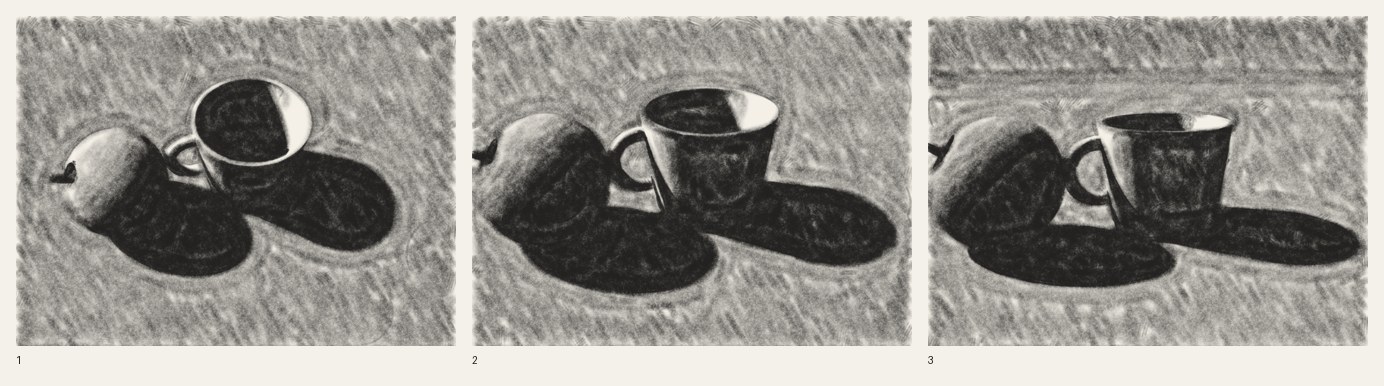
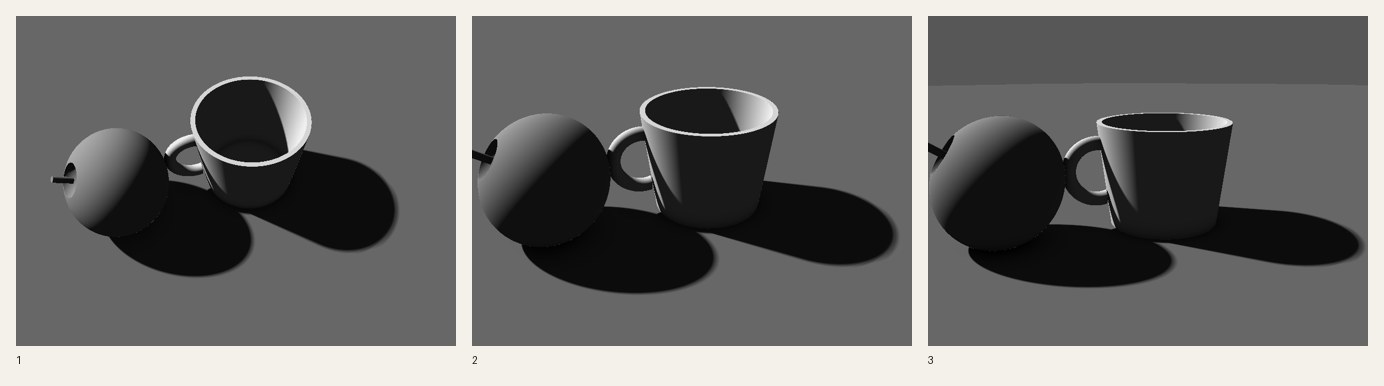
| drawing | question | decision |
|---|---|---|
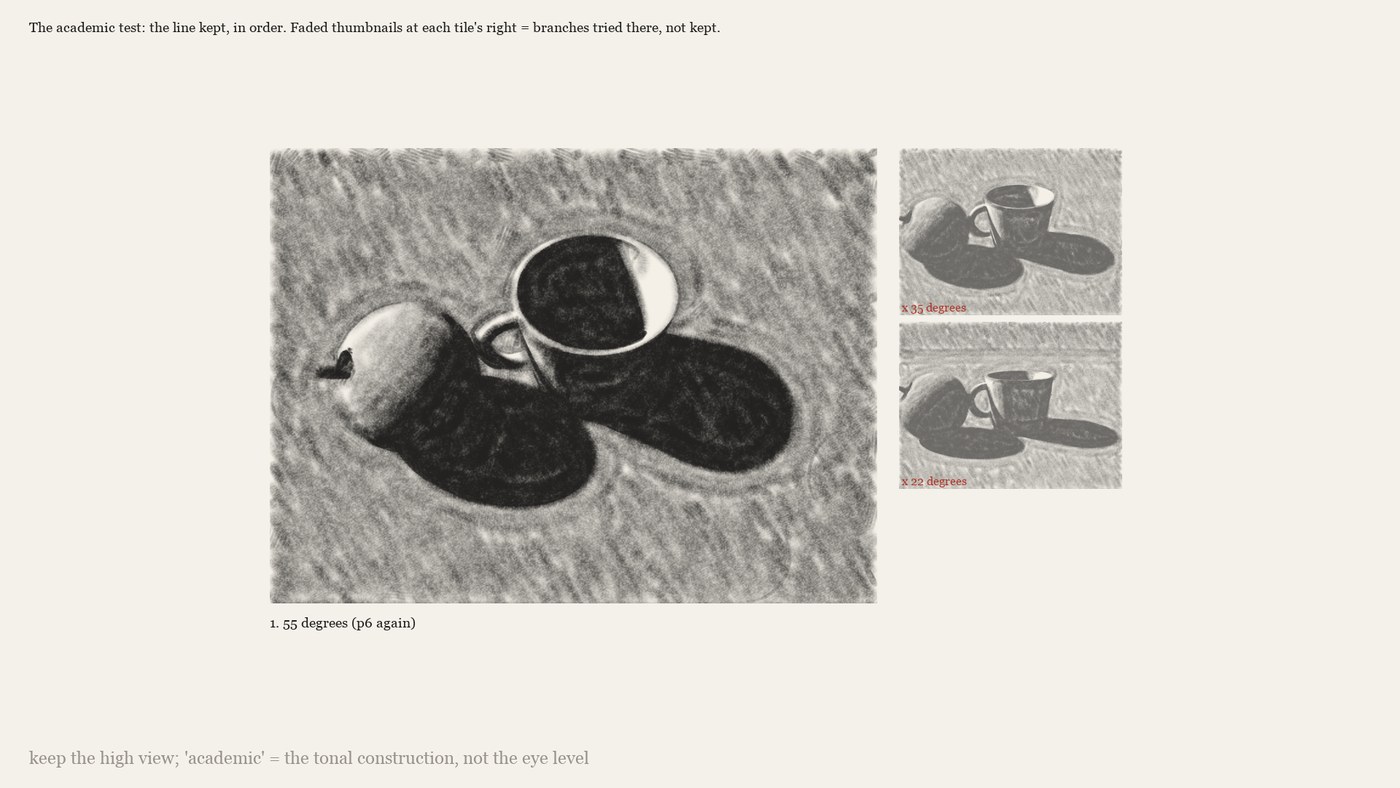
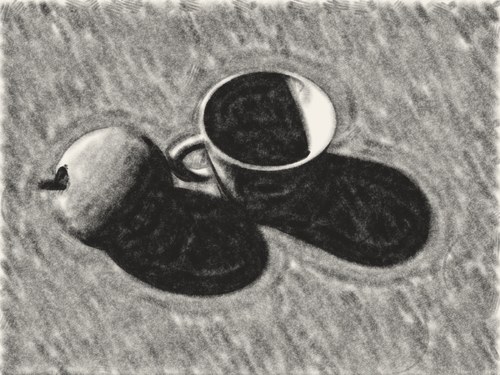 | e0_elev55 p6 again as the reference for this comparison (about 55 degrees). | |
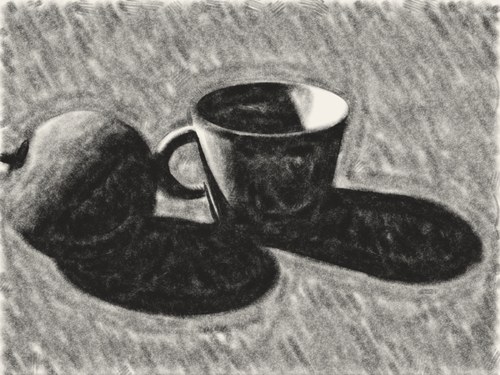 | e1_elev35 The academic test, 35 degrees above the table: does the cup's inside dark stay separate from its outside darks? | |
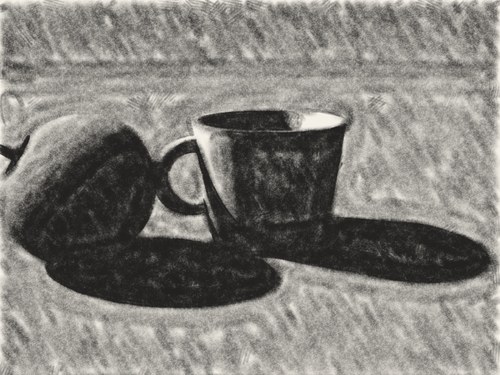 | e2_elev22 The academic test, 22 degrees (close to a seated draughtsman's eye level): what is left of the relation? |
Loop 1: ChatGPT, then native work on its ground
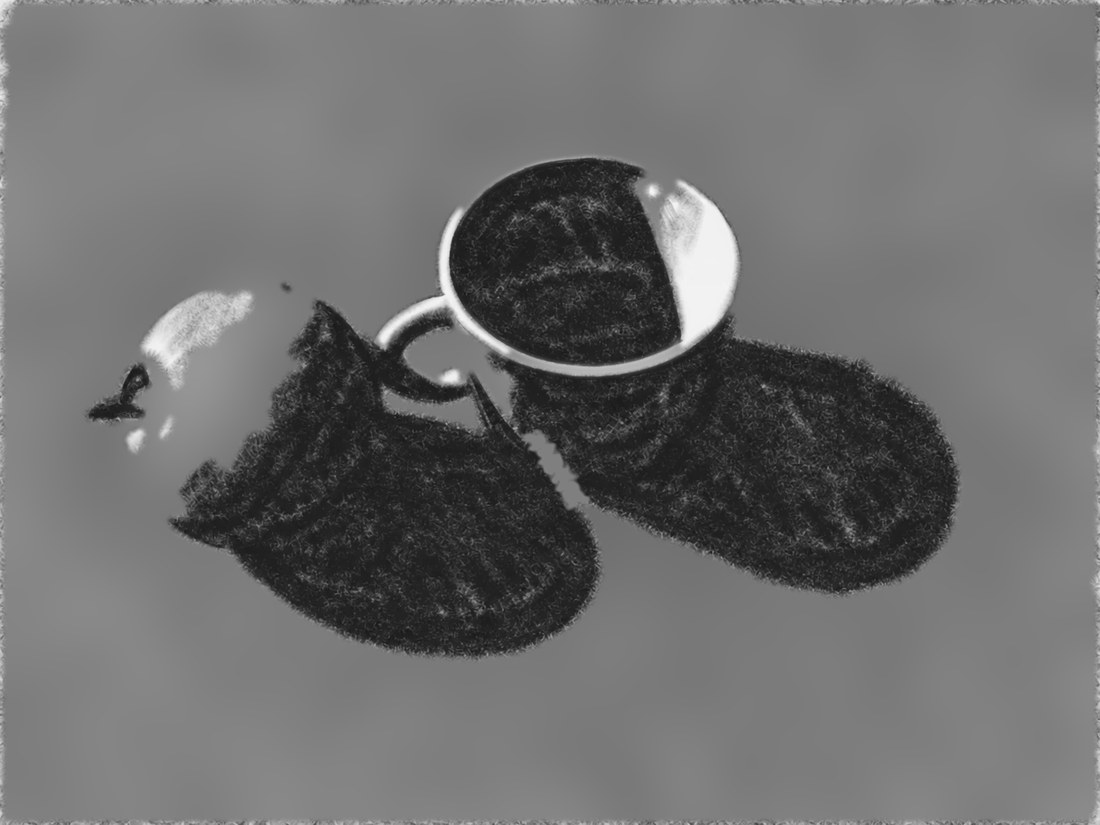
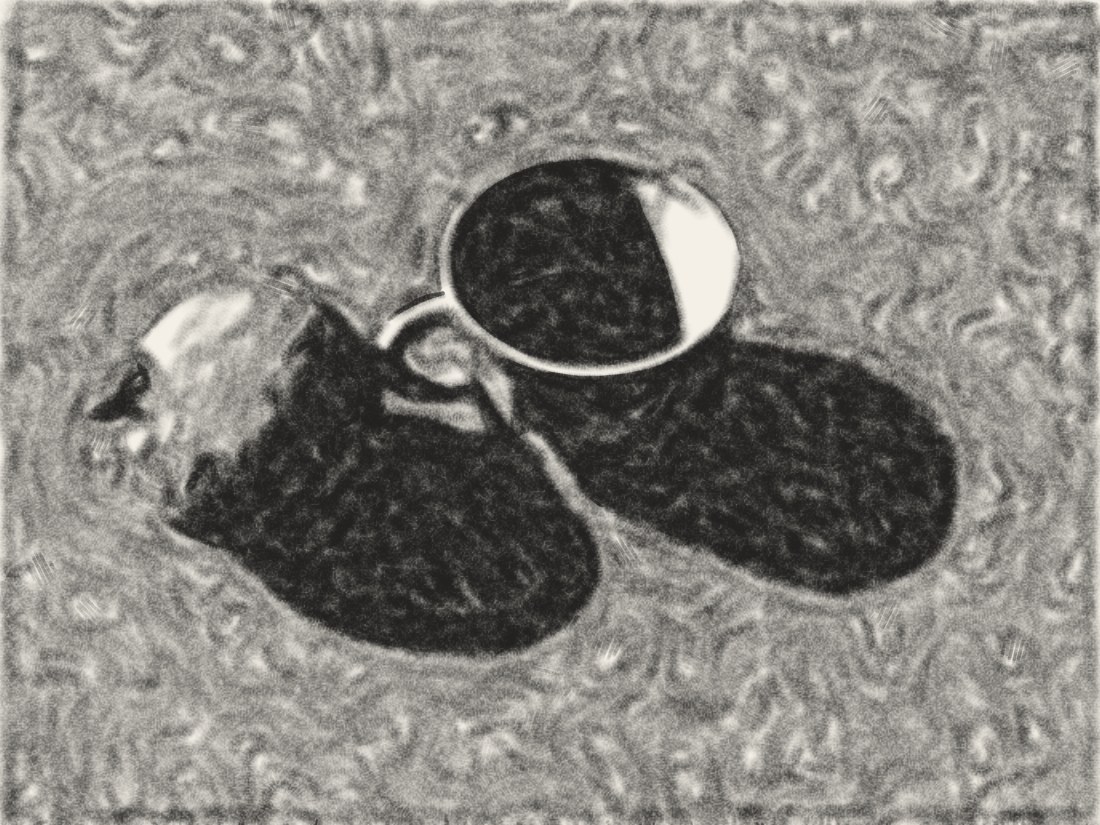
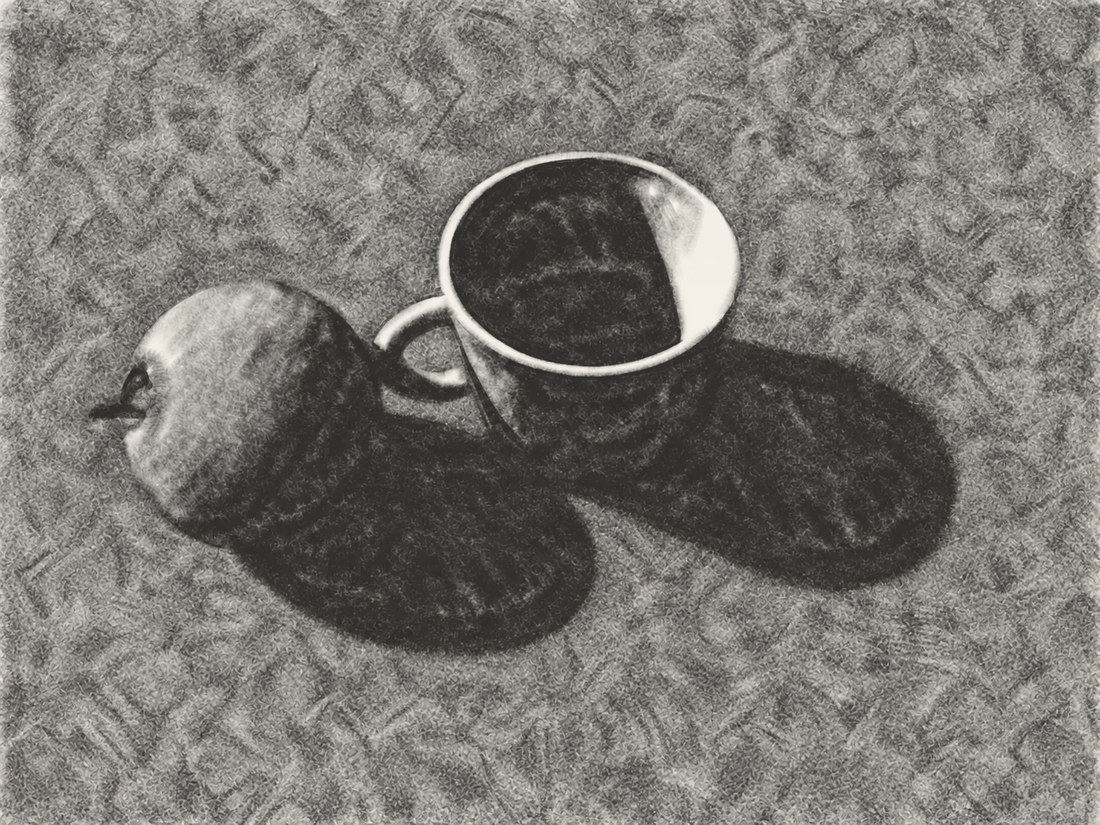
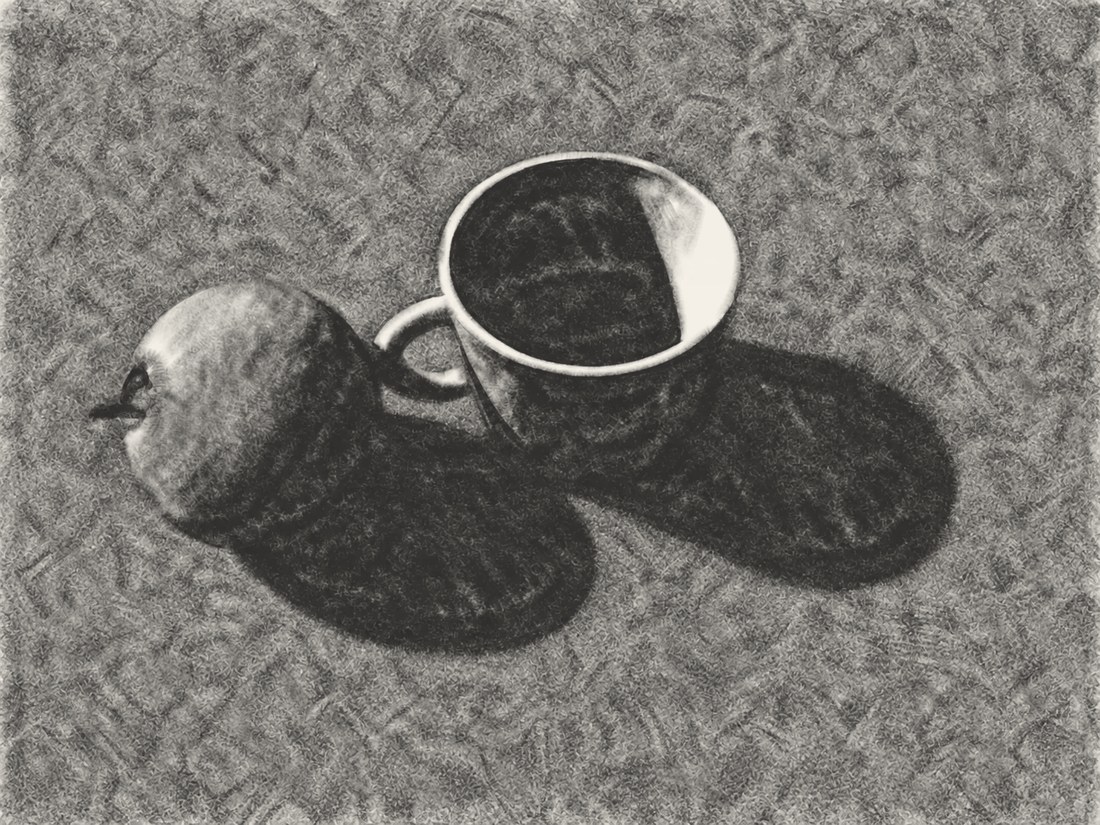
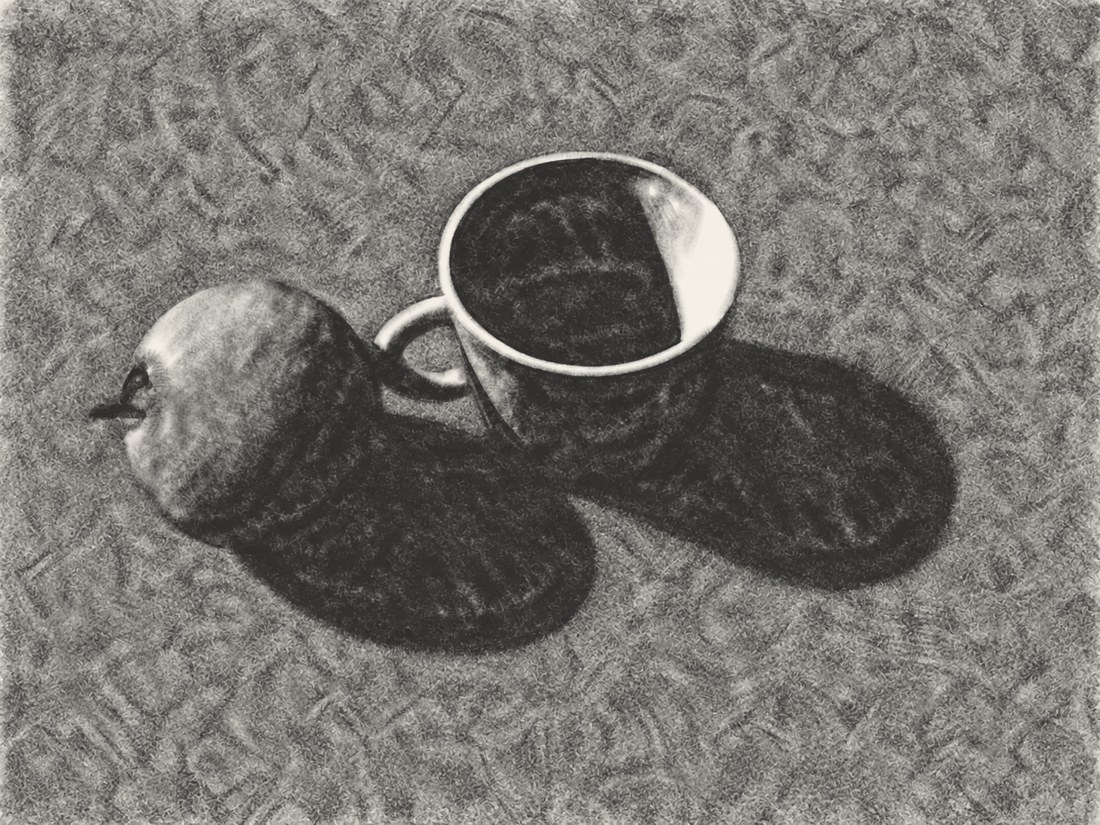
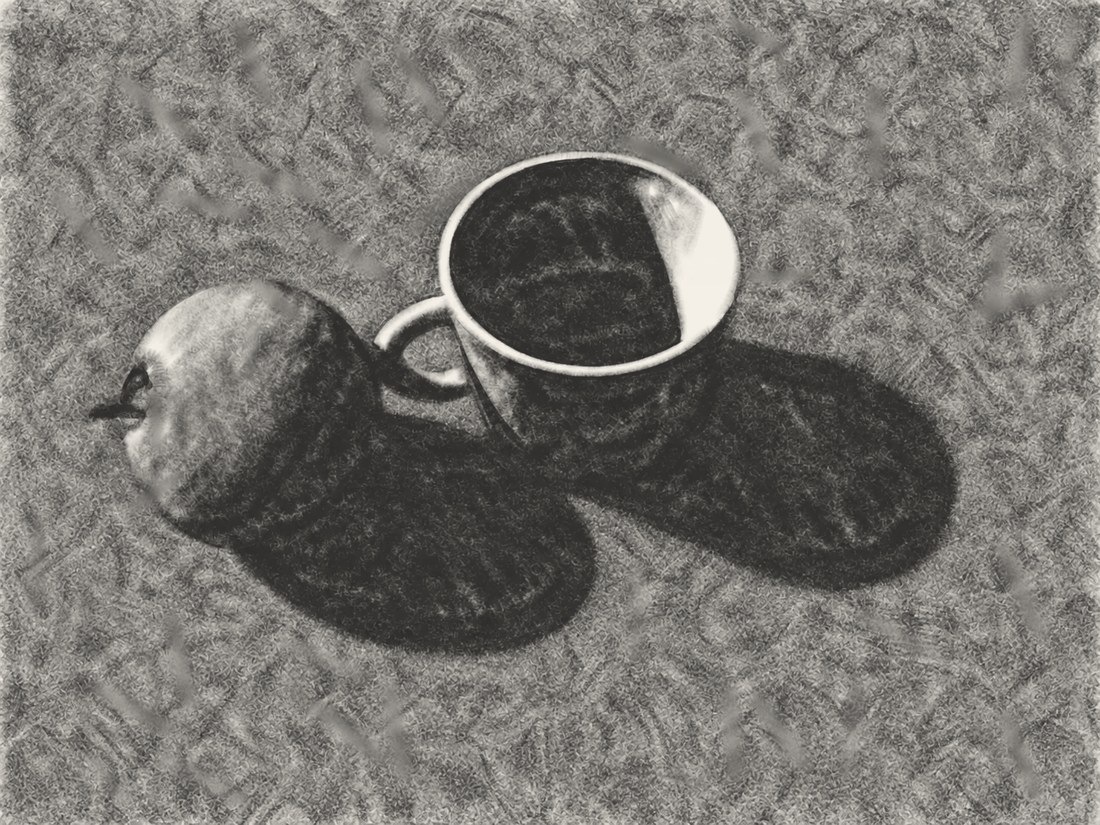
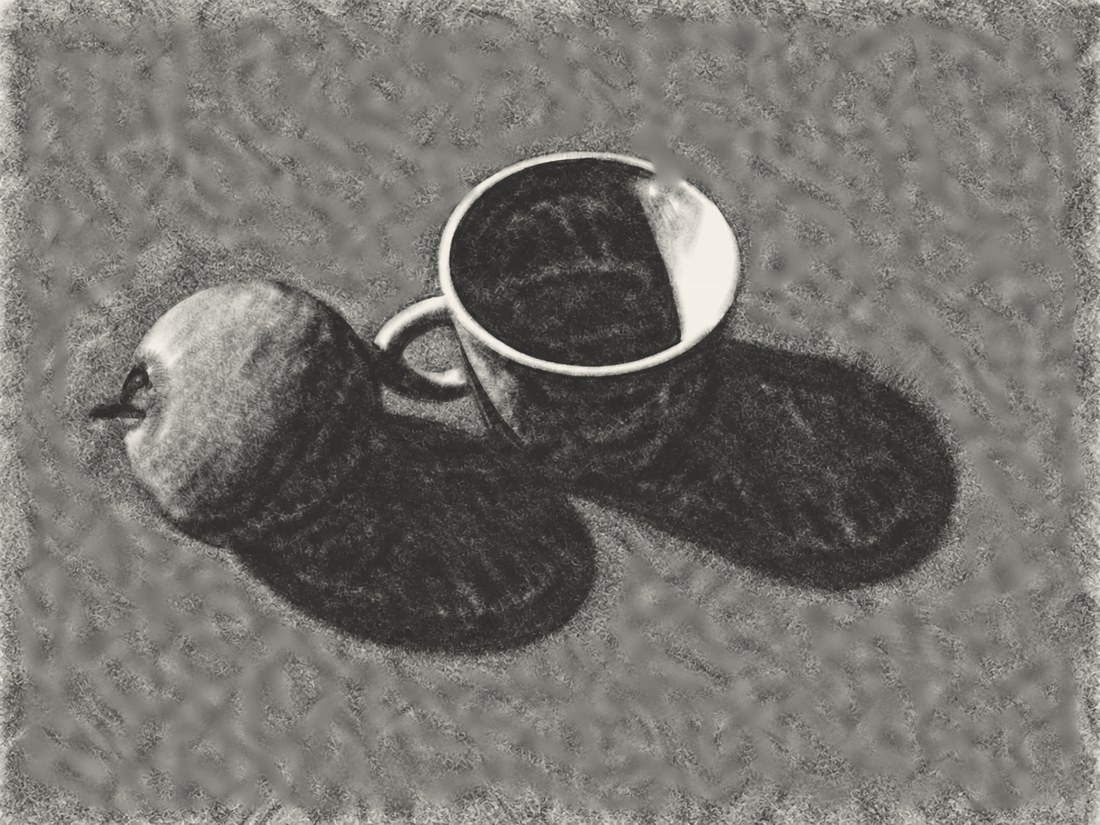
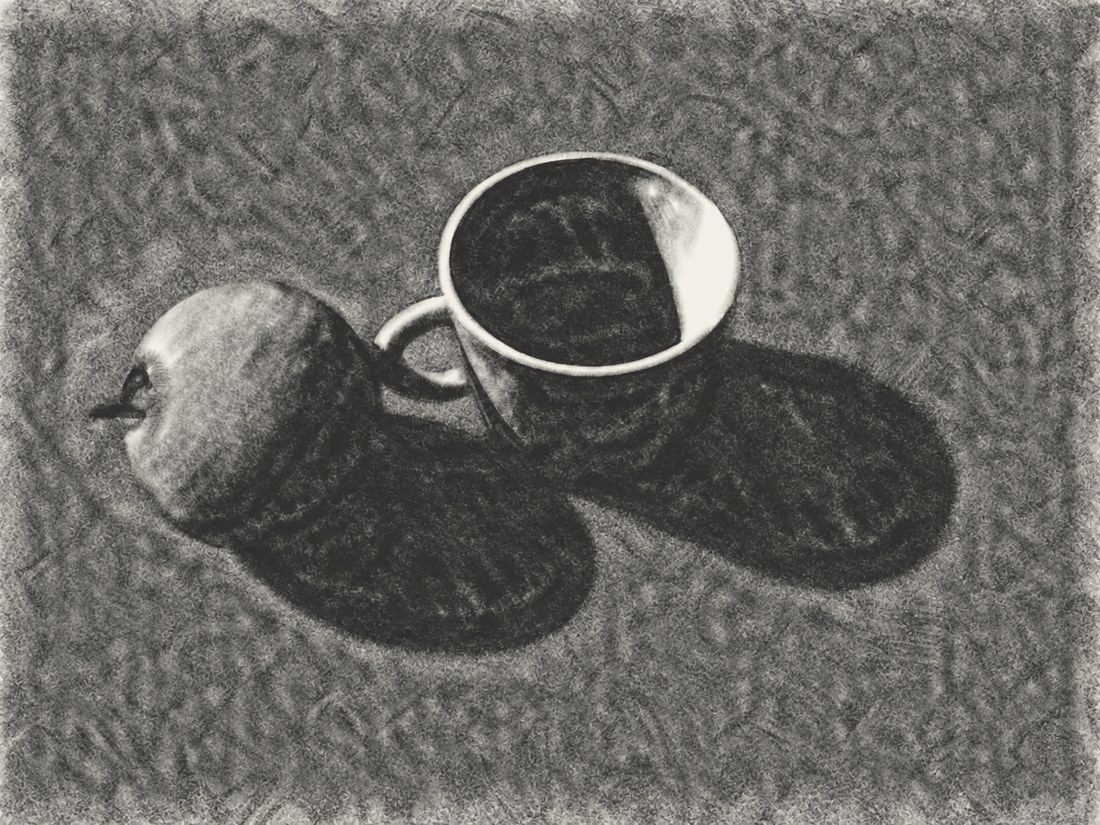
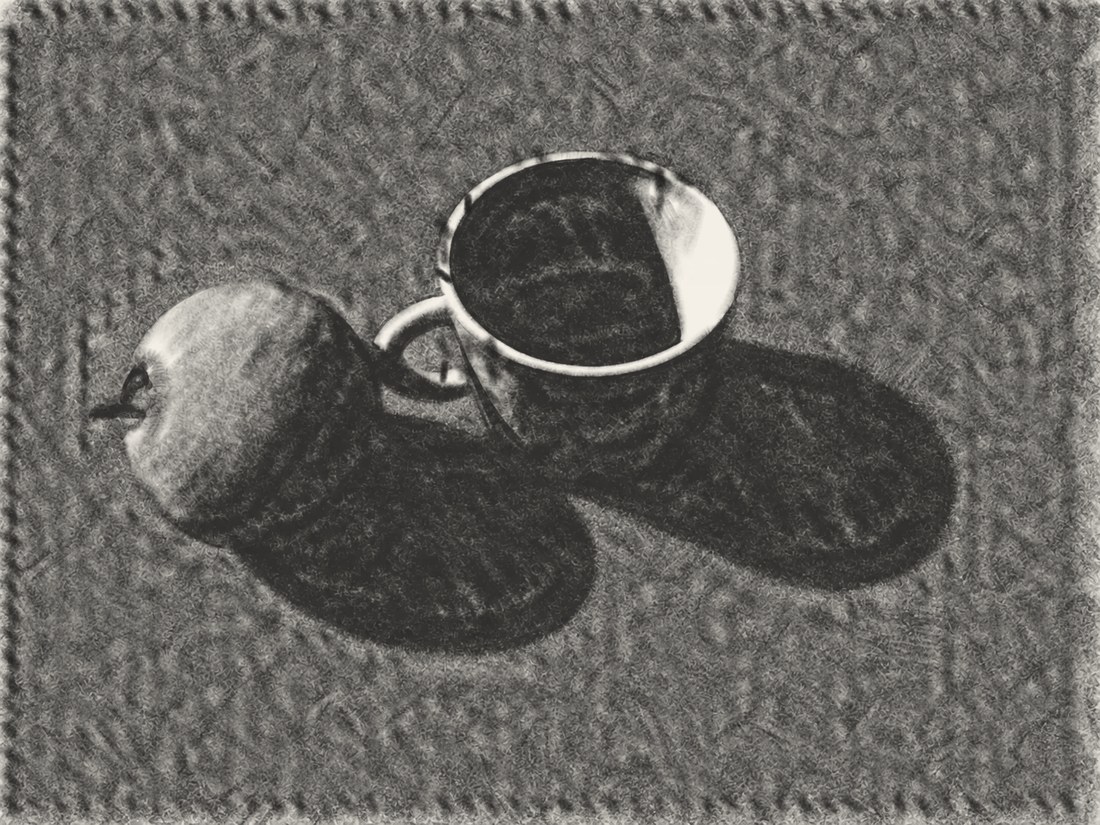
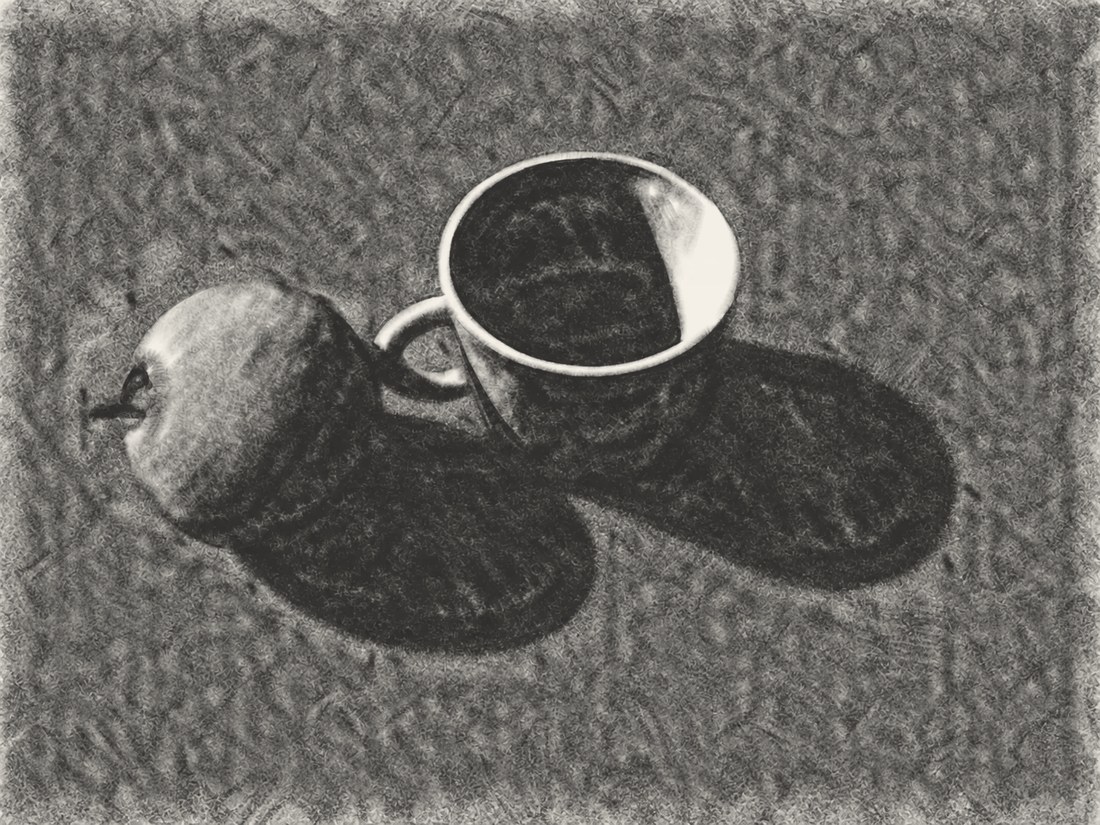
The masks the edits were confined to
Loop 1 (gpt1 -> Hold)
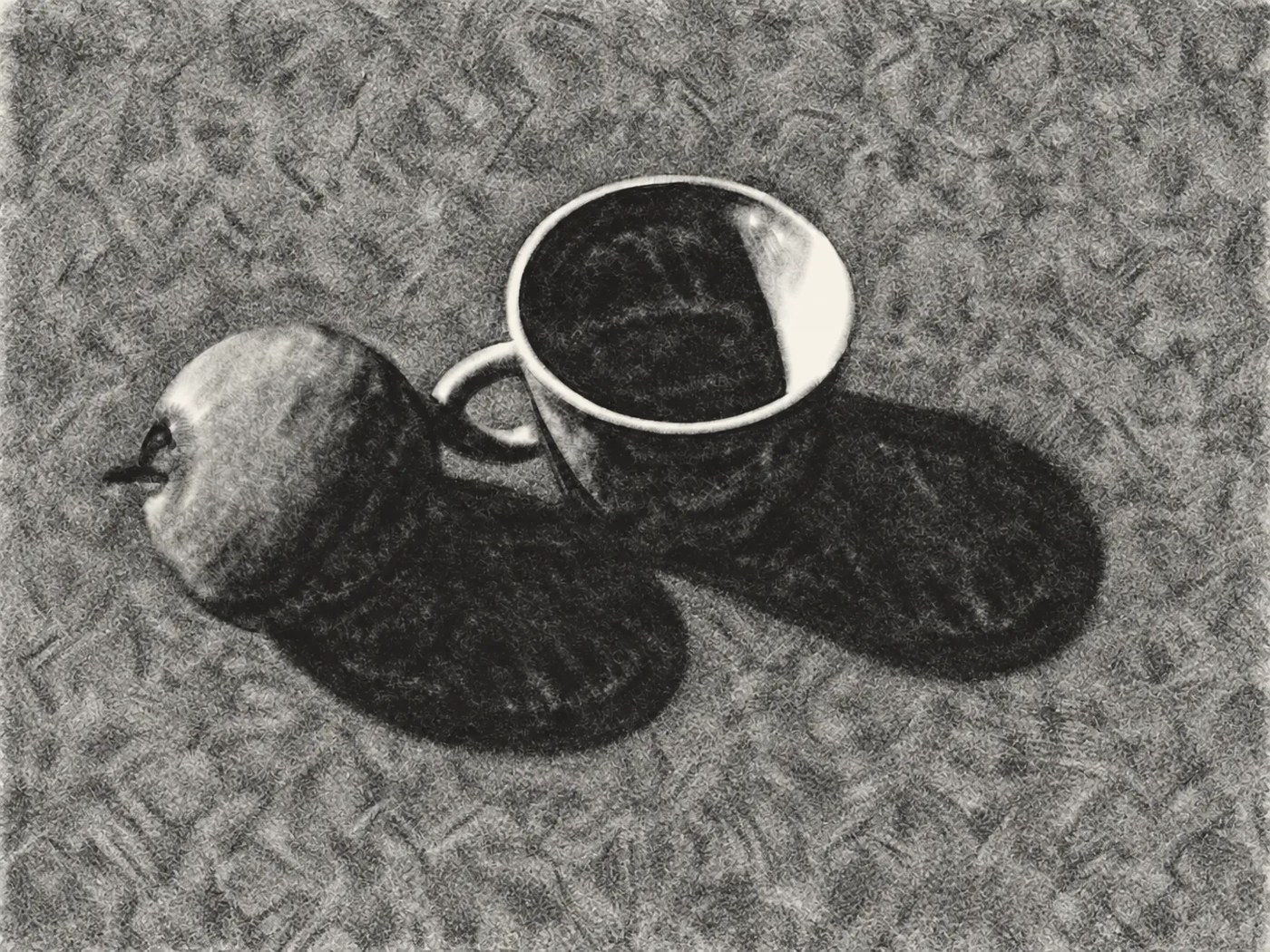
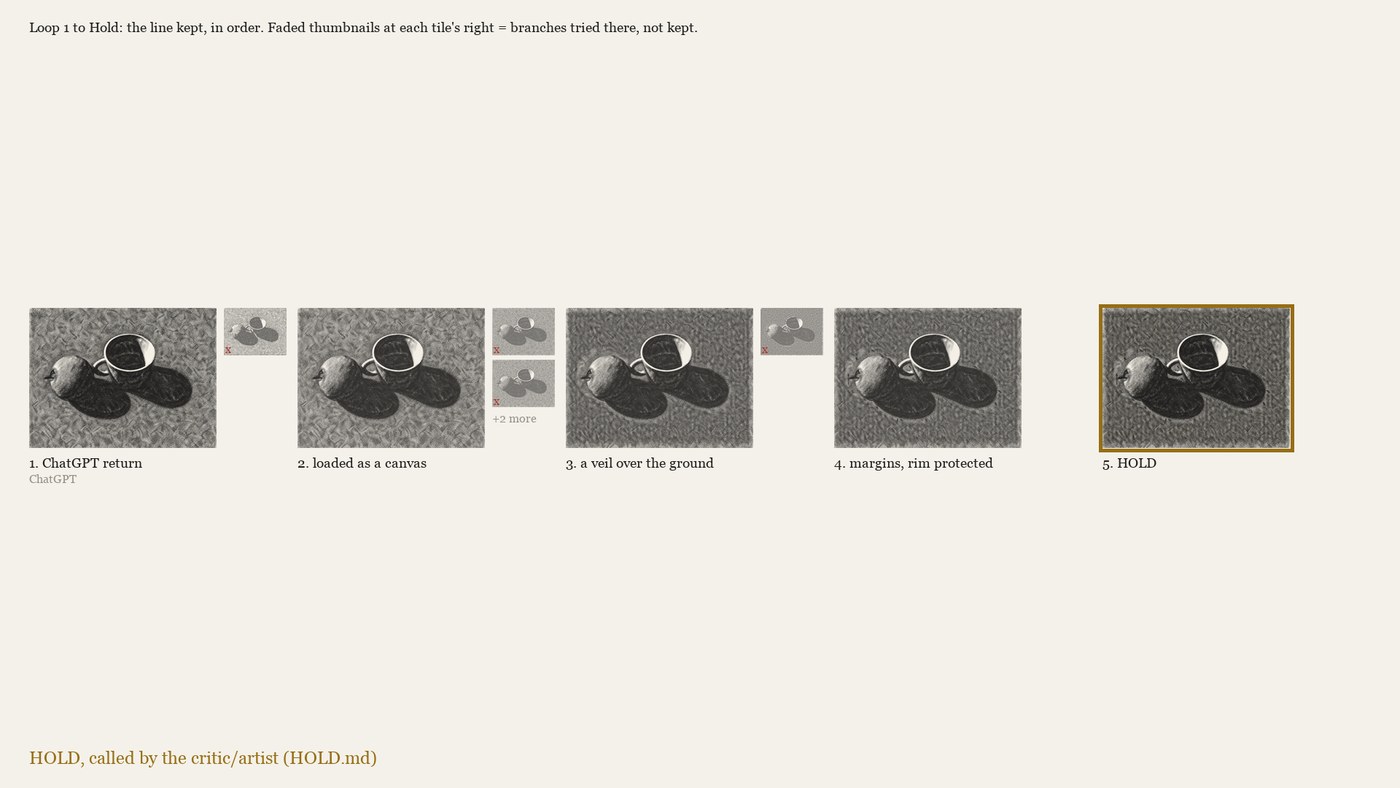
- gpt1.png: Russell, ChatGPT, from p6 + "Remaining faults". Halos and the bottom seam gone; the field became a strong mottled pattern (quiet share 0.05); the shadows join at the cup's foot.
- passage2/ (e0 55, e1 35, e2 22 degrees): the academic eye-level test. Decision: keep the high view.
- artist/A: Hands redraws gpt1 (quiet target, --absolute): the field becomes curly scribble, halos return. Branch, not kept.
- artist/G: gpt1 loaded as a canvas (C = L / q99.9 * 0.95). Rendering it back through render.py lifts the deepest blacks (ink floor): black share 0.144 -> 0.004 with no edit at all. The final therefore applies T7 - G to gpt1's pixels.
- artist/T, T2 (even-tone on cell means): almost no change; the pattern is texture inside cells, not tone between them.
- artist/T3, T4 (+ stump on busy cells; mask without the apple): the field reads as a digital blur; a grainy margin around the objects; the stump nicked the cup's rim. Branch, not kept.
- artist/T5 (a veil: light flat marks into the light mottles): the pattern loses contrast and keeps its grain. Kept.
- artist/T6 (small marks into the margins): stitched frame edge and marks across the rim (the smoothed mask counted the thin rim as field). Branch, not kept. T7: the same with the rim and the frame edge protected. Kept.
- artist/final.png: gpt1 + (T7 - G). Held (HOLD.md).
Hold, argued
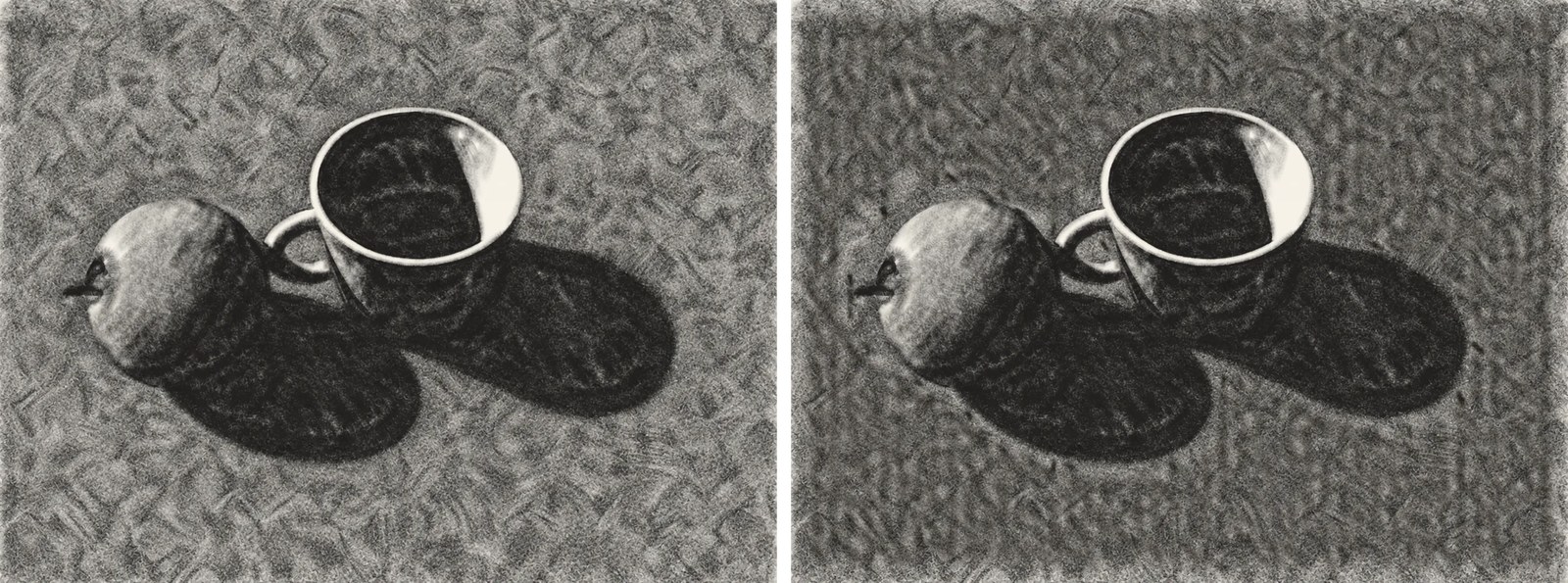
Hold: still life (teacup and apple)
Called by the critic/artist (Claude) on 2026-10-08, as asked ("find the hold"; decisions on the return are ours). Held image: loop1/artist/final.png. Its making: gpt1.png (ChatGPT, from p6 and its "remaining faults"), with the field veiled by native marks (hand/intend.mjs even-tone: 1893 + 1333 actions, Kollwitz flat marks laid lightly into the light mottles of the ground; the change applied to gpt1's own pixels so its blacks and colour stay exact).
Decisions made on the return (the open conflict from passage 1)
- "Academic" is taken as the treatment (constructed tonal modelling, cast shadows from one light), not the eye level. Evidence: passage2 e2 (22 degrees, a seated draughtsman's eye level) loses the relation; e1 (35 degrees) weakens it.
- "Melancholic" is dropped as a claim. Nothing visible in any drawing carried it; it was always a caption.
- The view stays high (about 55 degrees above the table).
What became specific to this work
The cup holds its dark inside a light rim; the apple's dark lies outside it, on the table. Both objects cast the same kind of shadow, in the same direction, of about the same size. Because their outside darks match, the one dark that differs, the one inside the rim, is the difference the picture is about. The rim is the brightest shape on the sheet and it encloses the darkest one.
Which alternatives revealed it
- 2-2 (the cup capped, no hollow): the cup dissolves into paper; every dark is a shadow; the rhyme becomes repetition.
- 2-3 (the light moved to the apple): attention stays on the hollow; the inside dark does not depend on the light.
- 3-2 and passage2 e1/e2 (lower views): the inside dark merges with the cup's shadow side, then shrinks to a sliver.
- 3-4 (more apples): repeated dark ovals dilute the one difference.
- p3 (apple closer): the shadows merge and the two objects read as one.
- p2/p5 (a pool of light): the field turns around the cup and the cup reads as a drain.
- loop1 artist A (Hands redrawing gpt1) and T4 (the stump): the field became scribble, then blur. A ground that competes or that looks filtered both take the eye from the rim.
What remains unresolved, and why preserving it matters
- Whether the black inside the cup is a depth or a liquid. The drawing never says if the cup is empty or full; the lit inner wall suggests depth, the flat black suggests a surface. It is the one passage that does not resolve at once, and it is the cup's half of the relation: settling it would turn the dark into an object.
- Whether the apple's shadow touches the cup: it meets the cup's foot at the handle while the two cast lobes stay apart.
The strongest remaining objection
Authorship and material. Most passages are ChatGPT's marks; the native work is the ground (65% of pixels changed, mean luminance change 0.07). The field still carries a faint trace of gpt1's mottled pattern, and the critic measures no withheld area [quiet share 0.02]: the sheet is worked edge to edge, where the prompt's "raw, loose" would leave paper. A second objection, weaker: the two shadows are the largest darks and read, at a glance, as a pair of footprints.
Measured (critic/read.py; for the record, not the argument)
final.png: focus shift at 64px 0.01; black 0.144 (solidity 0.62); white 0.012; midtone share 0.57, p10-p90 41 L*; hard edges 0.05 of edges; route OMEGA (the numeric route cannot compute Hold: A27 and the Hold block have no code). gpt1.png for comparison: p10-p90 50 L*, midtone share 0.69; the veil compressed the field's range and kept its blacks.
The lineage
The ledger: 15 steps, every pull between platforms
| # | tool | platform | by | what happened |
|---|---|---|---|---|
| 1 | midjourney | midjourney | russell | 12 images: the default map (s0_default/DEFAULT_MAP.md) prompt: A moody chiaroscuro charcoal drawing of a ceramic teacup and apples on paper, dramatic side-lighting casting shadows, raw charcoal marks, rendered in a loose, melancholic academic style. |
| 2 | critic | local | claude | default map measured; inquiry written |
| 3 | scene+hands | local | claude | set1 drawn (native: hand/scene.py value studies, Hands Kollwitz charcoal); critique and decisions in set1/CRITIQUE.md and each scene.json |
| 4 | scene+hands | local | claude | set2 drawn (native: hand/scene.py value studies, Hands Kollwitz charcoal); critique and decisions in set2/CRITIQUE.md and each scene.json |
| 5 | scene+hands | local | claude | set3 drawn (native: hand/scene.py value studies, Hands Kollwitz charcoal); critique and decisions in set3/CRITIQUE.md and each scene.json |
| 6 | scene+hands | local | claude | passage1 drawn (native: hand/scene.py value studies, Hands Kollwitz charcoal); critique and decisions in passage1/CRITIQUE.md and each scene.json |
| 7 | workshop-overview | local | claude | |
| 8 | chatgpt | chatgpt | russell | Russell took p6 and the 'Remaining faults' section (not 'The return') to ChatGPT. Russell: decisions on the return are the critic/artist's to make; find the hold. |
| 9 | scene+hands | local | claude | academic eye-level test (55/35/22 degrees): the relation weakens at 35 and is lost at 22; keep the high view |
| 10 | compose+hands | local | claude | branch: Hands redrawing gpt1 makes the field a scribble; not kept |
| 11 | intend | local | claude | branch: stump field reads as blur; nicked the rim; not kept |
| 12 | intend | local | claude | kept: a veil of light flat marks over the field (T5), margins closed with the rim and frame protected (T7) |
| 13 | compose-change | local | claude | final = gpt1 + (T7 - G): the native change applied to gpt1's own pixels (keeps its blacks) |
| 14 | hold | local | claude | Hold, argued (HOLD.md): specific relation, revealing alternatives, unresolved passage, strongest objection |
| 15 | video | local | claude | lineage video: 52 states from the Midjourney default to Hold; spine vs branches with reasons; value studies beside native drawings |