Visual stages, comparisons and decisions from the original run. Internal prompts, operating documents and downloadable implementation files are omitted. Some interactive comparisons are shown as separate images.
htmlDrawing instruments: what is actually supported?
6 October 2026 · Research and first local rendering evidence · U03 remains paused
Recommendation: advance libmypaint to a controlled drawing prototype; keep Rebelle as the wet-media evaluation priority; retain Krita and Ciallo as serious alternatives. This is a feasibility ranking, not a demonstrated artistic winner.
What changed after inspection
Alice’s engine is one implementation, not a requirement. Its dry drawing path currently uses a round variable-width footprint and fixed-direction hatch generation. MyPaint gives us richer stroke dynamics without rebuilding a brush engine. It compiled locally and rendered through its own tiled surface. No system-wide application was installed.
Krita is more accessible than our first search established: its documented Node API can paint lines with endpoint pressures and paths with the current brush. That still does not prove a complete streaming stylus interface. Rebelle’s documented command set is extensive, but neither its rendering nor full state restoration has been tested here.
Actual local gesture sheets
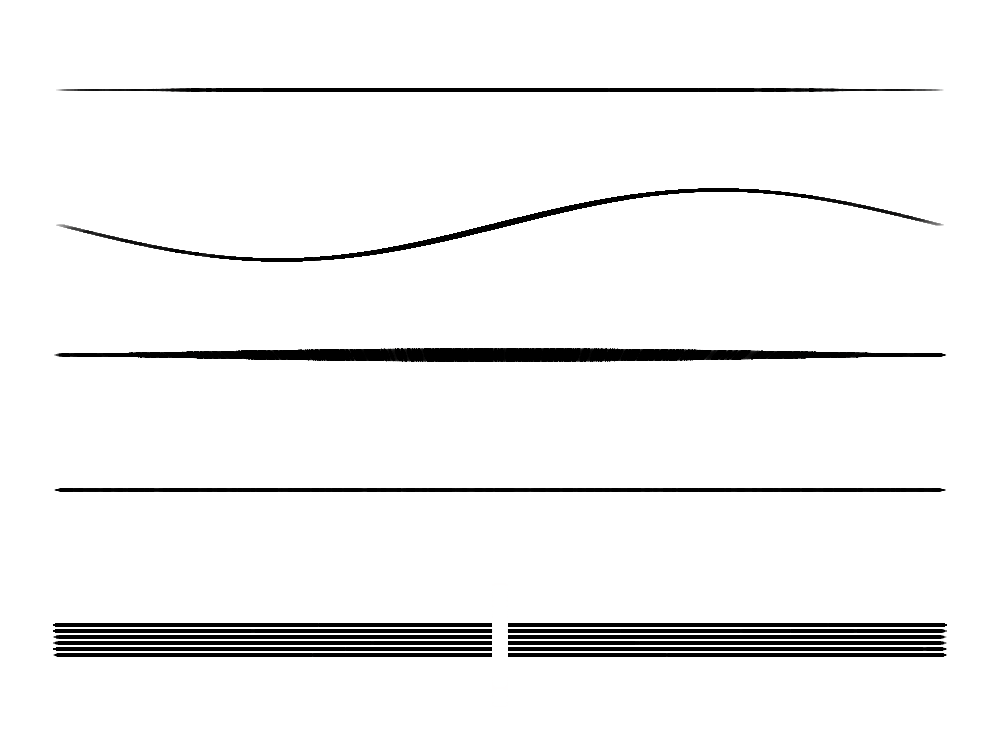
All sheets use the same sampled paths and pressure schedules on a 1000 × 750 surface. Read rows from top: pressure ramp; curved taper; constant pressure with tilt/rotation input; three repeated passes; six lines crossed by an eraser. Click a sheet for full resolution.
Default brush sizes and responses differ. These are comparable gesture inputs, not width-matched or density-matched quality scores. The diagnostic tip demonstrates additional controls. Erasing uses different mechanisms: MyPaint’s brush eraser versus Easel’s deposit-lifting mask. Tilt values are normalized for MyPaint and rotation is converted from degrees to turns.
Easel compressed charcoal
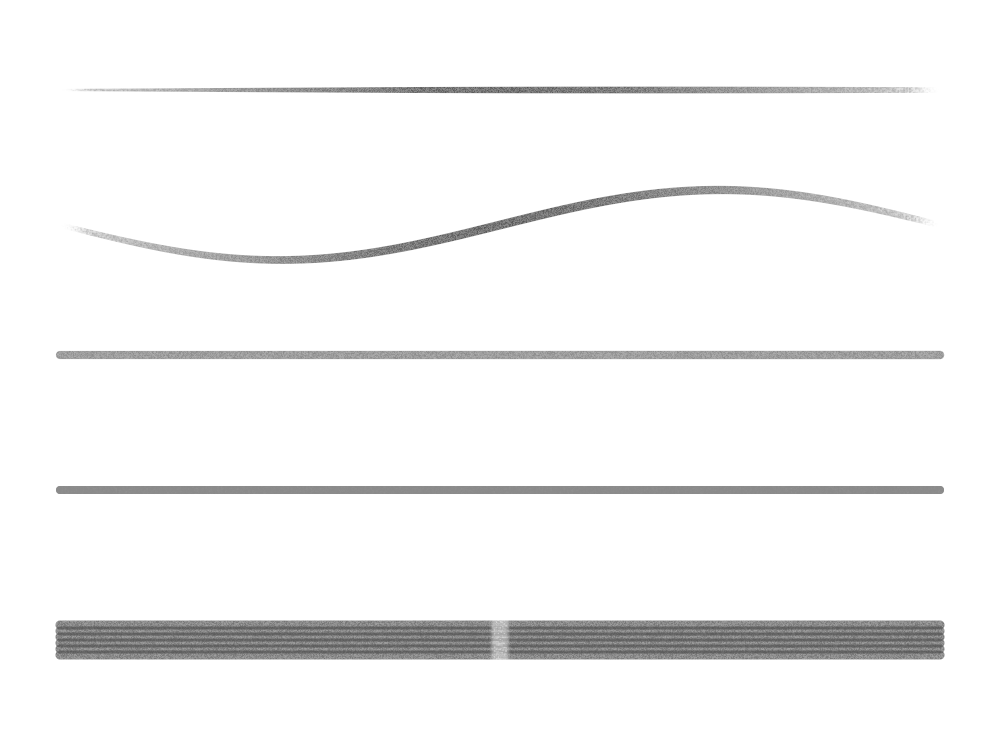
MyPaint · Tanda charcoal 01
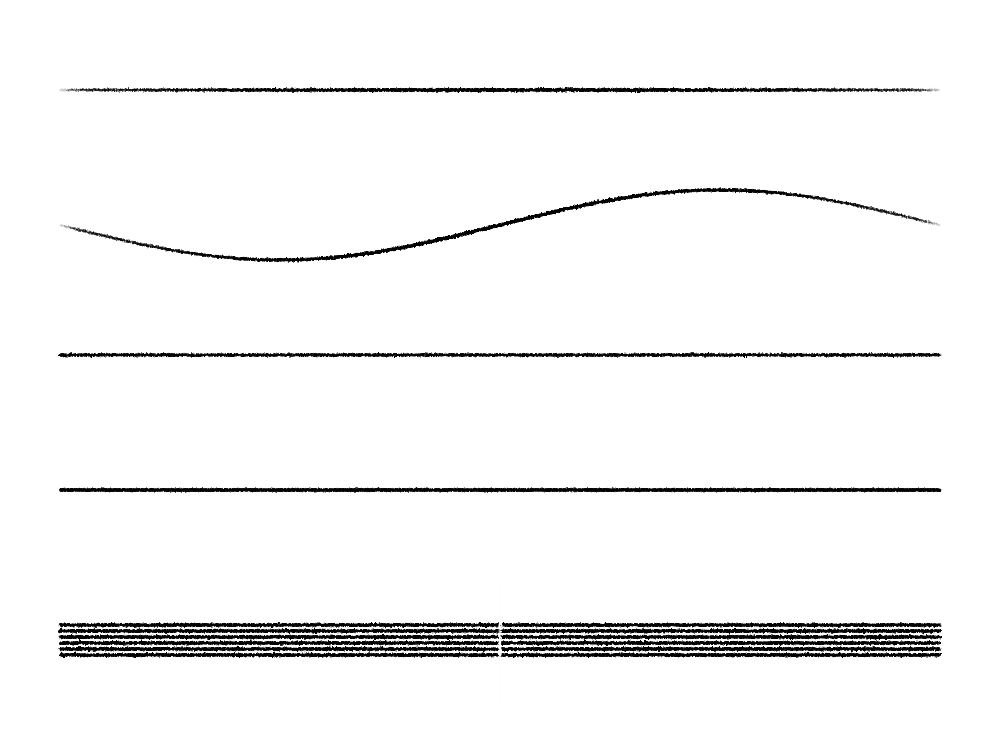
MyPaint · Classic pencil
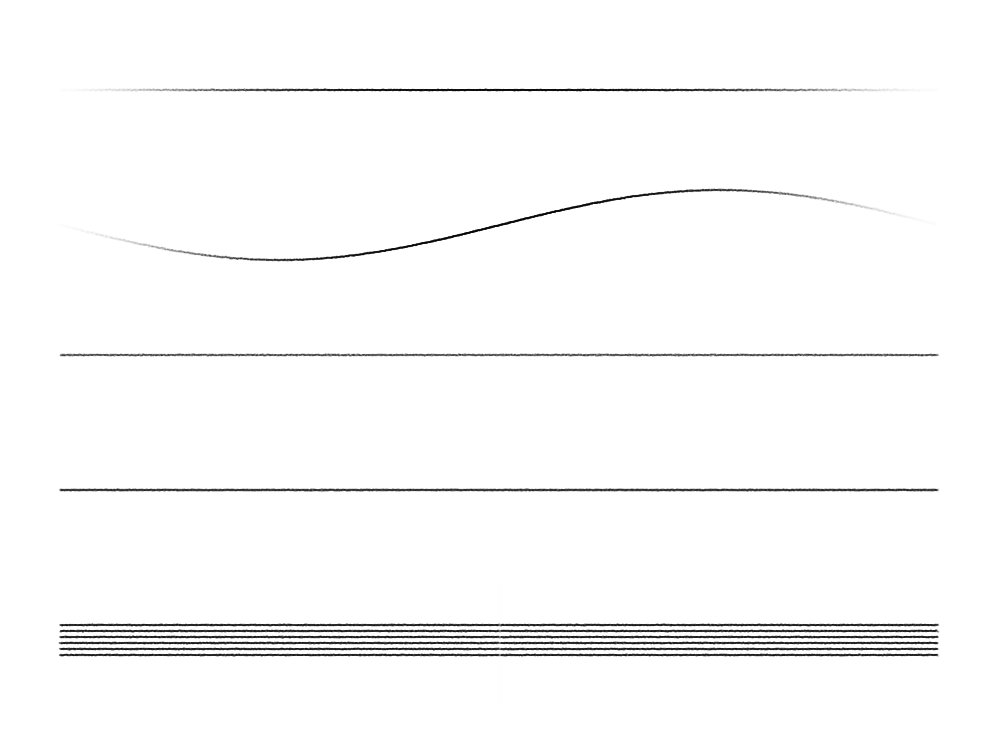
MyPaint · diagnostic rotating tip
What the sheets establish—and what they do not
MyPaint’s pencil yields a thin line with visible pressure taper; the charcoal preset yields a darker, irregular narrow edge. Easel’s default charcoal broadens through wear and remains comparatively uniform along the curve. Those are visible behaviors under these settings, not judgments of each engine’s maximum ability.
The configured MyPaint tip makes orientation an explicit input rather than approximating it by changing a round stroke’s width. Initial adapter tests exposed startup filtering and angle-unit issues; those were corrected before the final sheets. The stock charcoal replay was byte-identical on a second local execution. This does not prove cross-platform determinism, interrupt/resume equivalence, or all-preset reproducibility.
We have not demonstrated wet mixing, smudge fidelity, faithful charcoal physics, superior whole drawings, or a trained painter. No AI authored these gestures. No U03 image was used, transformed, or continued.
Candidate review
| Candidate | Evidence level | Relevant capability | Disposition / gap | Evidence |
|---|---|---|---|---|
| libmypaint | Built and rendered locally | Direct stroke API; pressure, time, tilt, rotation, configurable dabs. Native fixed tiled surface exercised. | Best-supported immediate drawing prototype. No native Easel material state; surface/brush state restoration still needs testing. | Primary source |
| Rebelle 8 Pro / Motion IO | Official interface verified; not run | Pointer events, presets, material settings, load/save of simulation-related data. | Wet-media evaluation priority. Not installed; account registration required. Motion IO is a separate application with separate commercial terms; do not equate its permissions/features with Pro WebSockets. | Primary source |
| Krita | Official API verified; not run | Node.paintLine has endpoint pressure; paintPath uses the active brush. Many brush engines. | Retain as mature open-source app candidate. Continuous per-sample tilt/rotation is not established by these path methods. Not installed locally. | Primary source |
| Ciallo / CialloResearch | Source and research located; not run | GPU-rendered textured vector strokes; editability is central. | Important architecture comparator. Current app uses Godot/C# and lists Windows requirements; app/source licensing must be checked per component. Not a wet-paint simulator. | Primary source |
| DiffVG | Official source reviewed; not run | Differentiable curves: optimization can adjust geometry against an image objective. | Geometry assistance, not charcoal physics. Build and objective quality still untested on this machine. | Primary source |
| CLIPasso | Official implementation reviewed; not run | Reference-to-Bezier sketch optimization, with stroke-count abstraction. | Useful translation comparator, not the default artist. CC BY-NC-SA 4.0 implementation; output resemblance is not artistic success. | Primary source |
| Paint Transformer | Official implementation reviewed; not run | Feed-forward stroke prediction; official inference code and external weights. | Secondary planner baseline; no demonstrated dry-media control. Official repository says training code is available by contacting authors. | Primary source |
| Stylized Neural Painting | Official implementation reviewed; not run | Optimized stroke-based image reconstruction. | Secondary planner baseline. Reconstruction goals and preset stroke vocabulary differ from open-ended making; implementation has noncommercial share-alike terms. | Primary source |
| Birth of a Painting | Author project examined; implementation not verified | Differentiable strokes, texture synthesis and smudging. | Research watchlist. A convincing reconstruction demo is not a verified deployable engine. | Primary source |
| RealBrush | Primary research examined | Synthesis from captured physical strokes and interactions. | Strong alternative to inventing more procedural noise. Implementation/data availability and licensing not verified here. | Primary source |
| Wetbrush | Primary paper located | GPU bristle-level painting simulation. | Wet-media research reference. A paper does not establish a reusable package or local GPU compatibility. | Primary source |
| Sousa & Buchanan | Primary paper examined | Observational pencil, blender and eraser models. | Material-model reference rather than a modern turnkey instrument. | Primary source |
Decision gates
- Control: test independent pressure, width, orientation and speed at matched output scale. Verify erasure and smear as separate operations.
- State: compare uninterrupted rendering with save/reload/continue, including brush state and any wet simulation. Keep both commands and native checkpoints.
- Drawing: only then compare the same observational task with the painter using each viable instrument. Record actual commands and inspect marks close-up as well as the whole.
- Artistic judgment: choose for specificity, sensitivity and useful revision. Neither resemblance scores nor numbers of controls settle this.
The next implementation should be a small command adapter around the proven MyPaint API, with independent stroke geometry and material settings. Do not replace all of Easel with it yet: wet-media behavior and checkpointing remain unproven. Rebelle requires an installed, registered app or trial before rendering can be vetted; Motion IO licensing differs from Pro’s still-image WebSocket use. No account was created or purchase made.
Research method and limits
This review follows official repositories, API documentation and author research pages. It distinguishes renderer/materials, geometry planning and critique. Candidates were screened for programmable control, editable history, available implementations and medium relevance. No exhaustive claim to “best available” is made; practical rendering evidence currently covers Easel and libmypaint only.
Foundational physics is not the only route. RealBrush suggests building from captured material examples; Ciallo suggests keeping textured strokes editable as geometry. Both deserve consideration before committing to a larger hand-built simulator.