Visual stages, comparisons and decisions from the original run. Internal prompts, operating documents and downloadable implementation files are omitted. Some interactive comparisons are shown as separate images.
The Floor Takes It
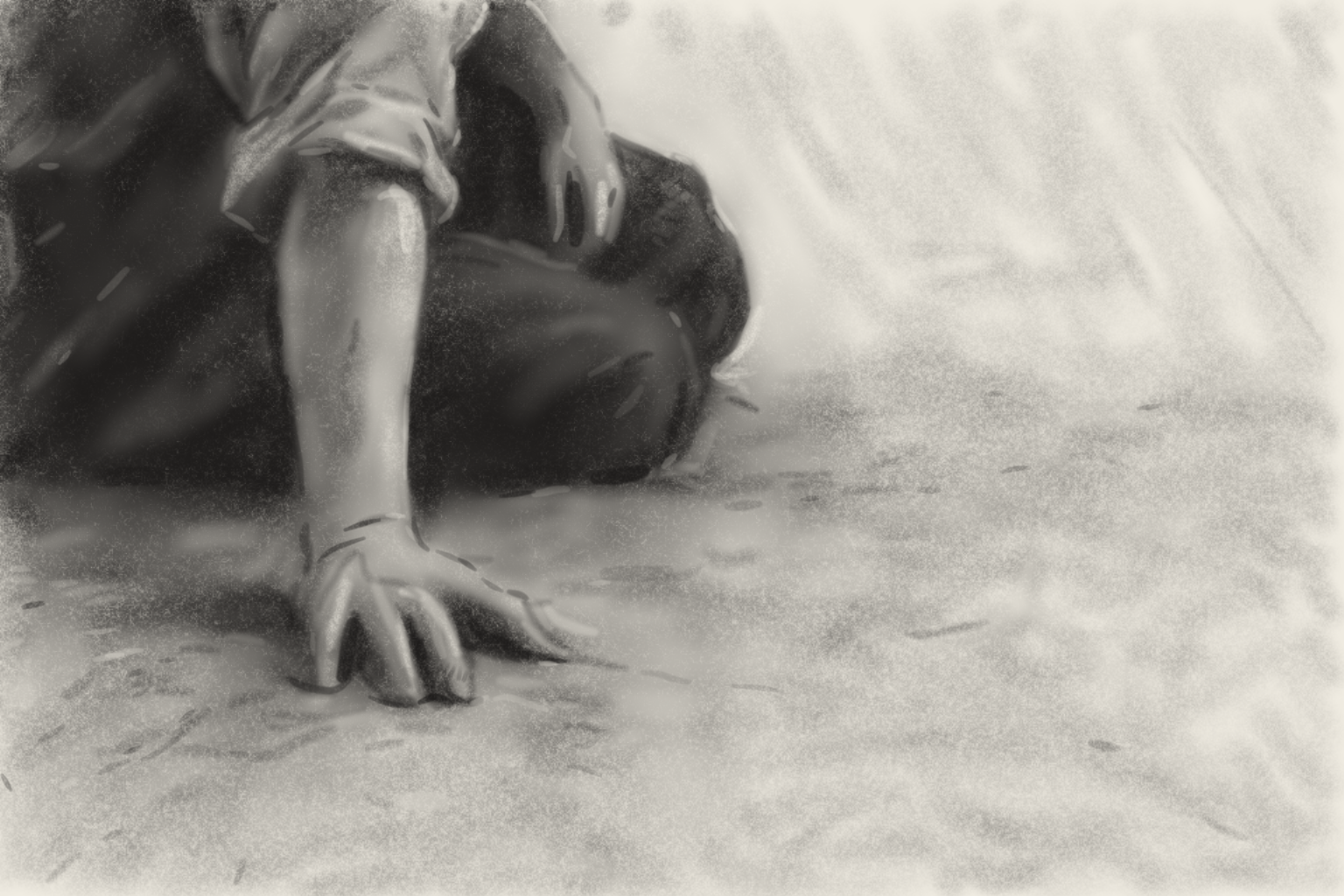
A clothed adult sits on the floor. One hand carries weight; the other has no task. The picture asks whether support can become its subject through the contact of palm, body and floor.
Finding a different relation
The twelve panels vary viewpoint, crop and scale. Reading them together also reveals a repeated default: a neatly described academic figure, similar body type, and busy clothing. This is one generated contact sheet with twelve panels, not twelve independent model samples.
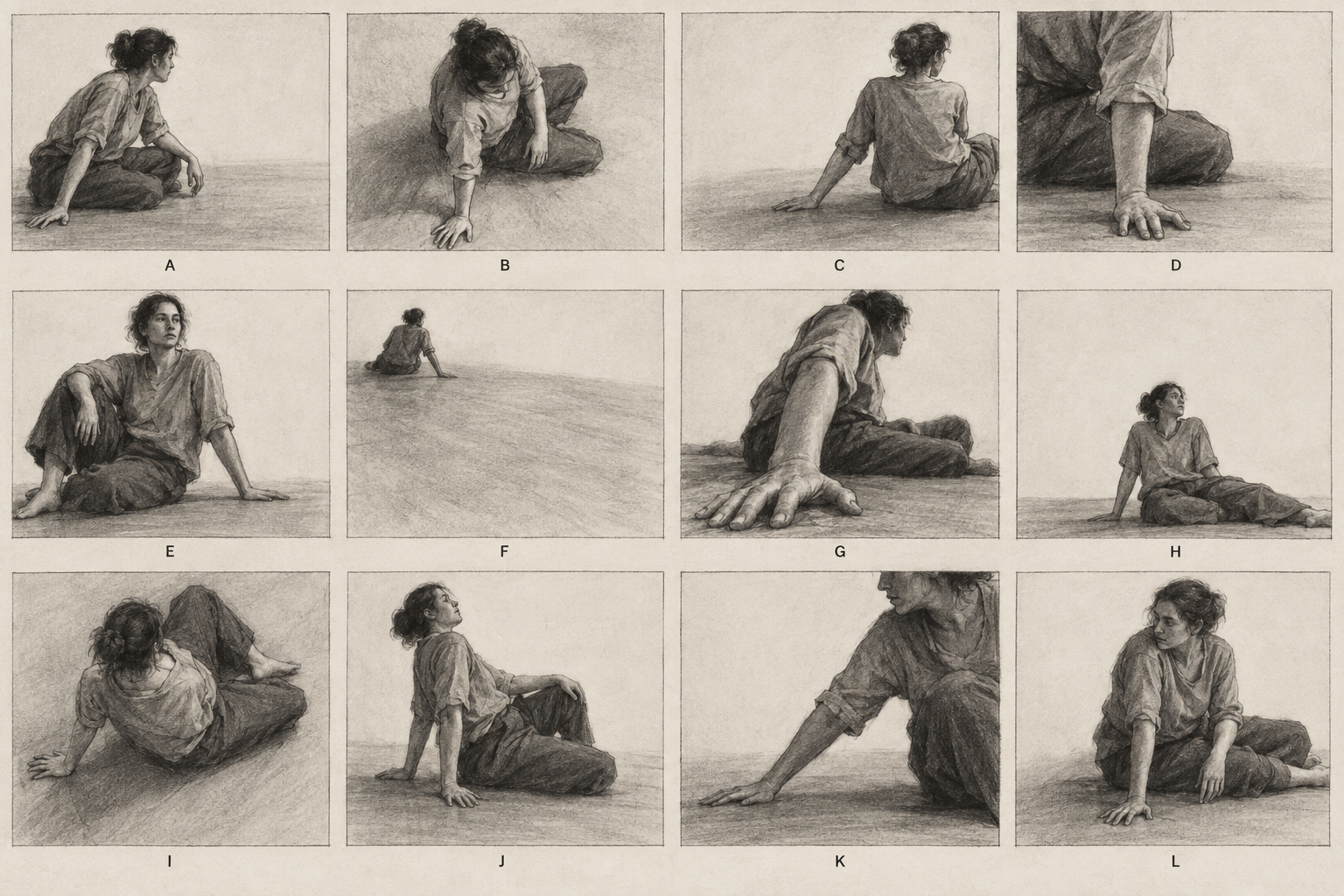
D was selected for its relation of support. The face leaves the frame because of viewpoint. The wrist and palm have to do the expressive work. The standalone plan develops that crop, but retains more fabric and floor detail than requested.
Process & methods
The assistant wrote the brief, read the study set and selected D. The built-in image generator made the sheet and a separate visual plan. The local Hands-based controller then drew on a blank scalar canvas. Generated pixels were not pasted onto that canvas.
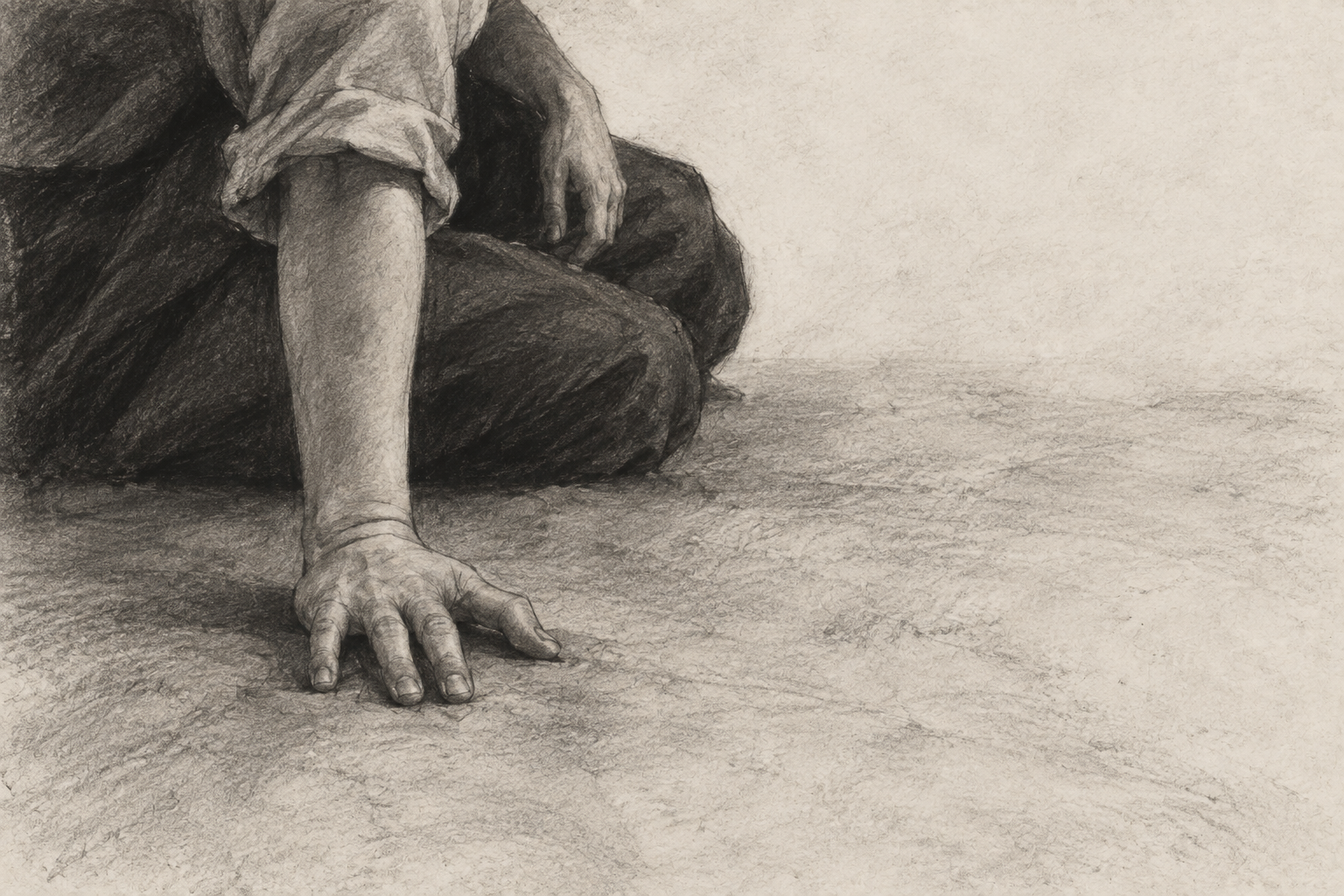
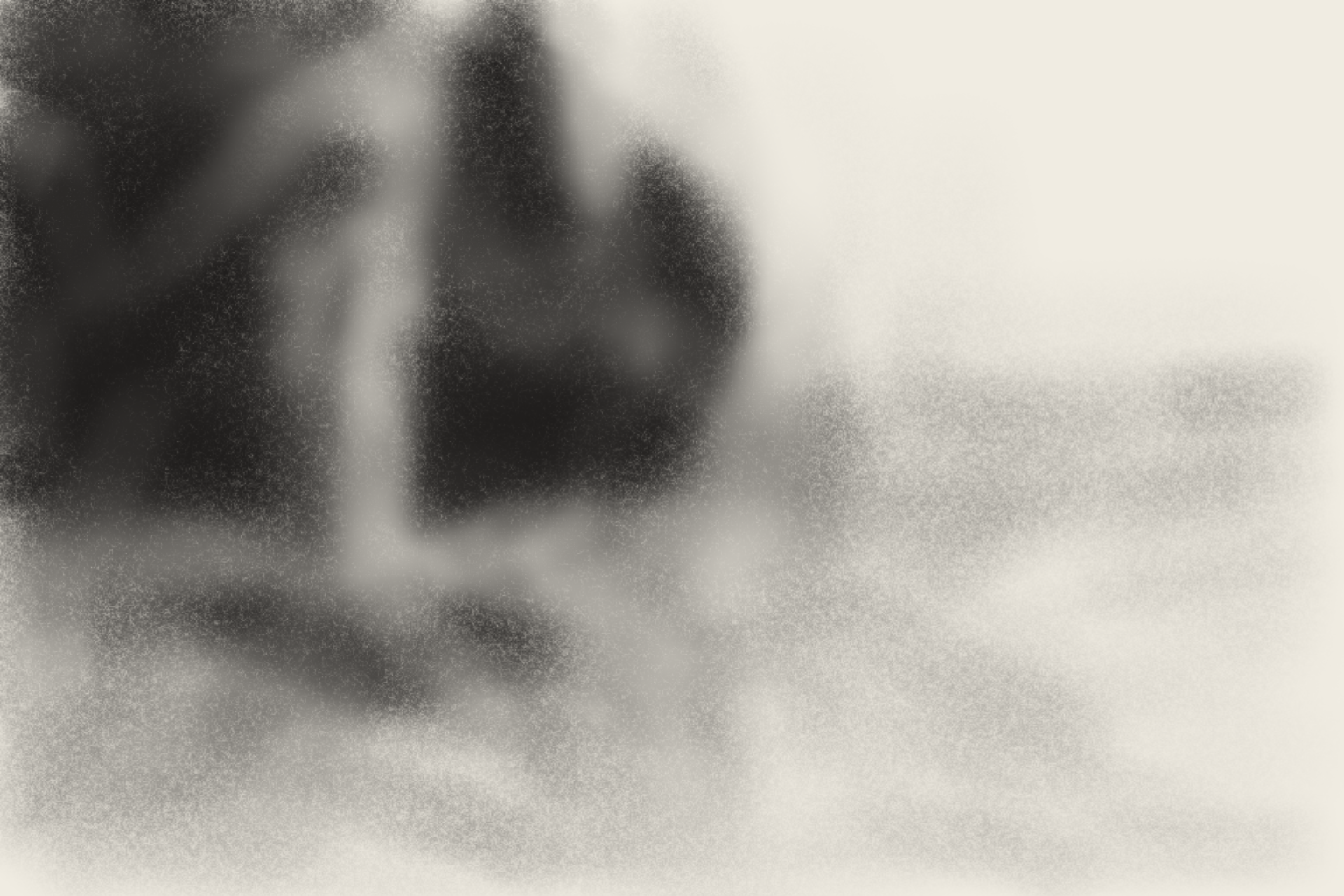
The controller used a 300-pixel planning view for the broad foundation, then a 600-pixel view for finer marks. Each candidate was rendered and assessed against the target’s pixel and gradient error; the planner reobserved the actual canvas every 32 accepted marks. Fixed tonal mapping preserved the plan’s values. The current repertoire comes from the Hands charcoal vocabulary, with a restricted broad-stick foundation.
The two stages formed one uninterrupted sitting. There was no critic interrupting each group of marks. This controller follows a visual target; it does not independently understand anatomy or decide artistic direction. The assistant’s critique below reads the actual output.
| Stage | Accepted commands | Attempts | Execution stop |
|---|---|---|---|
| broad | 305 | 8,400 | no-useful-actual-marks |
| current | 795 | 17,333 | attempt-budget |
Both stages replayed exactly on this runtime. The fine stage’s attempt limit ends this execution, not the artwork. A lower target error is evidence of closer execution, not of stronger art.
Δ — the weight is not settled
The crop is worth keeping: the dark body and descending arm establish a clear relation, and the two hands have different functions. But the native marks weaken the very contact the drawing depends upon.
- Missing digit: only four digits are clearly accounted for in the planted hand. The external visual plan already has this unresolved anatomy; the native drawing inherits it. The assistant missed this before execution. We cannot presume a hidden fifth digit without coherent overlap evidence.
- The planted fingers become rounded tubes and the palm arches visually; contact reads less convincingly than in the external plan. This damages the central idea of support.
- The right floor is an evenly active field of smudges and short marks. Its extent survives, but its quiet interval does not.
- The clothing remains a heavily modeled dark mass while the arm becomes smoothly modeled. This gives a polished surface hierarchy rather than the intended selective drawing.
Next transformation: establish credible five-digit structure or coherent occlusion in the proposal, and reconsider palm contact, the seated dark mass and the open floor together. The hand needs to act as a compressed support plane; the floor needs a deliberate interval of quiet. More finger detail alone would not answer that. A revised visual plan and its native execution would both need to demonstrate the change.
Retention: first working checkpoint retained. Route: Δ. No completion claim, no artistic Hold, and no further revision executed in this sitting. U03 remains a separate work.
The record
All artist and critic readings here are assistant-authored. The image generator supplies visual proposals; the native engine supplies the recorded drawing. This is an explicit, inspectable process, not an independently running critic system.