Visual stages, comparisons and decisions from the original run. Internal prompts, operating documents and downloadable implementation files are omitted. Some interactive comparisons are shown as separate images.
Bundled development cycle · 12 transfer branches · 7 sitting stages · 7 passing suites
The tools work together.
The larger planner is still missing.
What was built
A sequential sitting runner combines connected, pressure-varied marks, paired tonal transitions and removal on one persistent canvas. Later passages must respect earlier measured commitments, globally protected regions and a whole-sitting change limit. If they fail, the complete passage is rolled back. Observation stages measure without marking.
The regression test deliberately follows a softened edge with an incompatible darkening passage: the new runner rejects the second passage and restores the earlier canvas exactly. This is tested control over accumulated decisions. It is not a critic deciding which artistic commitment deserves to survive.
The integrated sitting
Intention: let the window read as an interval of light; connect its dark sill, ease the inner jamb transition, and reduce competing window marks. Preserve the jug and foreground hand. These choices, regions and thresholds were authored by the assistant.
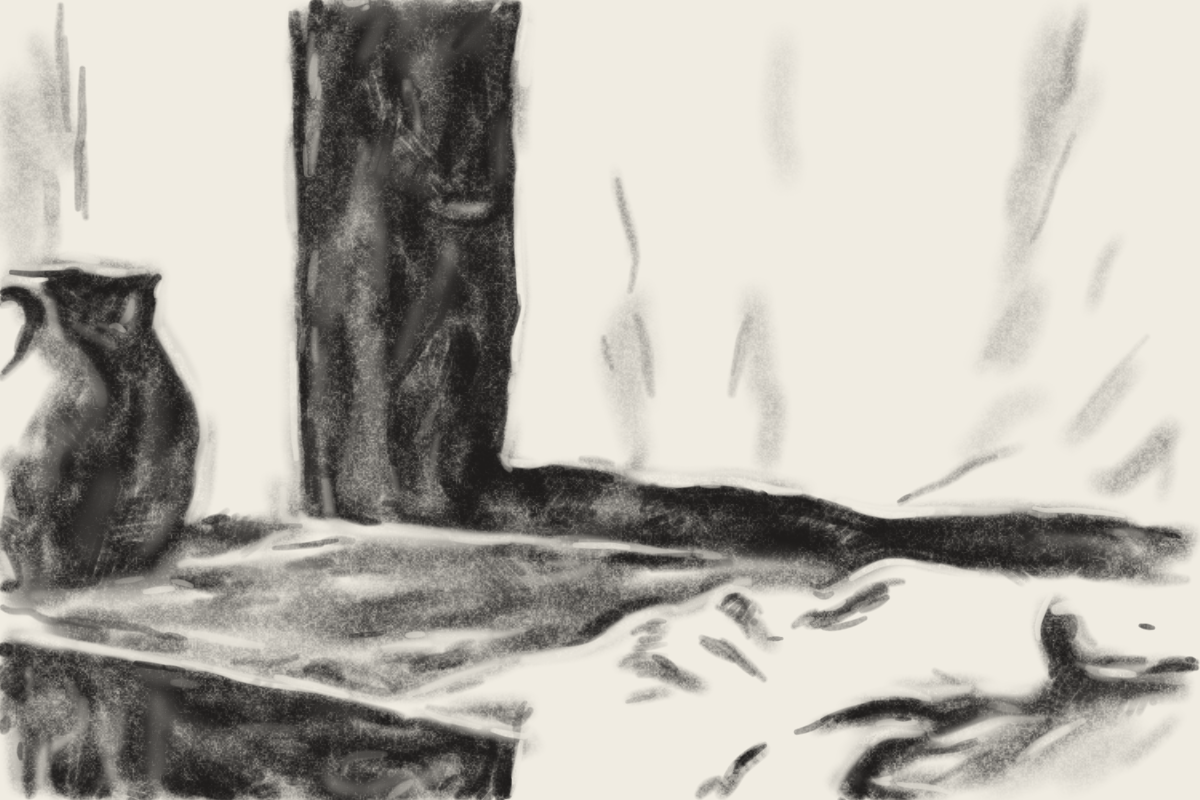
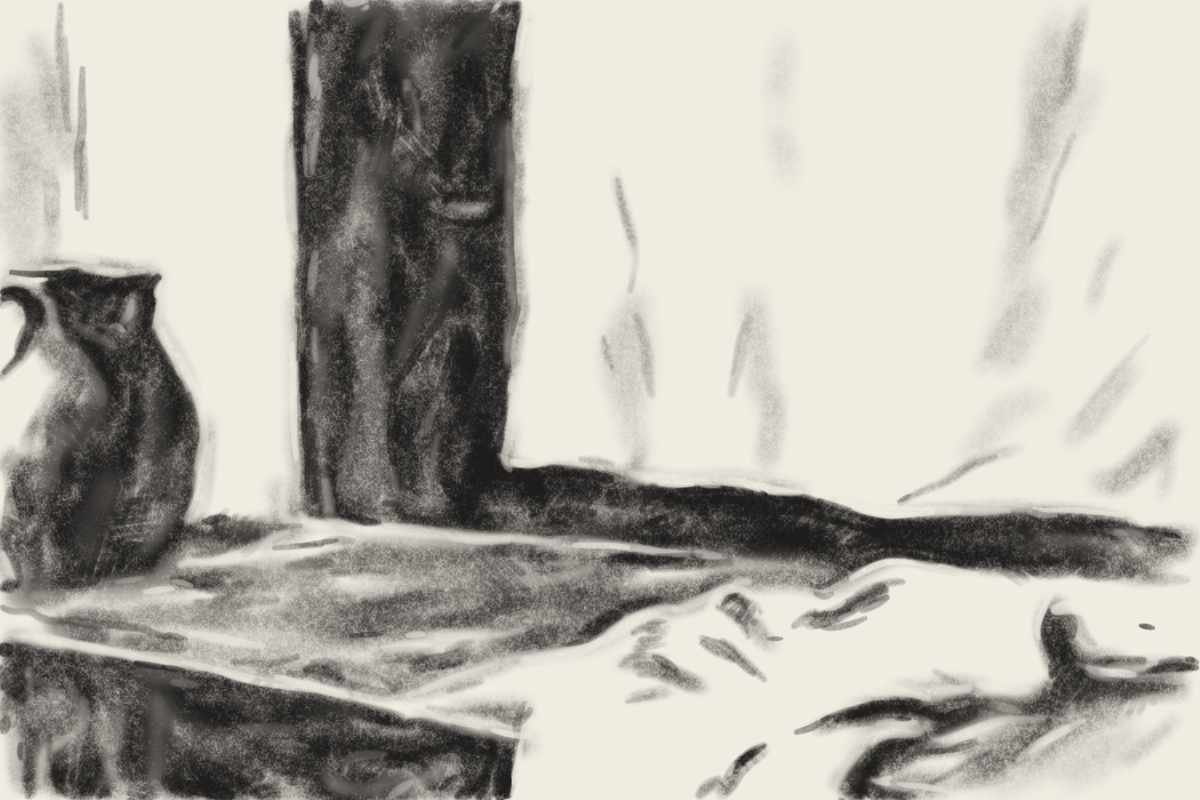
The window edge becomes slightly softer and the sill more connected. The removal passage has little visible effect on competing window marks. The overall image remains substantially the same. This demonstrates compatible local actions, not the larger transformation the project seeks.
| Stage / preview | Commands | Measurement | Stop |
|---|---|---|---|
| observe-source | 0 | observation only | no marks |
| join-sill | 24 | 76.0% local loss reduction | round-budget |
| release-window-edge | 16 | 54.9% local loss reduction | round-budget |
| observe-relations | 0 | observation only | no marks |
| reserve-window | 5 | 4.1% local loss reduction | no-admissible-intention-gain |
| continue-transition | 10 | 19.9% local loss reduction | no-admissible-intention-gain |
| observe-final | 0 | observation only | no marks |


Three observation stages, four work stages. Commands include 24 connected, pressure-varied segments, 26 paired-transition commands and 5 lifts. Local action limits are experimental compute caps, not artistic stopping rules. Final measurements retain all prior commitments within their authored tolerances.
Transfer changes the recommendation
These three historical canvases have edge regions not used in the preceding policy evaluation. They are not unseen subjects, independent samples or a broad generalization benchmark. At each region we compare lift-only with paired strokes, then challenge protection and weak-evidence refusal.
Paired strokes reduce contrast loss more on the vertical window edge, but less on the two sloping edges. The diagonal gestures still read as overlapping patches. No single policy earns promotion as a universal default. The paired policy stops early on both sloping cases when further proposals fail admission or gain.
Gesture
Field
Interior
| Source | Policy | Commands | Loss reduction | Stop |
|---|---|---|---|---|
| gesture | lift | 18 | 35.0% | round-budget |
| gesture | paired | 4 | 15.3% | no-admissible-intention-gain |
| gesture | keep-firm | 0 | 0.0% | no-admissible-intention-gain |
| gesture | weak-evidence | 0 | not located | insufficient-edge-evidence |
| field | lift | 18 | 30.4% | round-budget |
| field | paired | 6 | 14.4% | no-admissible-intention-gain |
| field | keep-firm | 0 | 0.0% | no-admissible-intention-gain |
| field | weak-evidence | 0 | not located | insufficient-edge-evidence |
| interior | lift | 18 | 25.9% | round-budget |
| interior | paired | 12 | 45.1% | round-budget |
| interior | keep-firm | 0 | 0.0% | no-admissible-intention-gain |
| interior | weak-evidence | 0 | not located | insufficient-edge-evidence |
Firm-edge tests: an explicit protected rectangle blocks changes even when the contrast objective requests them. This proves obedience to an authored decision; it does not prove the machine recognizes which edge should stay firm. All three weak-evidence branches also remain exactly unchanged.
How the sitting works
- Read the current canvas and resolve the next authored intention. No generated raster target is used in this cycle.
- Render candidate native actions, evaluate their local effects and select admissible gains using the existing motor policies.
- Re-measure every previous commitment on its original guide and edge baseline. Also check global protected pixels and cumulative change from the sitting’s original source.
- If the passage breaks a commitment, restore the pre-passage pixels and committed command list. Retain attempted commands and the reason in the evidence record.
- On observation stages, measure without adding marks. Review the actual images separately before making any artistic retention decision.
Commitment tolerance is absolute squared normalized-ink loss; the global budget is mean absolute raw scalar-value change across the full canvas. Neither is an artistic quality metric. A new stage can relocate its own guide, but cannot move an earlier stage’s measurement guide to disguise regression. Firm commitments can impede a necessary rupture: revising them requires a new explicit plan.
Readiness and next direction
The instrument can now execute a small authored programme without silently undoing earlier gains. That is sufficient to stop this bounded tool-development round. It cannot yet decide a visual hierarchy, invent materially different structural directions, or choose its own operations from seeing the whole work.
The next substantial build is the image-level planning loop: propose distinct structural directions, select operations, inspect the rendered consequences, then keep or revise the plan—including abandoning a prior commitment when the artistic direction requires it. Use a new work to evaluate that loop. More small improvements to the current local loss will not supply the missing decision-making.
The Floor Takes It remains closed on sitting 05. None of these experiments is promoted into it.
Records and verification
Seven suites passed, including whole-passage rollback, observation no-op, persistent protection and incompatible-intention rejection. Twelve branch replays and the integrated replay are exact. Six refusal branches are pixel-identical to their sources; global protection and final commitments pass. Native images were inspected; this HTML’s local links were checked, but browser layout was not rendered.