Visual stages, comparisons and decisions from the original run. Internal prompts, operating documents and downloadable implementation files are omitted. Some interactive comparisons are shown as separate images.
New: integrated runner and retained U03 sitting →
Build the mass.
Then decide the marks.
Six fixed tonal targets × three drawing policies. Six verified existing baselines, twelve new renders. Calibration, implementation and replay checks are included in this one review. No new generated plans; U03 is unchanged.
Recommendation: integrate a choice, not one universal replacement
Adopt the hybrid for substantial tonal masses. A broad foundation makes fields and interiors more coherent; the finer pass restores important edges. All six hybrid results have lower target error than the current policy, by 5.4–74.8%, but the visual benefit is uneven.
Keep the current policy for sparse gestures. The two-gesture plan gains little visually. The denser gesture gets extra repeated shading in open paper under the hybrid. Lower target error does not justify sacrificing withholding.
Use broad-only as a foundation. It establishes mass with relatively few strokes, but its soft edges lose narrow forms and intervals. It is not a general finished-drawing method.
Compare the actual drawings
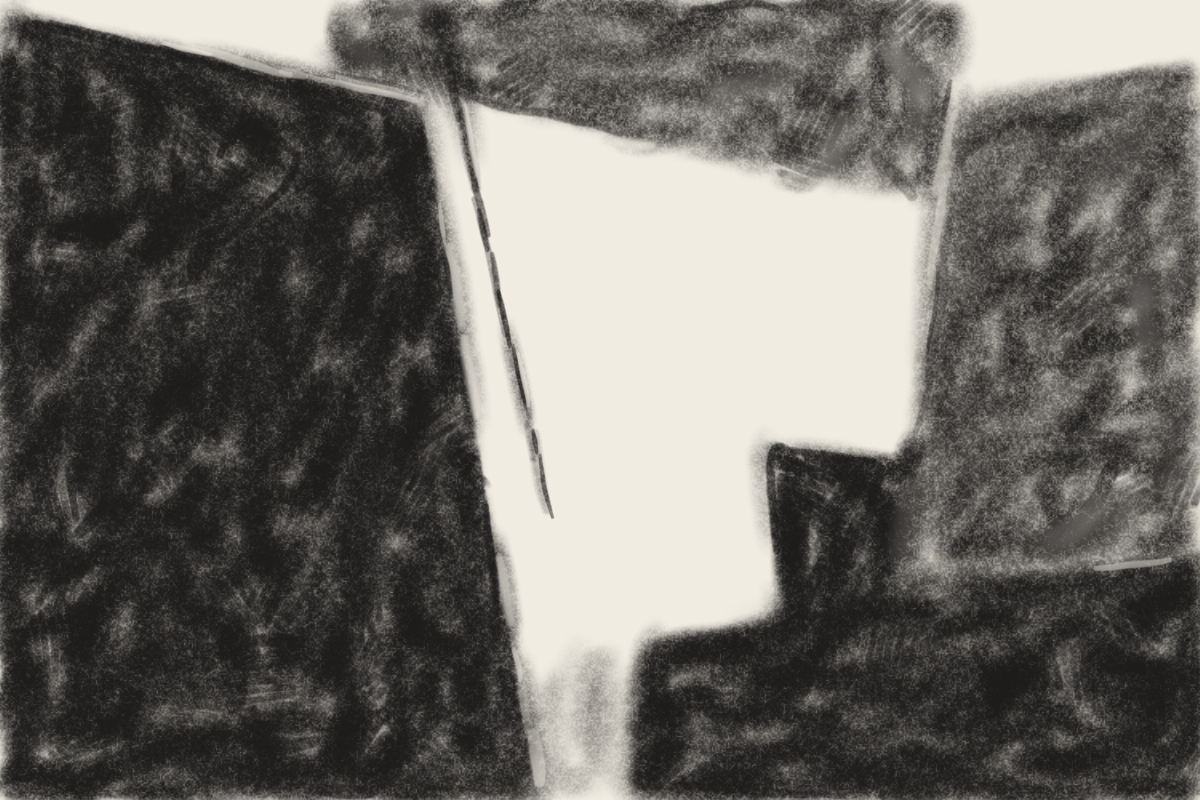
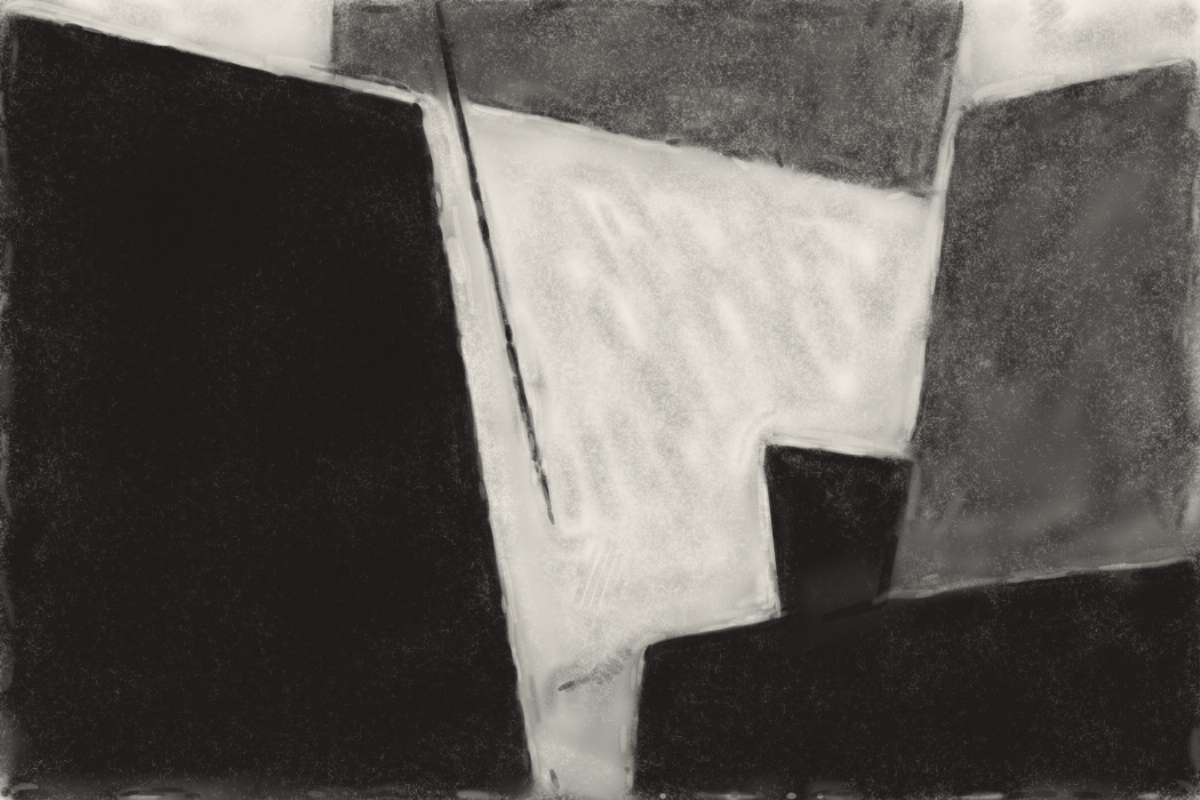
See the unchanged plan and hybrid foundation
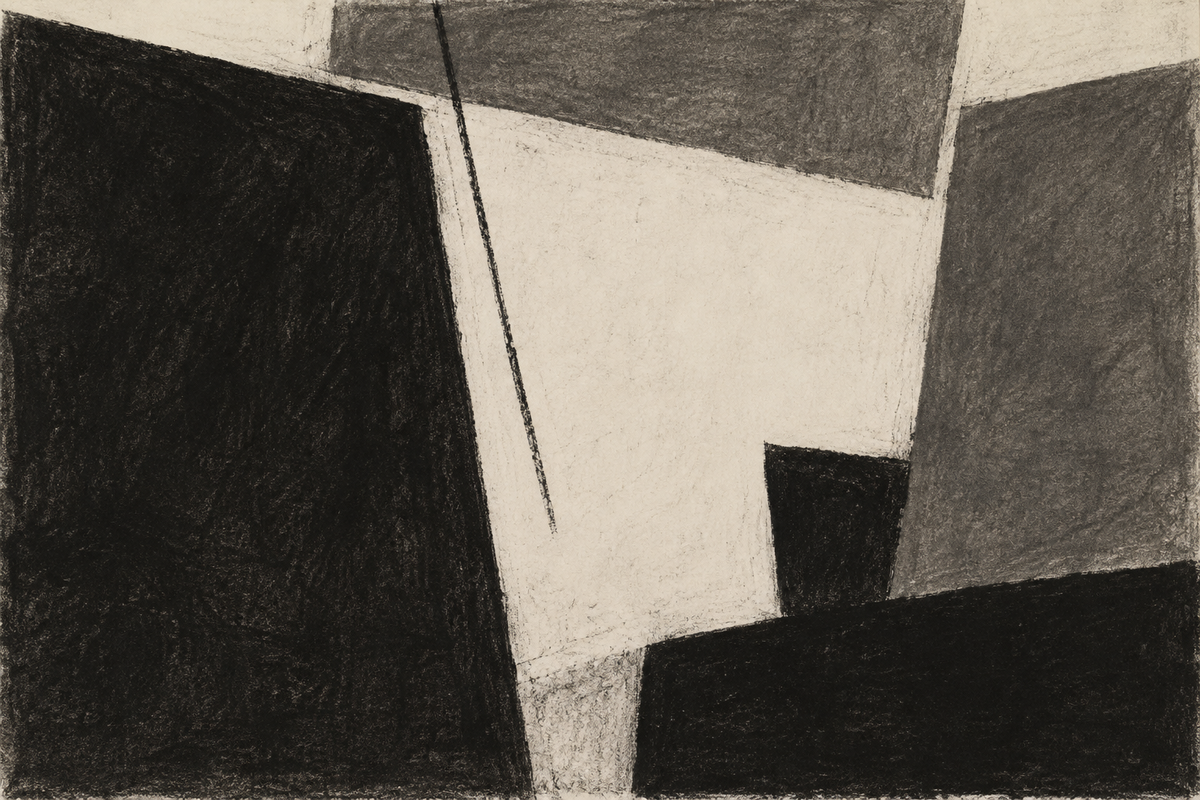
How this round works
- Hold the six generated plans and fixed-anchor tone conversion unchanged. Use the same 1200 × 800 canvas and paper seed 11.
- Reuse the six current-method outputs from the tonal correction batch. Their canvas, source-plan and dependency hashes were checked. They are not rerun or counted as new drawings.
- Create a restricted vocabulary of broad sticks: widths 24 and 48 at the 300px planning scale, length 240, two pressures, low taper, soft edges, no jitter, and along-path or fixed-horizontal modes. At canvas scale, nominal widths are 96 and 192 pixels before pressure/taper.
- Broad-only gets the original total caps: 2,400 accepted marks or 26,000 attempts. It can stop early when it finds no useful marks.
- Hybrid begins with up to 800 broad marks / 8,667 attempts, then continues on that same canvas with up to 1,600 original-vocabulary marks / 17,333 attempts at a 600px view. No raster crop is pasted.
- Each candidate is judged on its actual raster effect against the fixed tonal target. The finer pass is target-error-driven, not an independently thinking artist choosing what to describe.
- Replay all twelve new command streams and compare exact scalar hashes. Review the eighteen whole images together, including cases where a lower error makes the artistic result worse.
This compares composite policies: vocabulary, planning scale and staging change together. It does not prove brush width alone caused the gains. Equal caps do not mean equal accepted strokes or equal runtime. The broad renderer is the existing native stamp engine with a restricted vocabulary; this is not a new fluid or pigment simulator.
Calibration and validation
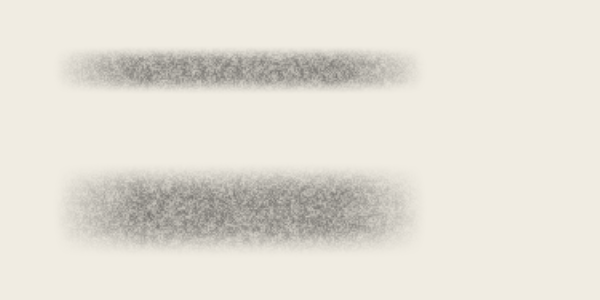
Three paper seeds confirm increased support with width, bounded scalar values and exact serialized replay. Every new full render also replays exactly. Completed receipts stay within shared total caps. Calibration establishes basic behavior, not perceptual flatness. .
All comparisons
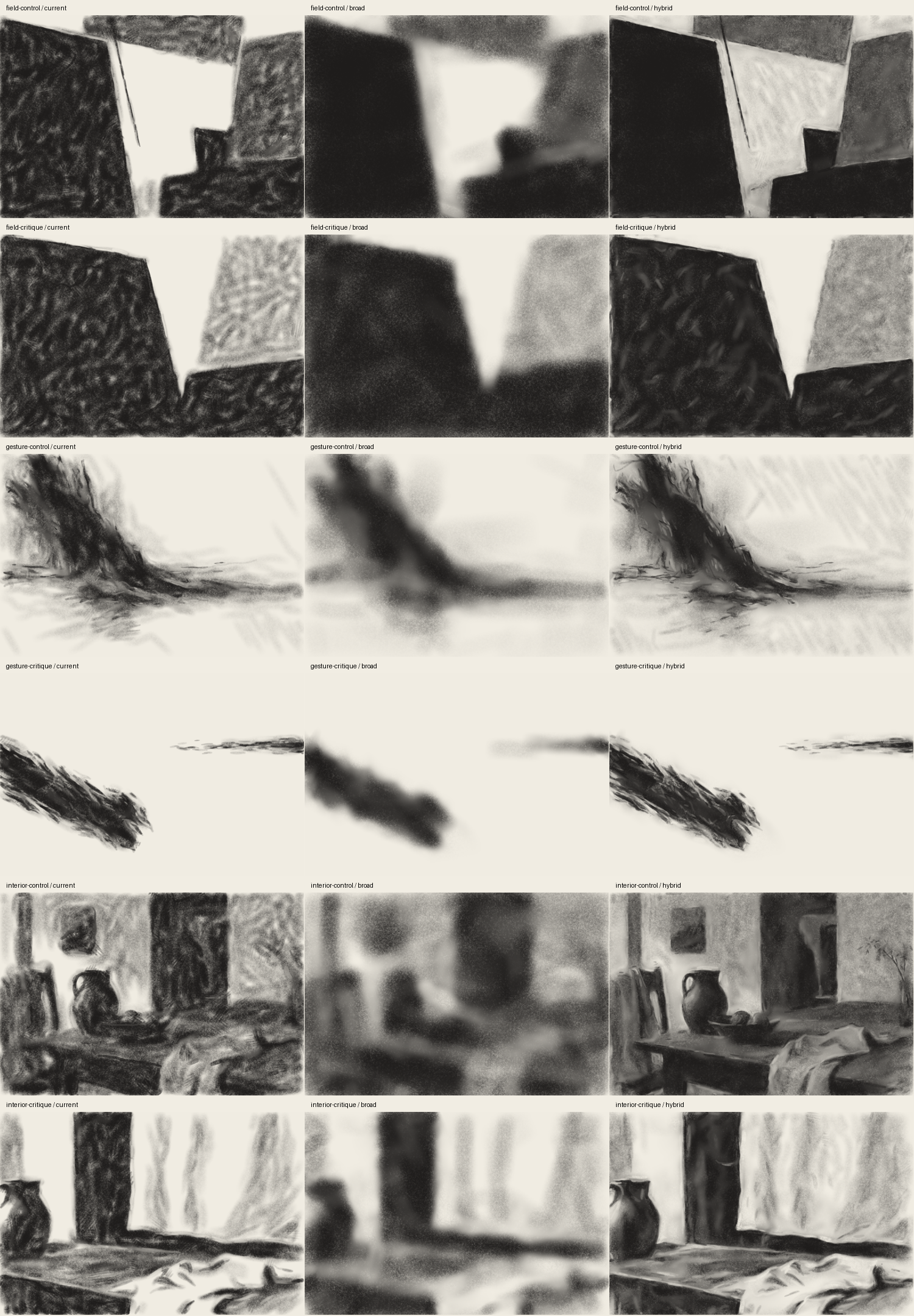
Common-target measurements
Each row is scored against the same fixed-anchor target as its two partners. Reduction is relative to the current policy. These are execution measurements, not artistic scores.
| Plan | Policy | MSE | Reduction | Marks | Attempts |
|---|---|---|---|---|---|
| field-control | current | 0.01403 | +0.0% | 972 | 12000 |
| field-control | broad | 0.01078 | +23.2% | 269 | 6400 |
| field-control | hybrid | 0.00353 | +74.8% | 1270 | 23733 |
| field-critique | current | 0.01178 | +0.0% | 927 | 8800 |
| field-critique | broad | 0.01143 | +2.9% | 226 | 5200 |
| field-critique | hybrid | 0.00404 | +65.7% | 1230 | 22533 |
| gesture-control | current | 0.00861 | +0.0% | 832 | 17600 |
| gesture-control | broad | 0.00868 | -0.9% | 237 | 5600 |
| gesture-control | hybrid | 0.00476 | +44.7% | 1150 | 22933 |
| gesture-critique | current | 0.00228 | +0.0% | 1084 | 26000 |
| gesture-critique | broad | 0.00543 | -138.3% | 236 | 8400 |
| gesture-critique | hybrid | 0.00216 | +5.4% | 1377 | 25733 |
| interior-control | current | 0.01404 | +0.0% | 1070 | 16800 |
| interior-control | broad | 0.01246 | +11.2% | 337 | 7600 |
| interior-control | hybrid | 0.00461 | +67.2% | 1634 | 24933 |
| interior-critique | current | 0.00954 | +0.0% | 922 | 16800 |
| interior-critique | broad | 0.01353 | -41.8% | 392 | 10000 |
| interior-critique | hybrid | 0.00450 | +52.8% | 1485 | 26000 |
Progress and stopping point
The original 30-output round, six-output tonal correction, and this 18-cell plane-building round are complete. This round adds twelve new renders by reusing six valid baselines. No pending repair was hidden by the verdict.
Enough evidence to integrate: expose explicit tone conversion and current/hybrid construction policies in the studio runner, then conduct one complete artistic sitting with critique and retention. Another broad benchmark round is not required before that work.
Still unresolved: coherent individual gestures, restraint around incidental paper texture, autonomous selection of what to omit, colour, and performance outside these six plans. Hybrid is a useful instrument option, not a claim of top-tier artistic capability.