Visual stages, comparisons and decisions from the original run. Internal prompts, operating documents and downloadable implementation files are omitted. Some interactive comparisons are shown as separate images.
1 · Ω · rejected
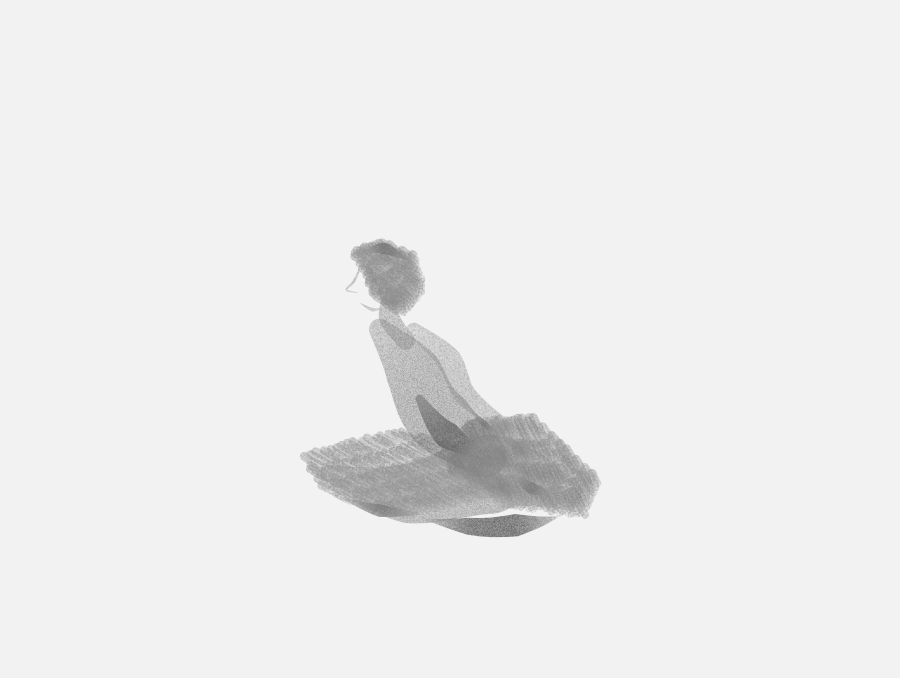
Assumption released: Release that scaffold, including the assumption that added lap mass can make its suspended parts bear weight.
Painter: accept — Build a broad seated base near the lower centre, with a short torso displaced left of its principal contact. Leave an exterior-connected paper notch between torso and folded thigh.
Consequence: The blank restart produces a different arrangement and avoids the former enclosed knee. Nevertheless, new-01 visibly installs an upper emblem above rounded, translucent deposits, with its strongest underside accent reading as a separate supporting shape. This fails the governing test despite the real change in orientation. Prior-01 through prior-10 are supplied as reviews rather than attached images; their reported recurrence informs this judgment but cannot establish direct visual equivalence.
Route and next direction
Choose blank paper as a refusal of the protected scaffold. With native Rust charcoal tools, establish an unequal compressed ground contact and build a broad folded lower body from it. Let the pelvis receive a shorter, oblique torso; keep the head responsive to that bearing rather than prescribing a bowed pose. Allow an open paper interval between the folded leg and torso to interrupt the mass, while exterior absence presses against its other side. Use blunt, directional charcoal contacts whose changes follow bodily planes. Gain a construction governed by support and counterweight; risk reduced immediate recognizability and a heavy closed mass; relinquish the inherited silhouette, placement and knee reach. U03 supplies evidence of folded bodily pressure, not a layout to preserve.
Reconstruct from blank around an unequal folded body whose principal bearing is embedded within its lowest plane. Let one leg turn across and partially obscure the pelvis while the torso presses into that turn; allow the head, scale and placement to follow this pressure. Test a compressed, interrupted mass against one substantial exterior-connected paper interval, sacrificing profile recognition and any neat underside crescent. Read the whole for mutual dependence: changing the torso's direction should require changing the folded support. The failed restart exposes the assumption that a broad base plus an oblique torso already constitutes counterweight; Delta can relinquish that assumption without another compulsory rupture.
2 · Δ · rejected
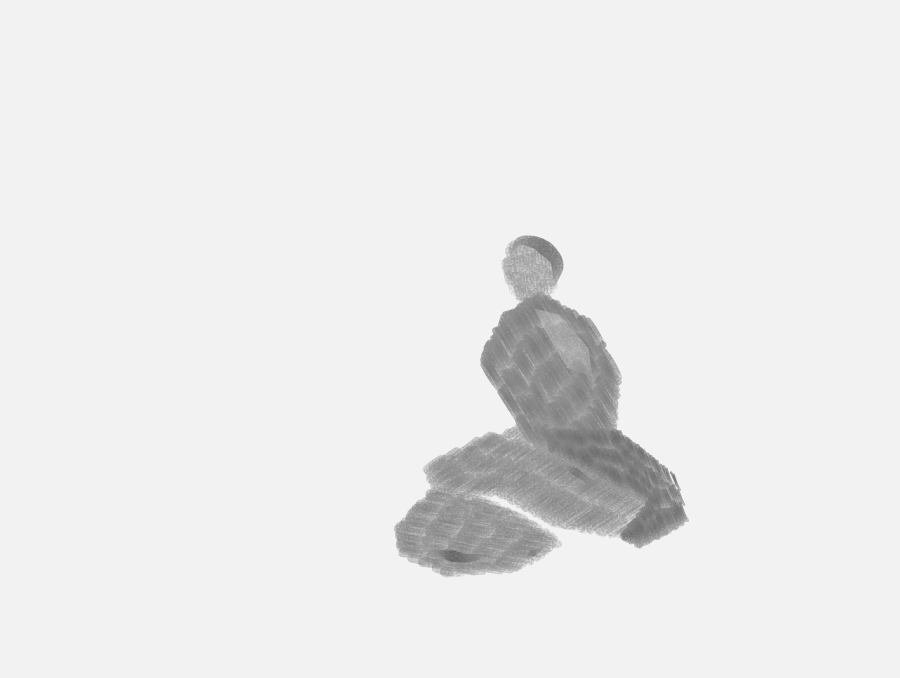
Assumption released: Release the hierarchy of upper figure over supporting base. Let folded limbs, pelvis and torso determine each other before recognition or a separate ground accent is secured.
Painter: accept — Build an unequal crossing thigh that obscures the pelvis, then receive the torso behind its rising edge. Keep a substantial exterior-connected interval between the torso and returning shin.
Consequence: New-02 reduces profile specificity and replaces the proposed fan with a more diagonal construction. Those changes are real, but the whole still assembles an upper mass over lower deposits. The pale slit and right dark terminal divide rather than explain support. The supplied reviews of prior-03 and prior-10 describe breadth repeatedly being accepted without earned overlap; new-01 records the same deeper assumption after a restart. Those historical images are not attached here, so their significance is reported recurrence rather than direct visual comparison. New-02 visibly fails the governing dependence test.
Route and next direction
Use blank and native Rust charcoal tools to construct the first alternative. Begin with the crossing folded leg and receiving pelvis as unequal, interlocking planes rather than a horizontal spread. Develop the torso through their overlap, allowing its angle, the head, scale and placement to change together. Make the lowest bodily plane carry an interrupted contact with the ground instead of adding a crescent beneath it. Let exterior paper enter between the leg's return and the torso so that the interval changes how the body bears weight. Charcoal direction must turn with those planes rather than repeat across them. Gain a body whose parts constrain one another; risk reduced immediate recognition and excessive closure; relinquish the emblematic profile, fan-shaped base and separate support accent. This is a whole construction from blank, not retention of new-01 for its changed silhouette.
Reconstruct from blank around a compressed hip and one folded leg that interrupts the torso's descent, allowing a different pose, scale and placement. Relinquish the broad lower spread itself: make a narrower, unequal bearing determine how far the torso can rise or lean, and let the other limb emerge through partial obscuration rather than become a second detached mass. Let paper enter where that fold changes direction, while bodily contact elsewhere keeps the interval from severing support. Recognition can follow this construction. Test whether moving the upper body would destroy the fold's visible pressure; reject another upper emblem over a band even if its marks or contacts improve.
3 · Δ · rejected
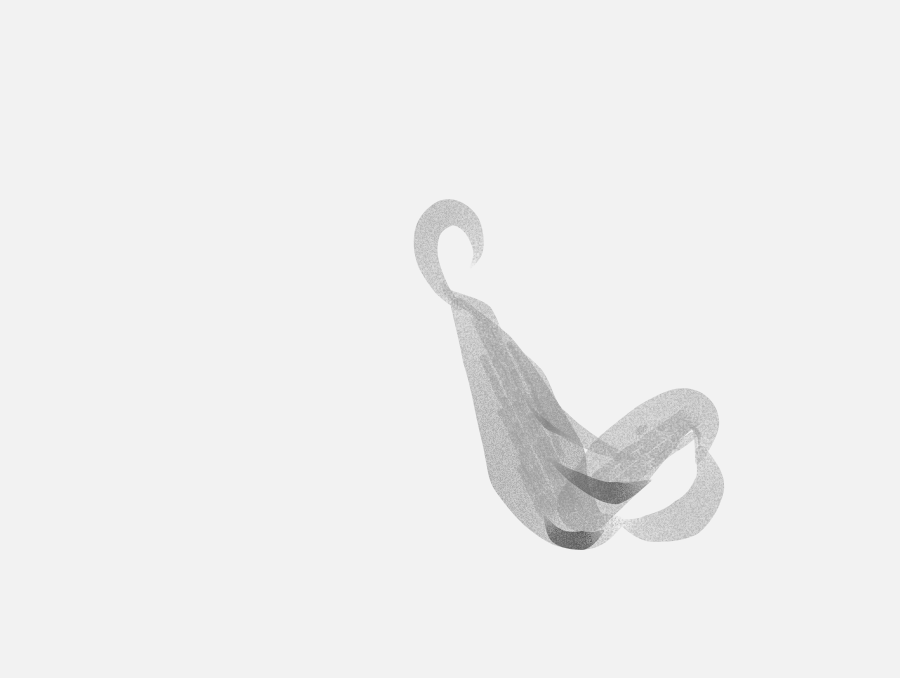
Assumption released: Release the division between upper figure and supporting base, including the expectation that an entering paper slit necessarily creates consequential absence.
Painter: accept — Construct flank, compressed hip and returning thigh as one interrupted turn. Displace the shoulder left of that bearing and return the legs toward the right edge.
Consequence: New-03 genuinely narrows the lower spread and returns a limb beside the flank. Its lowest dark also belongs more closely to the main deposition than the detached supports described in earlier reviews. These changes do not pass the governing test: rounded, tapering contacts still determine the anatomy, and the overlap dark crosses rather than reconstructs their relationship. Historical images are not attached in this turn; prior-08, prior-10, new-01 and new-02 establish reported recurrence, while new-03 directly shows the surviving convention.
Route and next direction
Choose the sideways construction from blank using native Rust charcoal and paper tools. Develop hip, flank and folded thigh together as one unequal bodily turn, with the legs returning beside the seated mass. Let shoulder displacement and head position follow that turn rather than crown it. Establish rest through a compressed interruption within the hip's lowest edge, with no separate underside shape. Allow exterior paper to press close along the returning legs and open more broadly beyond the shoulder; an internal gap is optional. Different charcoal pressures and directions should distinguish compression from release rather than cover each part with equivalent hatch. Gain a construction whose sideways bearing determines its occupied space; risk losing immediate leg recognition or producing a closed lump; relinquish the broad supporting spread, prescribed crossing-leg solution and mandatory paper notch. Neither rejected candidate is retained for its smaller gains.
Refuse the assumption that a continuous tapering charcoal path can serve as bodily unity. From blank, relinquish the head-to-flank stem and enclosing limb loop together. Test a compact body folded forward, with a broad back displaced across an obscured pelvis and one returning thigh interrupting that displacement. Establish occupation through unequal, interrupted masses and selective occlusion; let head recognition arrive only if this relationship requires it. Allow scale and placement to follow the fold, including substantially closer exterior clearance if it makes the displacement consequential. The visible test is whether the thigh's interruption changes the back's apparent load and whether moving either mass would destroy the bearing. Reject a newly oriented ribbon assembly. This rupture addresses the contact geometry that the present sideways reconstruction continues to protect, rather than prescribing another correction to its hip or loop.
4 · Ω · rejected
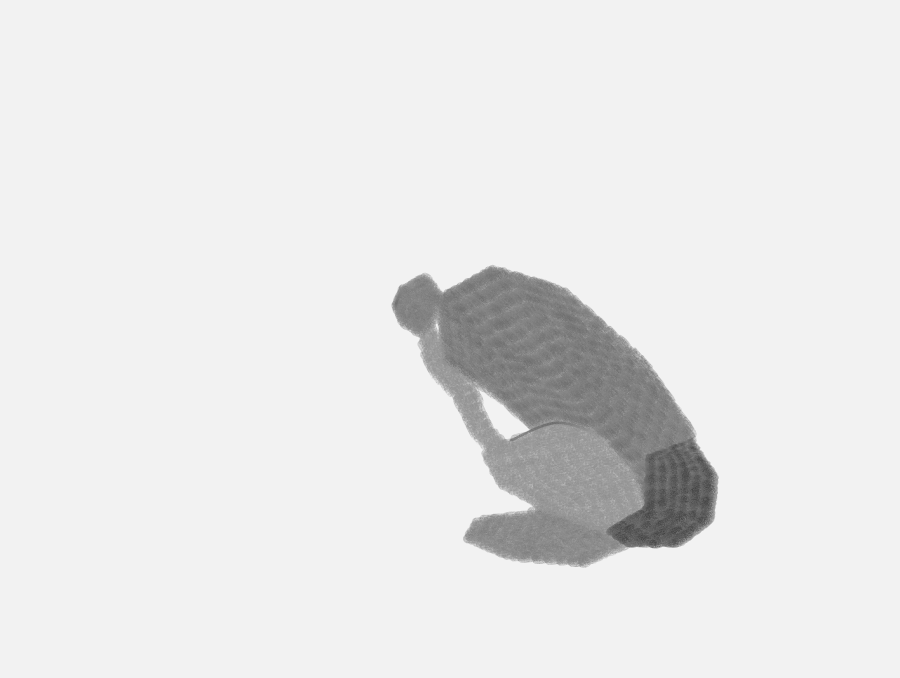
Assumption released: Relinquish continuity as the proof of unity. Permit interrupted, unequally valued masses to establish bodily dependence through actual obscuration and compressed contact.
Painter: accept — Construct a folded body with interrupted polygonal charcoal fields. A nearer thigh removes part of the descending back from visibility; an exposed compressed hip shares their lowest boundary.
Consequence: New-04 materially changes the construction: the enclosing leg loop is absent, a broad back replaces the narrow stem, and a lighter thigh actually obscures its descent. These are substantive departures, not merely obedience to polygonal operations. Yet the rendered fields soften into rounded, separately legible components. The dark hip terminates the assembly rather than visibly receiving displaced pressure, while the shin supplies another supporting shelf. The supplied reviews of new-01 through new-03 describe related substitutions of connection for load; those images are not attached here, so that recurrence is reported rather than independently verified. The governing test fails despite the clearer occlusion.
Route and next direction
Choose the compact construction from blank using native Rust charcoal and paper tools. Refuse the stem, basin and enclosing loop together. Establish a broad back and a nearer folded thigh as unequal masses: the thigh must obscure part of the back-to-pelvis descent, while a compressed exposed hip carries their ground bearing. Let charcoal contacts stop, break and change pressure at these encounters instead of drawing continuous paths around them. Allow scale and placement to arise from the fold; test closer exterior paper where the body turns, without prescribing a slit or an edge approach as proof of tension. Head orientation remains open; forward folding must arise from loading rather than signify vulnerability. Gain consequential occlusion and differentiated pressure; risk excessive closure and reduced recognition; relinquish flowing unity and the reassuring underside crescent. This Omega addresses a visibly recurring construction convention, not the number of rejected sittings.
Reconstruct from blank, relinquishing the division into complete back, light thigh, dark hip and supporting shin. Test a body whose principal turn is shared by torso and folded leg: let the torso descend partly out of sight behind a near thigh, then let a small exposed pelvic plane emerge lower and on a different axis, visibly compressed between that thigh and its own ground boundary. Allow the back's inclination, leg reach, scale and placement to change together; a more upright or more lateral bearing is legitimate. Sacrifice the complete pale thigh lobe and separately legible hip cap. The test is whether obscuration changes the apparent direction and pressure of the hidden body, rather than merely placing one shape in front of another. Delta can develop the real discovery of unequal visibility without retaining this failed assembly or prescribing another overlap accent.
5 · Δ · rejected
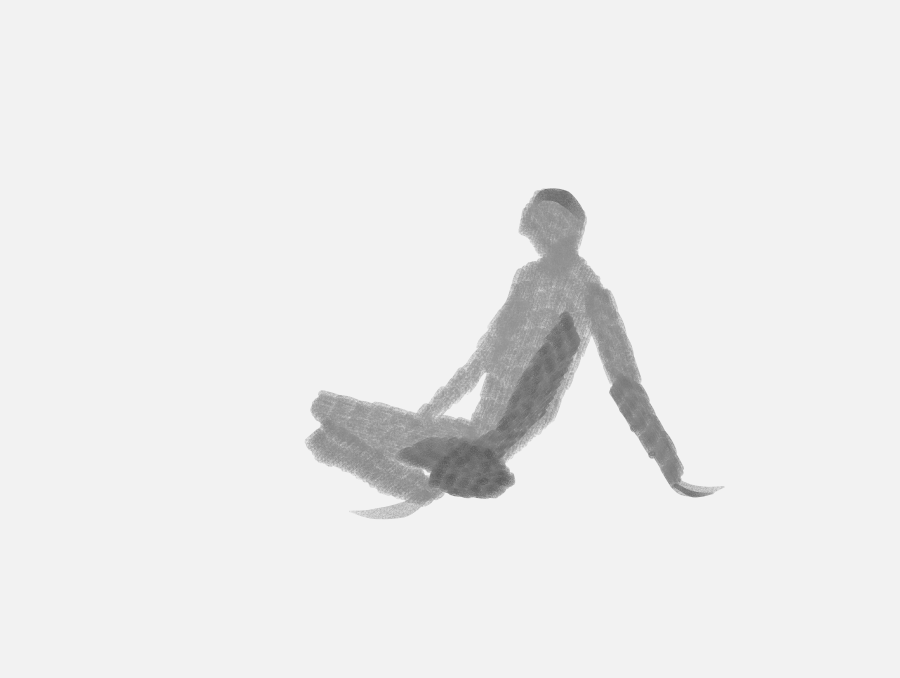
Assumption released: Release the single receiving-mass solution. Seated weight may be distributed between a hip and a braced arm, making an open interval part of the body's support relationship rather than an inserted notch.
Painter: accept — Construct a lateral seated bearing in which a displaced shoulder divides its load between a stretched arm to the right and a compressed seat to the left. Fold the legs away from the hand.
Consequence: New-05 makes a substantive departure by opening the body toward a distant hand. Its arm-flank interval is more consequential to occupied space than an inserted internal notch. Nevertheless, the governing distributed-bearing test fails: the right hand reads as a tapered flourish, the seat as a rounded cap, and the folded legs as overlapping bands. The supplied histories of prior-10 and new-04 describe lower terminals repeatedly standing in for bearing; new-05 visibly preserves that convention within a changed pose. Those earlier images are not among the three current attachments, so this historical comparison relies on their supplied assessments.
Route and next direction
Choose the lateral, braced construction from blank using native Rust charcoal and paper tools. Develop the shoulder, supporting arm and seated hip together: let the shoulder fall between unequal contacts rather than crown a lower base. Turn the folded legs away from the arm so their reach changes the torso's balance. Allow a substantial exterior-connected paper interval beneath the arm and beside the flank; its shape must follow the bearing, without a prescribed triangle or enclosing outline. Establish the hand's contact through the arm's direction and interruption at the ground, and let the hip rest through its own unequal lower boundary. Use charcoal pressure and direction to distinguish the stretched supporting arm, turning torso and compressed seated contact. Scale, placement and head orientation remain open. Gain distributed bearing and an absence bounded by bodily action; risk a diagrammatic tripod or disconnected limbs; relinquish the complete pale thigh, hip cap, shin shelf and compulsory hidden-pelvis solution. New-04's occlusion is useful evidence for another construction, but its failed assembly is not retained.
Reconstruct from blank with the braced contact determining the whole body's turn before recognizable components settle into place. Test a body rotated toward one planted palm: let the shoulder press across that contact, the trunk twist away toward a short seated boundary, and one folded leg interrupt that twist rather than extend a broad base. Allow head, scale, placement and limb visibility to change together. Relinquish the rounded seat cap and paired lower bands, including the present reclining silhouette if necessary. Paper should open through the unequal directions of those pressures. Judge whether moving the hand would require reconstructing shoulder, seated turn and leg fold together; reject another complete seated figure supplied with an accessory arm. This develops new-05's discovery of exterior-connected space without retaining its failed assembly.
6 · Ω · rejected
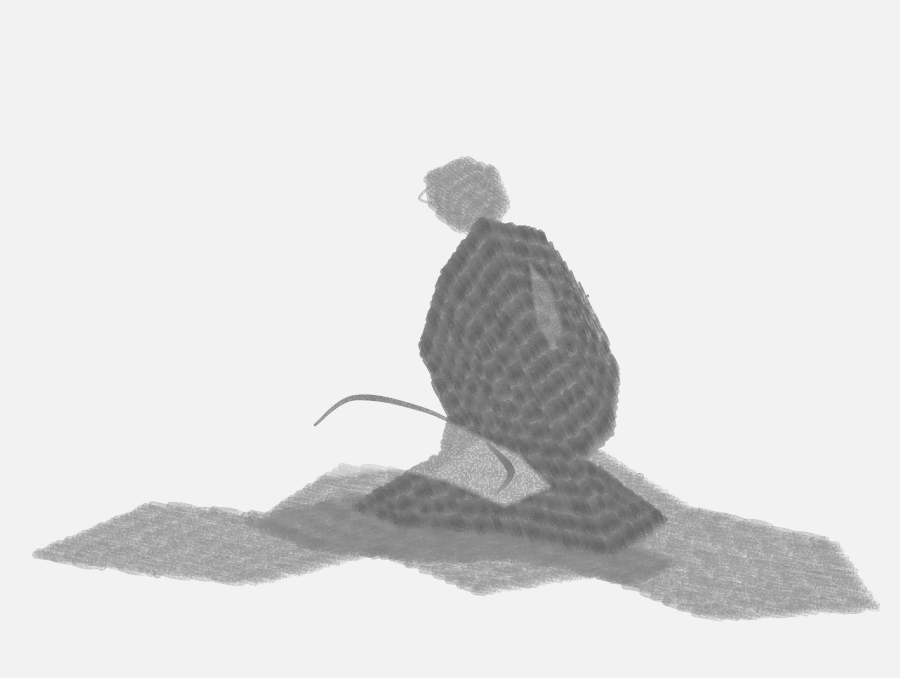
Assumption released: Relinquish the self-contained silhouette and the separation of bodily construction from ground. Absence need not surround a complete figure; it can determine where body and ground become distinguishable.
Painter: accept — Omega relinquishes the complete silhouette. A wide, uneven charcoal occupation will rise into a displaced trunk, while one exposed thigh plane cuts across it. The seated underside will remain partly indistinguishable from ground.
Consequence: New-06 genuinely introduces a substantial ground field and loses portions of the lowest bodily boundary. Those changes expand the pictorial question beyond isolated anatomy. Nevertheless, the actual image realizes the stated failure risk: a bounded torso sits on a dark mound within a wider landscape-like patch. The proposed thigh interruption becomes a thin arch and pale junction; it does not reconstruct the torso's descent. The supplied reviews of prior-10, new-04 and new-05 document repeated acceptance or pursuit of supporting terminals; their images are not attached here, so that recurrence is textual evidence. New-06 directly shows the supporting-terminal convention surviving the shared-field construction.
Route and next direction
Choose the shared body-and-ground construction from blank using native Rust charcoal and paper tools. Establish an uneven ground passage that continues into the seated body's compressed underside, then develop a folded thigh and displaced trunk through changes of value, direction and selective paper exposure within that relationship. Let part of the bodily boundary disappear into ground while another part separates decisively; avoid enclosing the woman or installing a dark platform beneath her. Scale, placement, pose and head visibility must follow this encounter. U03 offers a source for unequal cloth masses and lost boundaries, without requiring its arrangement. Gain resistance between occupation and absence; risk an undifferentiated charcoal patch or landscape with an attached figure; relinquish the isolated silhouette, accessory bracing arm and requirement that a pelvic terminal explain all bearing. This refusal addresses a convention visible across the attached history, rather than the number of rejected sittings.
Reconstruct from blank by making the ground cross the body's occupation rather than extend beneath it. Test a substantially enlarged lateral seated fold intersected by an oblique ground passage: let that passage obscure part of the lower body, while a broad thigh turns across it and carries a displaced, shortened trunk. Allow cropping, head omission and unequal clearance to follow this encounter. Sacrifice the upright torso emblem, thin knee arch and compact basal mound together. Establish a consequential distinction between one bodily edge emerging against paper and another becoming unreadable within ground; neither must complete a component. Judge whether changing the ground's direction would require rebuilding the seated fold and trunk, and whether the exposed light redirects the mass rather than decorating it. This develops the shared-field question through a different spatial relationship, without preserving the failed candidate or adding further ground around its silhouette.