The series: does critique move the defaults?
Repeated runs from one proposition (S21's block-in) under enforced conditions, a protocol frozen before the first run, final states blinded and read by two annotators.
SR1: critique on and off
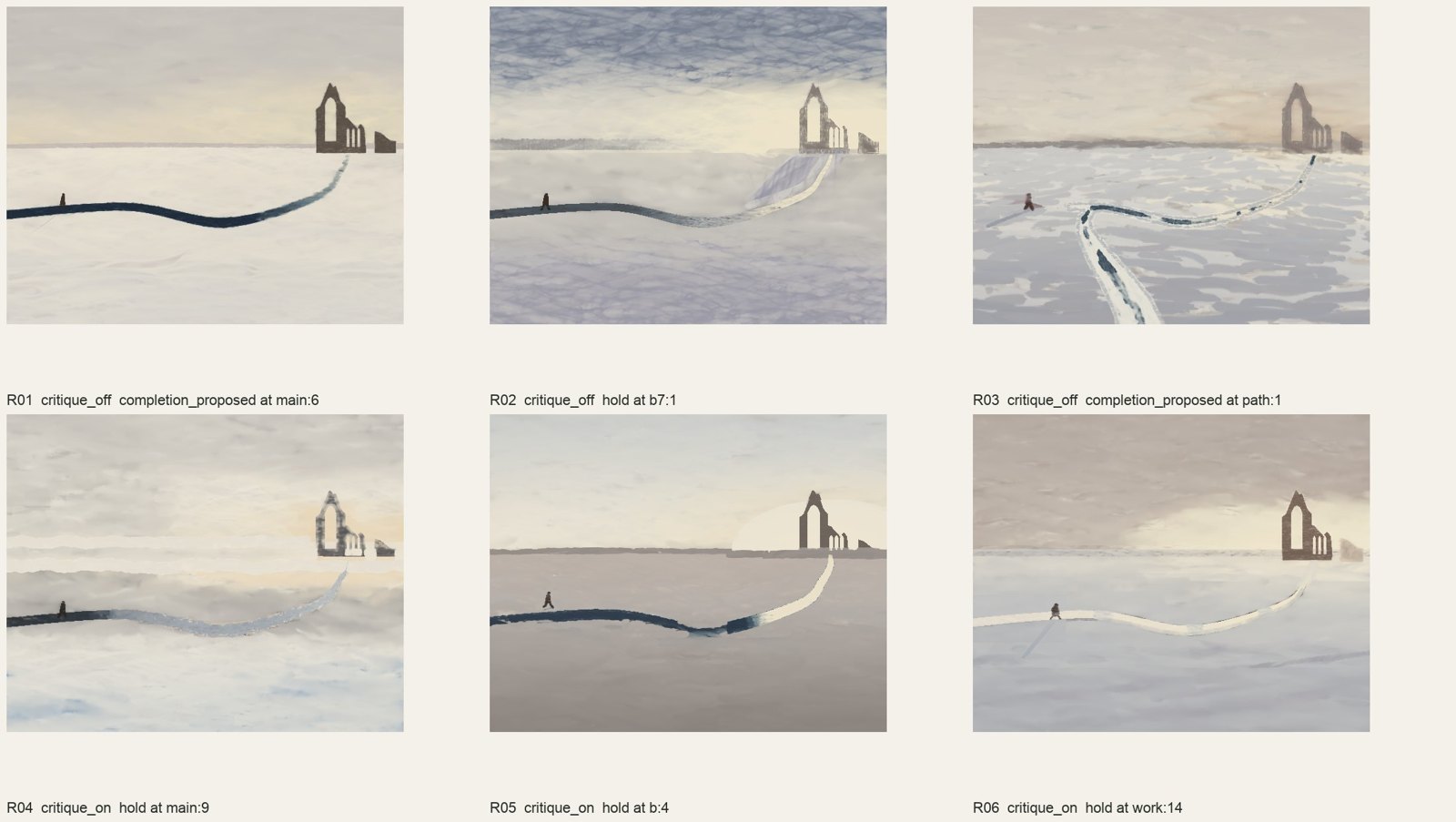
A glow behind the ruin arrived in five of six finals whatever the condition, and the starting value key survived in one. All three critiqued paintings stopped the dark before the ruin; a value gradient in the near snow appeared only with critique.
The instrument was itself a finding: the two annotators agreed on 17 of 36 answers. Questions about value moved to measurement from pixels, and the remaining questions were rewritten to describe what is visible and practised before use (agreement rose to 24 of 30, then 34 of 36). Questions that ask for meaning stay with the critique.
SR2: critique, with and without the intent ledger
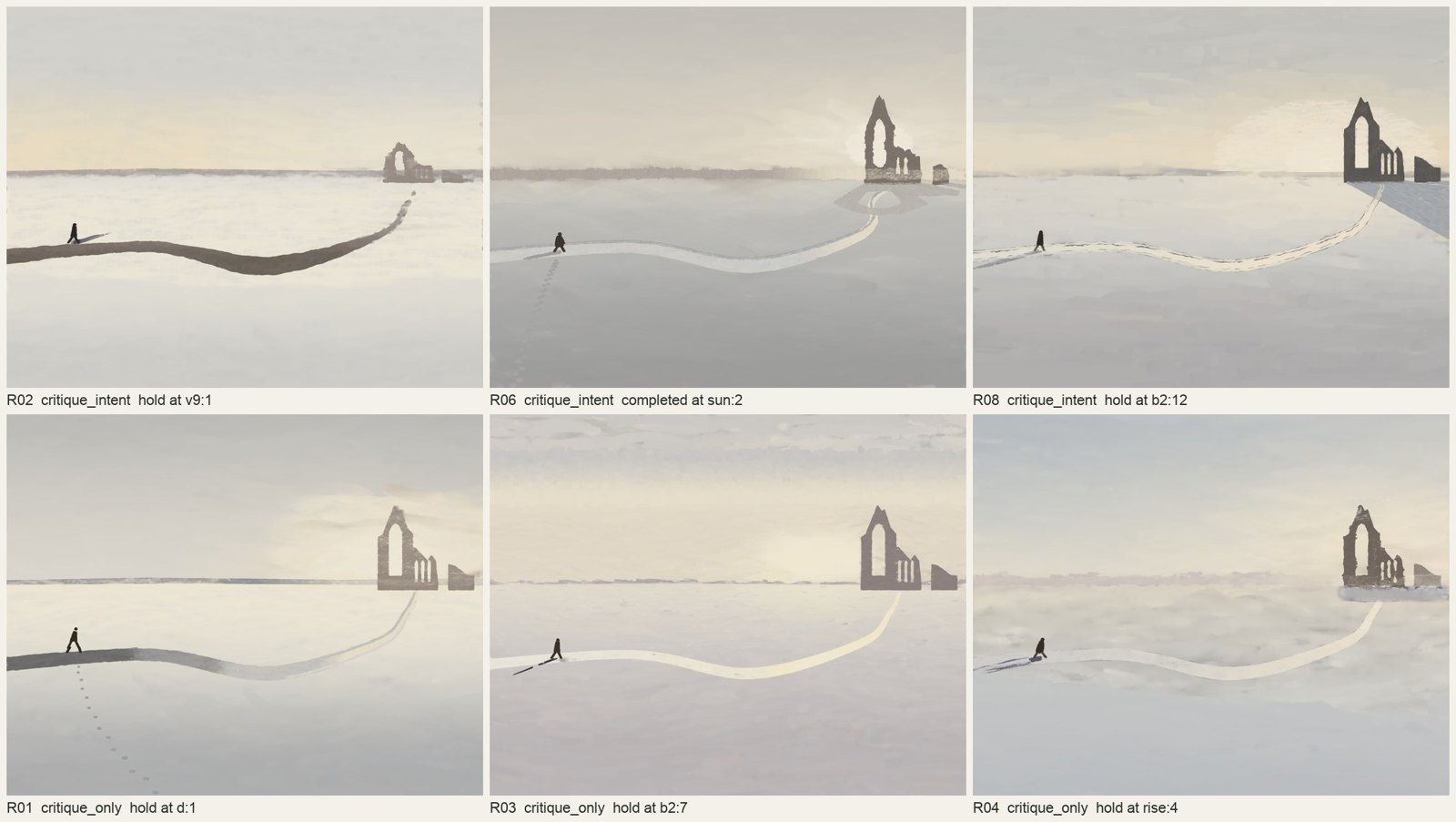
Both arms kept S21's geometry and turned its low key pale; the dark brook became a lit path in five of six, and five of six first questions put a low sun behind the ruin. The ledger arm produced the one completed painting, more completion tests and six reading disputes. The ledger changed how painters answered for the picture, not which picture they painted.
That pointed upstream: in both series the picture was decided in the first sitting, before any critic or ledger could act. Three runs per condition describe a sample; they do not establish an effect.
Winter Brook closed there, on Russell's art teacher's advice that the real work is in the twenty drawings made after the first plan (the passage is on the Overview). The next experiments asked whether that fate could be changed after all: Refusal and critic modes.