Transfer authority
Move attention from one character to another while keeping the performance and required geography intact.
Visual measurement → directorial control
It reads structure in rendered images as a field of coordinates: placement, void, packing, cohesion, peripheral pressure, orientation, dispersion, color relationships, and change through time. Connected to Blender or Unreal, those readings can guide the next camera or scene edit.
The strongest production proof
A 16-second five-character sequence was revised cumulatively: first disrupt the group, then let the original order recover, then bring one witness into alignment without rewriting what had already been approved.
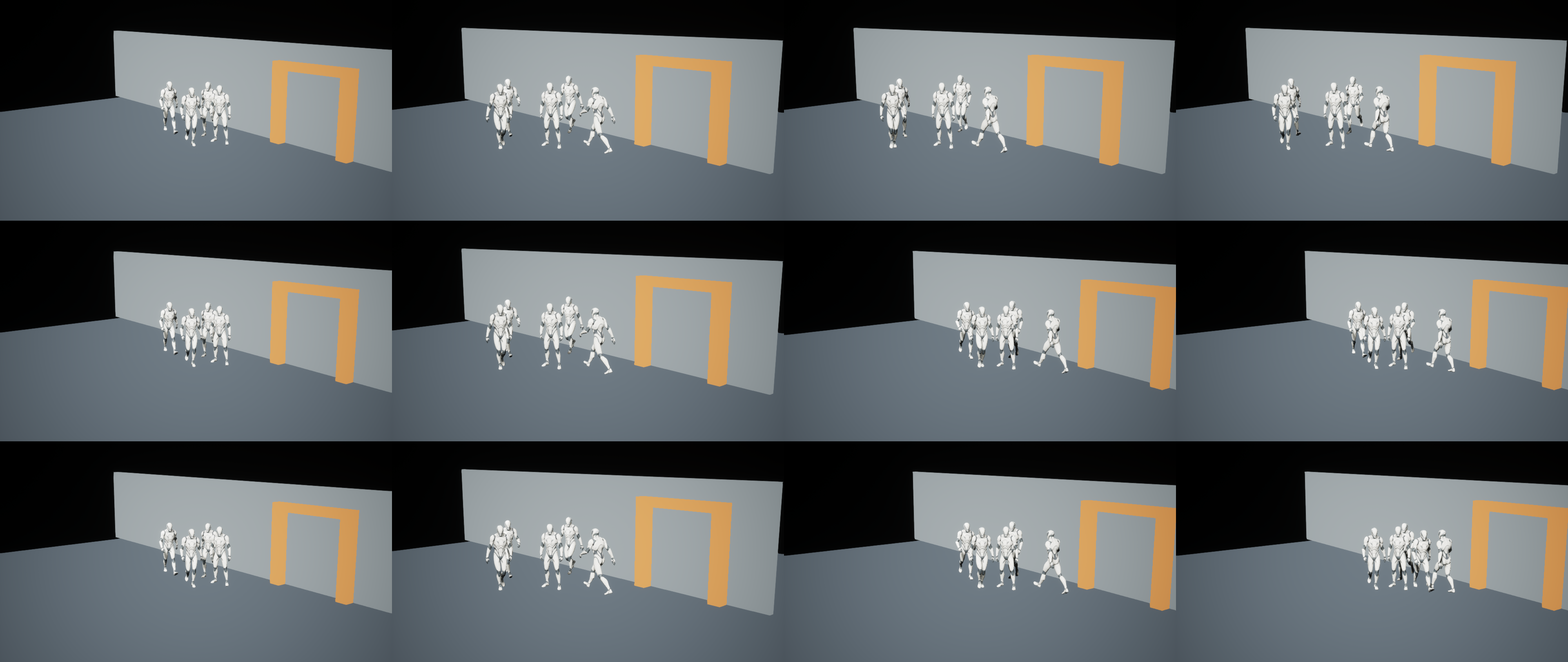
V1 · disruption
A enters and takes visual authority from the group.
V2 · recovery
The earlier disruption remains; the prior order later reasserts itself.
V3 · selective alignment
Only E changes after the protected history; A–D and the camera remain locked.
What this establishes
The system did more than select a frame. It retained approved directing state, introduced a later relationship change, and verified that unrelated actors and the camera did not move. That is a bounded revision workflow inside an editable production sequence—not autonomous direction.
The clearest camera-only proof
Every character root and six named bones per character remain identical across 48 frames. Only the camera changes. The measured difference can therefore be attributed to framing rather than altered acting or timing.
Baseline
The action is clear, but the frame does not strongly declare rupture or absorption.
Disruptive
The entrance reorganizes the group. The frame appears to react to A.
Inevitable
A joins an order that already appears capable of containing the arrival.
What this establishes
The disruptive treatment produces 2.13× the horizontal-center range and approximately 2× the combined temporal change of the inevitable treatment. This is not a preference result. It is evidence that the same action can be navigated into distinct, inspectable coordinate regions.
What the system is
Name the requested relationship, the protected facts, and what may remain free.
Change camera, lens, aim, blocking, light, color, or other authorized scene controls.
Measure the image that was actually made—not what metadata predicts it should look like.
VTL describes placement, pressure, organization, color, and temporal change as separate channels.
Keep valid alternatives, expose coupling, and search again from the chosen or measured direction.
Evidence ladder
Each stage answers a harder question. The claims remain bounded to the tested scene, renderer, measurement version, and declared controls.
48 Cycles renders of one Classroom scene showed broad, reproducible variation across placement, pressure, tone, color, and stance.
Three film passages separated pixel movement from structural behavior: suspense produced stance volatility; release carried visible motion inside a stable stance.
A full-scene controller moved color counterweight, peripheral pull, and directional structure while exposing coupled changes and protected-coordinate failures.
Unreal searches produced editable camera families, then responded to explicit notes while locking character performance and scene landmarks.
The disruptive and inevitable branches reached different temporal regions without changing the five-character performance.
Camera-led, blocking-led, and balanced routes fulfilled the same authority-transfer brief through measurably different causal mixtures.
A 16-second sequence accepted three cumulative revisions while protected time ranges, characters, camera state, and relative performance remained locked.
A five-character Sprite Fright shot accepted two cumulative camera notes and one selective blocking note without modifying its source animation.
Current capability
Next threshold
A director supplies language the experiment was not written to expect. The system identifies targets, protections, writable controls, and several causal routes; returns editable revisions; and preserves the first approval when the next note arrives.
That has not yet been demonstrated. It is the next product-defining test.
Present conclusion
The work now supports measurement, comparison, constrained search, joint camera-and-blocking revision, bounded cumulative change, and transfer into an independent production shot. It does not yet establish autonomous taste, story understanding, generally valid dramatic semantics, or an interactive note-to-scene product.