Reachable ranges
- Horizontal placement Δx
- −.096 to .222
- Peripheral pull xₚ
- .145 to .412
- Color dispersion
- .218 to .634
- VCLI-G
- 1.803 to 2.503
Curated evidence record
The sequence below omits exploratory dead ends unless they clarify a boundary. It focuses on the shortest evidentiary path from descriptive measurement to persistent, bounded direction.
How to read each case
Ask whether the visual relationship actually changed before reading the metric explanation.
A result is useful only if the requested movement occurred without violating the facts the brief said to hold.
High and low are directions within a particular intention—not winners, quality grades, or style rankings.
Measured change is evidence. Dramatic language remains a proposed reading until recognized by people in context.
01
Blender · static camera observatory
The Classroom established the basic observatory: generate reproducible camera candidates around a real scene, render every view under controlled conditions, attach exact camera parameters, then measure the reachable compositional space. Diversity sampling chose difference, not excellence.
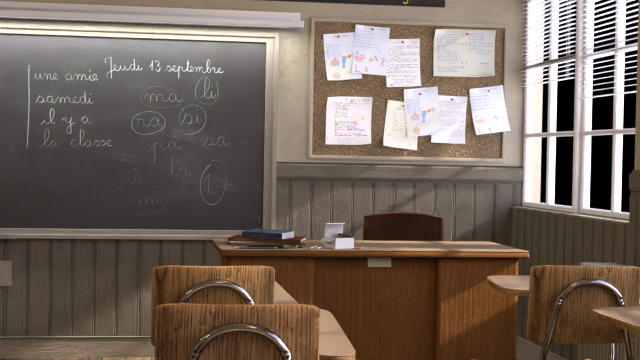
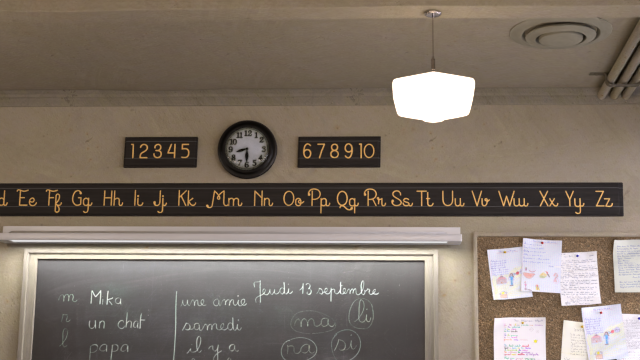
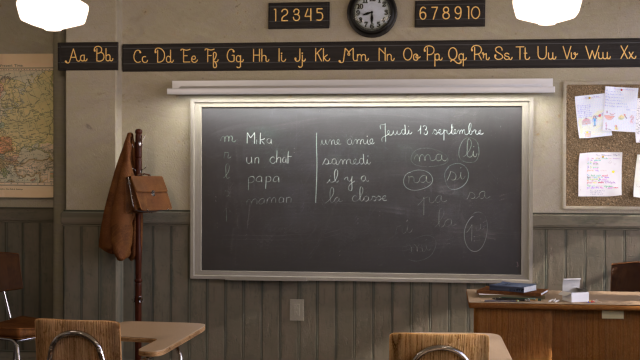
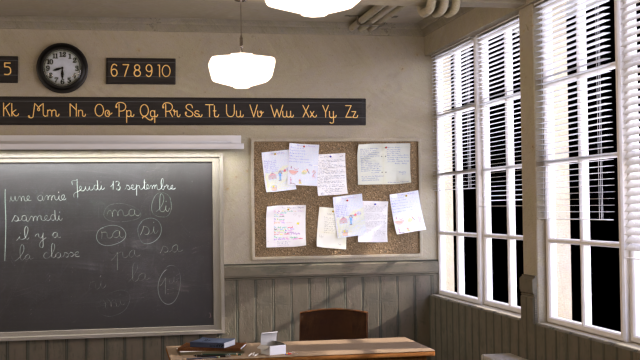
Reachable ranges
What controlled this scene
Horizontal position tracked saliency and color–structure relationships. Vertical aim tracked shadow, midtone, and Notan-void measures. Focal length tracked diagonal energy, color coupling, orientation, and saliency concentration. Forward movement was comparatively weak inside the sampled volume.
Validity lesson
An earlier engine conversion produced near-black images. Preserving Cycles raised mean luminance from .0303 to .3755 and reduced pixels below 5% luminance from 85.3% to .68%. Illumination and render-engine control are measurement validity, not cosmetic polish.
A scene has a reachable measured topology. Camera position, aim, and lens move several coordinates together in discoverable, scene-specific ways.
Not establishedNo coordinate range identifies the best classroom shot, and these correlations are not universal camera laws.
02
Film · temporal observatory
Three passages from Sprite Fright tested whether VTL could describe how a composition bears change through time. Structural change was measured across robust-scaled coordinate vectors; raw RGB difference remained separate.
Suspense passage
The shot oscillates between structured activity and resolved economy. Six stance transitions and a torque range of .449 describe repeated cross-scale destabilization.
Release passage
Characters keep walking, overlapping, entering, and leaving, yet all 28 samples remain standing. Motion continues while the deeper organization stays settled.
| Passage | Stance | Torque range | Coherence crossings | Useful reading |
|---|---|---|---|---|
| Clarification | All standing | .015 | 1 | Low internal volatility |
| Suspense | 6 transitions | .449 | 5 | Repeated cross-scale destabilization |
| Release | All standing | .106 | 4 | Active motion held inside stable stance |
Strongest temporal finding
Release was not a destination quadrant or a fall toward minimum activity. It appeared as a relationship: substantial visible motion continued while cross-scale stance remained stable. VTL was not simply calling movement “tension.”
The coordinate trajectory contains information that raw pixel motion and isolated-frame labels do not. Different layers can divide descriptive labor.
Not establishedThe instrument does not know plot events. Automatic peaks require narrative context; the largest release-shot peak was a closing foliage boundary, not automatically the dramatic release.
Source footage: Sprite Fright, © Blender Foundation, licensed under CC BY 1.0.
03
Generated 3D scene · intervention test
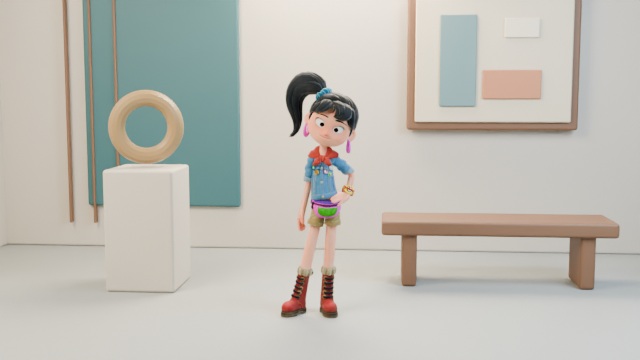
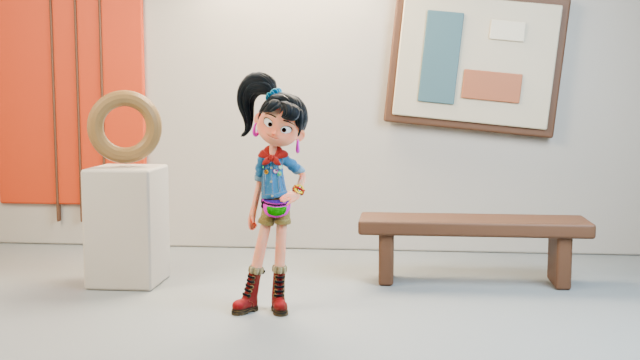
The scene itself became editable. Camera, figure, artwork, props, light, and color could change. Three briefs were stated before selection: peripheral pull, directional drive, and color counterweight. Each requested a target and protections rather than one total score.


Cleanest selective control
Horizontal color–structure separation changed from 4.52% to 34.27% of frame width. The structural centroid moved only .79%; mean lightness moved .0111 OKLab L; diagonal energy changed from 8.75% to 9.38%.
Coupling exposed
The peripheral result also rotated a major artwork and raised diagonal energy to 29.85%. The directional result reached 30.15%, but also pushed the figure left. The two images became visually similar because the unprotected channels were free to move.
Search result
Both approaches reached all three target thresholds. The guided endpoints went farther because the tie-breaker rewarded added progress—not because VTL established that more was artistically better.
Rendered feedback can locate scene inputs that move a declared coordinate while holding specified protections approximately stable.
Not establishedThe channels are not independent knobs, and this experiment did not prove a superior search algorithm. Missing protections become visible tradeoffs.
04
Unreal · native directing loop
Before any search, the loop was tested by hand. A enters through a doorway and joins B and C. The performance was recorded once; two notes were then answered by the camera alone. Prioritize the entrance: move closer, keep all three readable, let A become the largest figure at arrival. Hold the group: widen the field and keep the three figure heights in a narrow band.
Baseline
Neutral coverage of the doorway and group. Arrival xₚ .080, cohesion μ .974, G1 range .199.
Note 1 · Prioritize the entrance
At arrival A spans 32.2% of frame height against 30.3% and 27.6%. The most cohesive arrival (μ .991) and the largest G1 range (.288).
Note 2 · Hold the group
The three heights sit within 18.1–20.4% of the frame. The highest peripheral pull (xₚ .119) and the lowest cohesion (μ .905).
What was held
Across 36 sampled frames, all three actor roots and six named bones per actor agree between versions to 0.0 cm. Every sampled body point is in frame at arrival. No acting or blocking was changed to make the compositions.
What VTL reads
The two notes land at different coordinates. The close version gathers the arrival field and moves the structural center most over time; the wide version loads the frame edges and loosens cohesion. Higher G1 is not better, and lower cohesion is not a failure.
Scope
These cameras were authored by hand to meet framing constraints; VTL measured them afterward and chose nothing. The figures are mannequin stand-ins, and B and C walk in place. Whether either version carries the intended drama is a judgment for a director and viewers.
The next step replaced authoring with generation. For the note “prioritize A’s entrance, preserve the complete performance, keep all three characters readable,” a generator tested 2,400 cameras against the full recorded action. 718 qualified: every sampled body point inside a 2.5% frame margin, and A at least 1.035× the height of the taller of B and C at arrival. Six were chosen for geometric diversity. VTL was deliberately kept out of that choice and measured the six renders afterward.
01 · Strongest size priority
A is 1.18× the next figure, the clearest prominence. The doorway crowds the right edge, exposing a constraint the brief never stated.
02 · Elevated separation
A’s priority is slight. A highly cohesive arrival field (μ .963) with the three positions clearly separated.
03 · Compressed frontal field
The figures are largest as a group. Arrival cohesion .996 and the slate’s highest peripheral pull, xₚ .248. This became the source shot in D.
04 · Close wide field
The measured center moves most across the action, but structural G1 is eligible in only 88.9% of frames, so its large range needs caution.
05 · Void-led distance
The black wedge and open floor become active: the lowest peripheral pull on the slate, xₚ .064. The void may be a choice or an unexamined default.
06 · High wide overview
The broadest view and the smallest reliable G1 range among fully eligible candidates. A distinct organization, not a lower-quality result.
| Camera | A height ratio | G1 range | Peripheral pull xₚ | Cohesion μ | Reading for this note |
|---|---|---|---|---|---|
| 01 | 1.179 | .244 | .132 | .827 | Most size priority; doorway crowded |
| 02 | 1.043 | .145 | .184 | .963 | Separated positions, cohesive field |
| 03 | 1.065 | .266 | .248 | .996 | Largest group, heaviest edges |
| 04 | 1.043 | .905* | .245 | .810 | Center moves most; partial G1 eligibility |
| 05 | 1.110 | .174 | .064 | .899 | Void carries the frame |
| 06 | 1.067 | .135 | .114 | .923 | Overview, quietest structural center |
Values at A’s arrival. *Candidate 04 has 88.9% structural G1 eligibility; the other five have 100%. All six preserve the performance at 0.0 cm across 216 rendered frames.
What the slate shows
A note defines a region of possible images, not an answer. Inside one brief, with the acting identical, arrival peripheral pull ran from .064 to .248 and cohesion from .810 to .996. Two valid cameras exposed intentions the note never stated (a crowded doorway, a dominant void). Those are questions to put back to the director, not candidates to filter out silently.
One entrance-and-reaction performance was held exactly constant while the system searched camera space for three directing hypotheses: geography, pressure, and fracture. The funnel narrowed 1,944 configurations to 1,202 geometrically eligible cameras, 30 rendered phase candidates, and nine complete editable sequences.
Geography
The group, doorway, and entrance path remain readable as an ensemble.
Pressure
Boundary engagement and compression become more active without changing the acting.
Fracture
The frame separates and counterweights the group through a different camera relationship.
Family names are directing hypotheses, not facts recovered from the pixels. All nine outputs retained five skeletal-animation tracks, five transform tracks, one camera cut, and the same performance.
A director-style note selected one active coordinate and several protections. The search examined 3,750 nearby cameras, found 255 geometrically valid candidates, measured 16 rendered arrival frames, and promoted four distinct revisions rather than one hidden winner.
Source
Arrival xₚ .2484. Strong figure scale, but high edge engagement and a clipped doorway post.
Maximum reduction
xₚ fell 59.4%, but G1 range and leftward placement moved substantially.
Restrained route
xₚ fell 49.6% with the smallest G1 departure and a more restrained placement shift.
Why a family matters
The same request had multiple feasible routes. One bought the largest boundary reduction with greater temporal and placement change; another reached nearly as far while preserving more of the source behavior. VTL exposed the local cost of the decision.
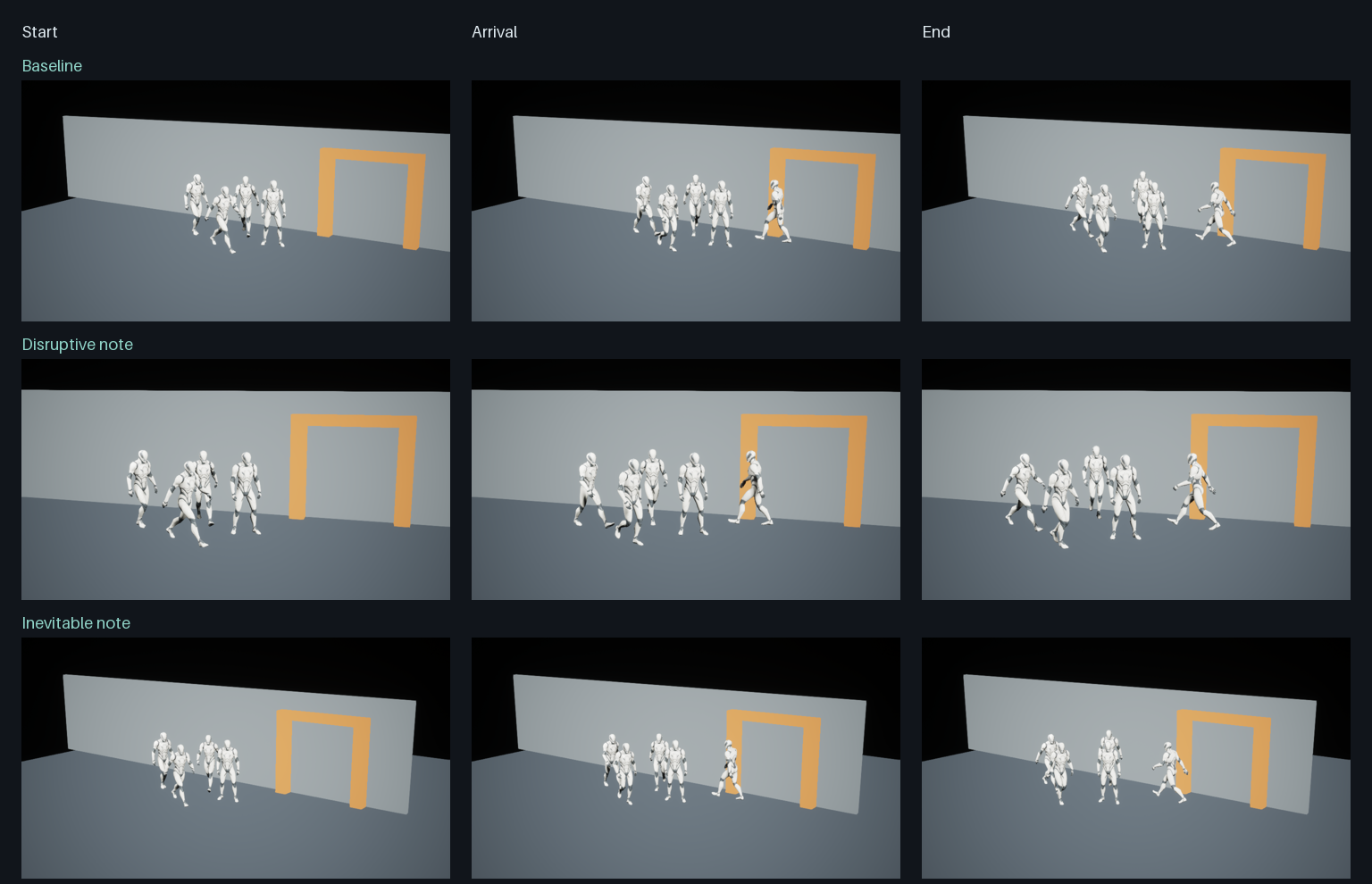
The same immutable beat was asked to support incompatible meanings: make the entrance disrupt the group, or make it feel absorbed into an order already present.
| Channel | Baseline | Disruptive | Inevitable | Reading for this test |
|---|---|---|---|---|
| Temporal Δx range | .0309 | .0494 | .0232 | Disruptive relocates the center 2.13× farther. |
| Seven-channel range cost | .1840 | .3081 | .1514 | Disruptive changes roughly twice as much across the selected surface. |
| Seven-channel path cost | .9931 | 1.5495 | .8240 | Inevitable travels less through combined coordinate space. |
| Center reversals | 10 | 8 | 5 | Inevitable follows a less corrective horizontal path. |
| Mean cohesion μ | .9741 | .8424 | .9444 | Inevitable retains more structural continuity. |
| Peak structural G1 | .1730 | .1074 | .1721 | Lower G1 did not mean calmer drama; this channel is not temporal continuity. |
Correction loop
The first inevitable branch reduced change partly by moving too far away: median projected figure height fell about 24%. Visual review exposed the false solution. A new ≥90% figure-height protection produced a final shot retaining 95.2% of baseline scale.
Causal verification
Five roots and six named bones per character were checked on every one of 48 frames. Maximum difference from the source performance was 0.0 cm. The output remained a native Unreal Level Sequence.
Interpretive result
Disruption and inevitability were not opposite ends of one scalar. They required different relationships among temporal placement, total change, packing, cohesion, edge load, and protected figure scale.
The next test stopped treating the camera as the only actuator. The note—transfer visual authority from C to A while keeping all five figures and the doorway readable—was realized three ways: mostly through camera, mostly through blocking, and through a balanced mixture.
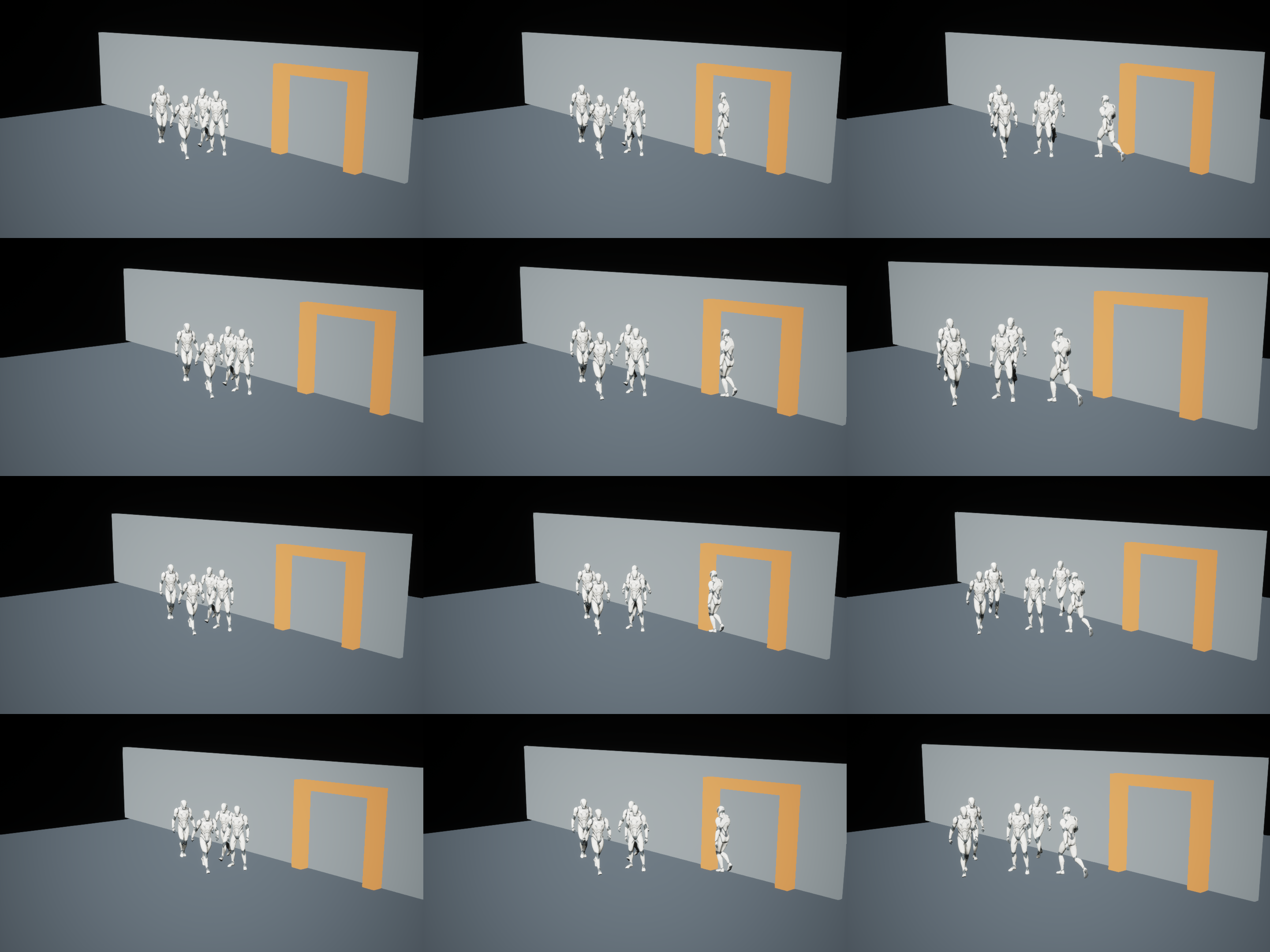
Camera-led · 83% camera
The largest center exchange and temporal range; the frame itself carries most of the transfer.
Blocking-led · 86% added blocking
The smallest G1 range; character placement carries the note while the camera stays comparatively restrained.
Balanced · 44% camera
A middle route: camera and blocking share the change without collapsing into the same surface behavior.
| Route | Center exchange | Temporal Δx range | Temporal G1 range | Causal reading |
|---|---|---|---|---|
| Camera-led | .560 | .093 | .338 | Framing carries most of the authority transfer. |
| Blocking-led | .397 | .048 | .086 | Staging carries the transfer with less whole-frame instability. |
| Balanced | .504 | .059 | .287 | Both inputs contribute; the visual consequence remains distinct. |
What the comparison means
These are not first, second, and third place. They are three production strategies for the same note. VTL reads the rendered consequence and helps reveal which control surface paid for it; scene-state audits establish that all five characters and the doorway remained present and the underlying skeletal performance stayed effectively identical.
The strongest production-oriented test moved from alternatives to history. A 16-second Level Sequence received three cumulative notes: disrupt the original order, allow that order to recover, then bring E into alignment with A. Each later revision had to preserve the already approved time range and leave unrelated channels untouched.
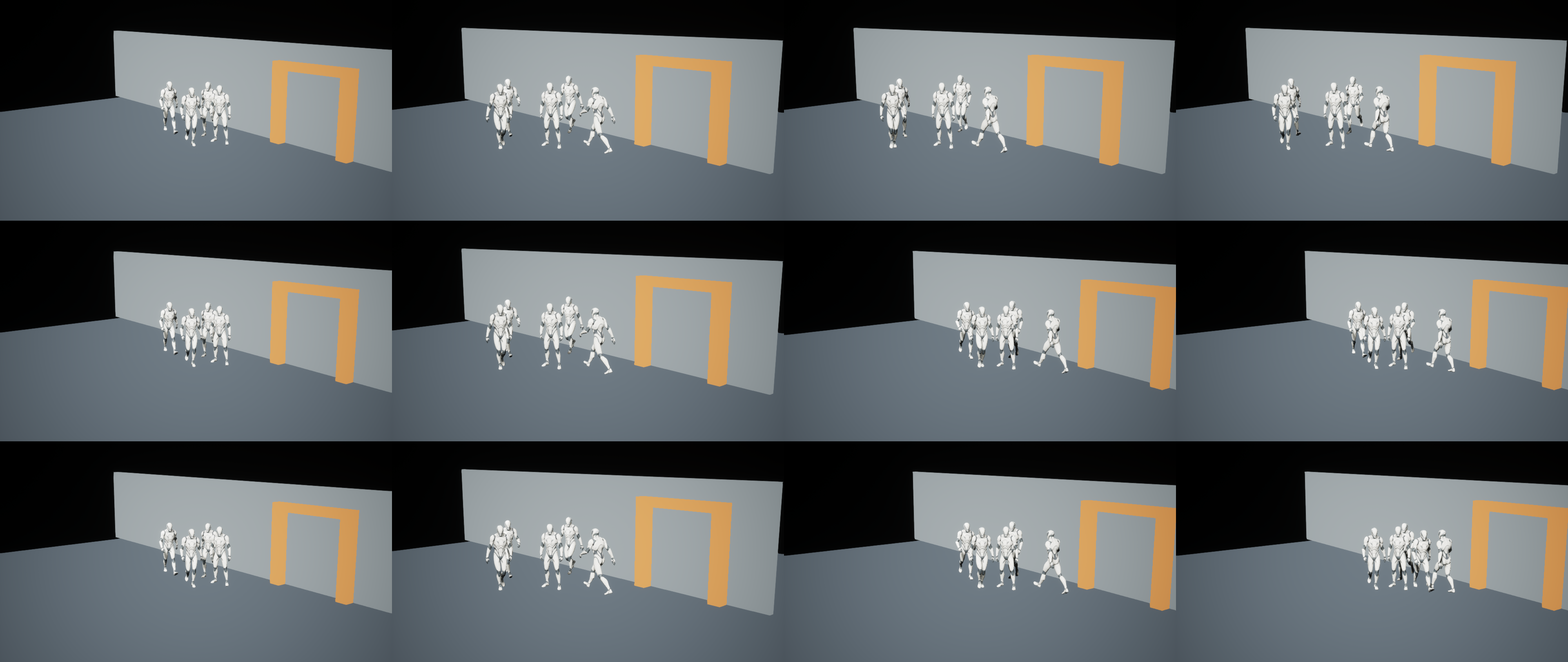
V1 · Disruption
A’s entrance reorganizes the group and becomes the dominant relation.
V2 · Recovery
The disruption remains intact; later, C regains the more central relationship.
V3 · E aligns with A
After the protected history, only E changes. A–D and the camera remain locked.
History preserved
V2 matched V1 through frame 191 within 0.000000315 cm of recorded state. V3 matched V2 through frame 287 exactly. Relative skeletal-pose error across the test was effectively zero.
Selective final revision
After frame 287, A–D and the camera remained at 0.0 recorded-state error. E alone moved 241.58 cm, shifting its screen relationship toward A while C retained the recovered central relationship.
Metric stability
Repeat renders of protected frames differed by only .067 of an 8-bit pixel level on average. The isolated Δx effect was 19× its repeat-render variation; xₚ sat at its floor, while ρᵣ and μ were too threshold-sensitive to claim as isolated effects.
Within this native Unreal test, VTL-informed revisions can combine camera and blocking, accumulate across a persistent timeline, and preserve approved history and untouched scene channels with explicit audits.
Not establishedThis is not yet an interactive director interface or autonomous scene intelligence. Human recognition, transfer across scenes and performances, multi-shot continuity, and production-fidelity character work remain open tests.
05
Blender Studio asset · production transfer
Shot 010_0050_A from Sprite Fright was not designed for VTL. Its existing five-character animation, bridge action, props, and production camera became the starting state. The experiment applied two cumulative camera notes, then held both while revising one actor’s blocking.
Lens and yaw shift gradually so the lead character’s separation pulls against the group rather than reading as an unrelated action.
Writable: lens + yawThe first revision stays. A vertical camera shift reveals more of the void beneath the crossing without losing a character.
Writable: vertical camera shiftBoth camera revisions stay. One rig moves half a step toward the bridge and ensemble; the other four actors and every skeletal performance remain locked.
Writable: one actor root
Camera revision only
The two approved camera notes remain active; all original character blocking remains.
Camera + selected blocking
The same camera and performances, plus one eased lead-character offset from frame 154 onward.
mean lead-to-group screen separation across the sampled beat
lead-to-group separation at the end of the intervention
maximum screen-box change among the other four actors
new character-clipping failures introduced
At the key frame, four rig offsets exposed the local choice. The smallest was weak; the largest began to collide with the bridge roots. The middle value was selected as a legible intervention. The labels describe that decision, not a universal VTL ranking.

What VTL read
Across the raw editable layer, packing rose 2.25%, cohesion rose .51%, and peripheral pull fell 6.05%; vertical placement remained essentially stable. The frame did not become an entirely different shot.
What scene instrumentation verified
Evaluated visible meshes measured the lead relative to the other four characters. Their projected boxes remained exactly fixed while the lead-to-group gap contracted. This attribution cannot come from a flattened image alone.
Calibration check
Three independently rendered, parameter-identical frame pairs gave zero rounded variation for the eight spatial channels; G1 reliable curvature varied by at most .000035. Every 0.25 m blocking step moved Δx, ρᵣ, xₚ, SDI, and both G1 measures beyond three times that local floor. μ stayed saturated at 1.0.
Production implication
VTL becomes a directing instrument when image coordinates are joined to scene knowledge. The kernels describe the rendered field; scene instrumentation identifies controllable causes and protects named actors, landmarks, performance, and approved history. Together they support selective native revision rather than after-the-fact scoring.
In this independent Blender production asset, two camera notes and one actor-blocking note accumulated while source animation, the other four actors, and prior approvals remained protected.
Not establishedThis is a reduced production reconstruction, not the final studio render. It does not establish automatic note interpretation, human preference, skeletal performance direction, or generalization across arbitrary shots.
Sprite Fright project material: © Blender Foundation, CC BY 1.0. Shot files were published for Blender 3.1.2; this experimental reconstruction used Blender 4.2.23 EEVEE Next with embedded scripts disabled. Detailed provenance and calibration are available on the Method & limits page.
Evidence summary
The clearest nontrivial result is not that VTL can find a high-scoring frame. It is that a declared visual relationship can be translated into coordinates, protections, and authorized controls; explored through actual renders; realized through camera, blocking, or both; revised later without silently discarding approved work; and transferred into an independently authored production shot.