
Study 01 · paintingMatisse, La Leçon de pianoColour and structure decoupled, made into instability.
CritiqueLab book
Portfolio
Every page here applies one commitment: read the geometry of a structure before assigning it meaning. No model in the loop, no semantic judgment. The same habit of measurement has been pointed at a Caravaggio, a wafer map, a seismic array, a tumour, a robot's success judge and a stock market.
This is the whole body of work, grouped by the field it was pointed at. Measured holds the studies, papers and lab books, with corrections and retractions left in. Made holds the studio tools, instruments and games built from the same measurements.
Each tile is a field the instruments were pointed at. Choose one to jump to its work.
I · Measured
II · Made
I · Measured
Studies, papers and lab books. Each field has its own instrument, but every instrument makes the same commitment: deterministic, interpretable coordinates, read before meaning is assigned.
Paintings, photographs & calligraphy · Image Structure Reader
A pre-semantic instrument aimed at works whose meaning is already argued over. Each study has a lab book, the working record with every correction kept, and a critique, the essay it earned. The full corpus, with notes on what each study taught the instrument, is on the studies page.
The sixteen studies


The instrument
What the reader is, and why it recognises nothing: it measures what is geometrically there, so critical language can be checked against it.
One painting taken down all four layers of the reader, with every metric named where it appears on the canvas.
Null controls, seed sweeps, pre-registration, and a register that records its declines.
Two works, one coordinate space. Pick any pair from the corpus and read their coordinates side by side.
The fields the reader computes (luminance gradient, OKLab chroma, cone-opponent channels, committed and soft edges, structural mass) and how regions are read as one system.
Also: July edition, 12 studies
Earlier readings
A training-free structural reading of Picasso's Family of Saltimbanques (1905), and what a measuring instrument can and cannot say about a painting.
Also: Lab book
Can a generator reproduce a composition it cannot read? Eight AI renders of the Saltimbanques structure, each scored by the instrument.
Whole careers plotted on colour and structure axes. Cézanne's 428 paintings by period and series, and five more painters.
Load a folder of images and plot them on any pair of the lens's axes.
Also: Saliency version
Each image read as a system of structural islands, a mass centre, conduits and resistant corridors, beyond frame-centre balance.
Does the structure reader add predictive information beyond simple pixel, regional and frequency features? Six pre-registered tests with planted controls. The decisive one, 859 steered images in 106 groups, found +0.003: structure added nothing there.
A reader of pictorial space: one picture in, readings of its planes, groups and field, and where its own local readings refuse to agree. Its pre-registered claim, that the relief mask reproduces beyond a trivial mask, did not hold, and the page says why.
Generative image models · Visual Thinking Lens
The lens measures the compositional prior that image generators apply to every output, whatever the prompt asks for. It is the field this work began in.
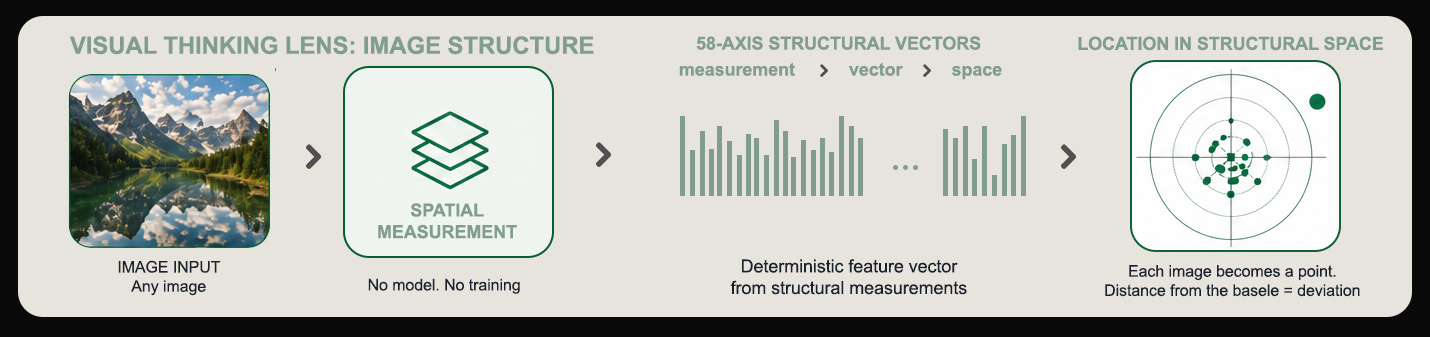
6,000+ images across Midjourney, GPT, SDXL, Firefly and Sora. Semantic diversity explains less than 10% of spatial variance.
A label-free count of compositional vocabulary. AI-default portraits use a narrower vocabulary of surface and colour than pre-modern oil portraits, and an equally wide vocabulary of placement.
Image-system independence in authored and generative portraiture: 1,341 images across pre-modern oil, Midjourney default and Midjourney steered.
What prompt steering actually moves, measured on 927 generated portraits and 125 paintings, and why the instrument agreed with it at first.
Do the steering clauses in a prompt move a picture's composition, or only its tone? 106 paired Midjourney sitters; 1 of 11 predictions held.
The operating windows of one image generator, measured object-level and mass-level: 864 Z-Image Turbo images, two frozen tests and three exploratory dives.
What changes when only the generator changes: one bet, one set of prompts and seeds, one frozen instrument, 810 images measured twice.
A pre-registered bet about prompt control, killed on FLUX.1-schnell: 324 images, one measurement pass, six referee checks.
Standard image metrics read what a picture contains, not its visual vocabulary. CLIP and the kernel side by side on two subjects, each made three ways: CLIP is indifferent; the kernel separates them.
Geometry-based field metrics for attractor basins, perturbation drift and geometric collapse, independent of semantic content.
Compare two complete sets of generated images on 17 pixel-traceable axes, with effect sizes and bootstrap intervals. Images never leave your device; no model judges another.
A pre-registered test on 1,080 images: the placement measures transfer to two held-out engines (46 of 48 directions), but the same prompt words make different compositions on different engines.
A seven-metric geometric framework for detecting compositional drift in image generators, with no model access required.
Spatial instruction compliance as a geometric probe of Midjourney v6 and Recraft V4: one neutral subject, eight placement prompts, 48 outputs.
Gradient-field analysis of 400 Midjourney images, explained in three vocabularies: the artist's, the researcher's and the engineer's.
Compression rejects byte-level sameness across the set, while the lens finds many near relationships in spatial structure: different substrates, kindred composition.
Runs: 134Kinship readout
A model-free similarity: two things share structure when they compress better together than apart.
A disagreement instrument for two images. Literal sameness is not structural kinship; drop in a pair and inspect the gap.
The choice detector. A line pressed far from the middle is improbable by luck, the fingerprint of a choice; every line dead centre is a prior.
A traceable record of vector image steering, geometric verification and bounded repair, captured as a reproducible snapshot.
The curation sheet for the 476-portrait corpus: every candidate laid out, with genre scenes and bad scans marked to drop.
Sixty portrait pairs. Pick the one that reads as a considered, authored composition rather than a default.
Upload an image, get a structural critique: mass, void, drift, radial gravity, and whether the image was authored or settled. Runs in the browser.
A colour critique that reads palette, value and hue breadth, and whether colour rides the structure or floats free of it.
The inverse of the instrument. Set target coordinates and it generates a composition that lands on them, then measures its own output to prove it.
Also: The Synth II
Ordered, near-to-far prompt capsules that make an image model earn its depth, with Sora examples and the full recipe book as a PDF.
Controlled figure warps: treat the distortion as its own object, then integrate it. Sora examples and the full playbook as a PDF.
Film & 3D scenes · VTL in the render loop
Connected to Blender or Unreal, the lens's readings of a rendered frame can choose the next camera move or scene edit.
VTL as a visual measurement and directorial control instrument, with evidence from Blender, film and Unreal.
Early evidence from a closed-loop camera experiment in Blender: of 24 deterministic paths, the searched one met the release brief at 24.8% lower loss than the best ordinary moving control. Not yet tested against random search.
One authored Blender shot revised four ways through the scene itself (relight, blue, gold, cleared), set beside frame-by-frame FLUX image editing and a masked baseline. The scene keeps what the frames lose.
Same controls, same available poses, different selection: picking frame by frame passes 17 of 24 mechanical checks; choosing the sequence as a whole passes 24 of 24. One development shot; artist review still open.
Across 495 rendered frames, the camera moves 25 of 38 measured coordinates, mostly through geometry rather than light; focal length is the strongest control. Two pre-registered conclusions were overturned by later checks, and both corrections are shown.
Language models · Linguistic Kernel
The same move applied to text: reduce an output to a small set of structural coordinates and measure it, without asking another model what it means.
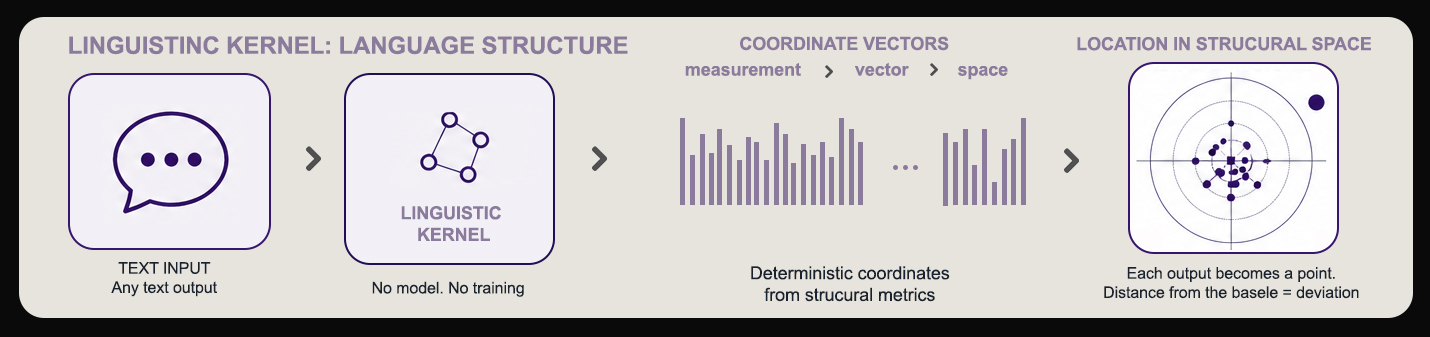
Eight-dimensional structural measurement for LLM outputs, measured across Claude, GPT and Gemini, with no judge model.
What a deterministic text reading can tell apart: prompt against run, engines under batch load, answers cut off mid-formula, and which instruction wins when instructions collide.
Clause density in a finished answer tracks how unevenly GPT-4o's own token-level uncertainty moved, with no access to the model: r = 0.36 after controlling for length and prompt family.
1,200 Gemini, GPT and Claude responses under twenty-prompt batch load: how each engine allocates output, and the rendering-intensive derivations that cut off mid-formula.
Stop using LLMs to judge LLMs. Score outputs, gate prompt changes and monitor drift in CI with a deterministic kernel.
The lens turned on source code: weigh each structural dimension against a corpus norm, and read where this code departs from the middle.
Histopathology · Parallax Pathology
Tissue architecture read as geometry: how far a section departs from the organisation of normal form.
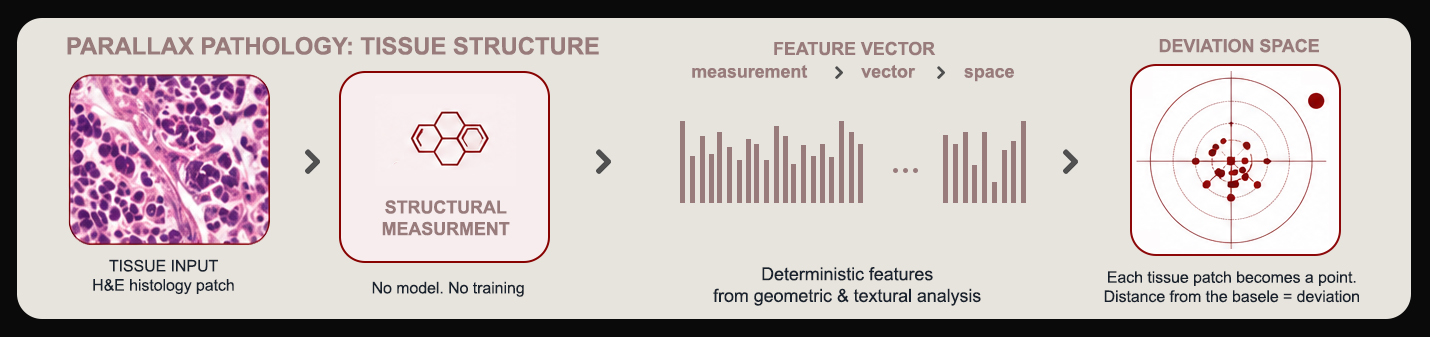
58 deterministic axes and zero trained parameters. 91.5% nine-class accuracy on CRC-VAL-HE-7K; hazard ratio 1.872 on TCGA-COAD survival.
The full framework: nine-class tissue accuracy with no training, plus a survival signal in 180 TCGA-COAD patients.
A methods paper on coordinate-free structural persistence across serial histology sections.
A methods paper showing that where a measurement is taken conditions what task-relevant information it carries.
Semiconductor inspection · VTL coordinates & PTD-Z
The same fifteen physics-grounded coordinates, carried from paintings to wafers without redesign.
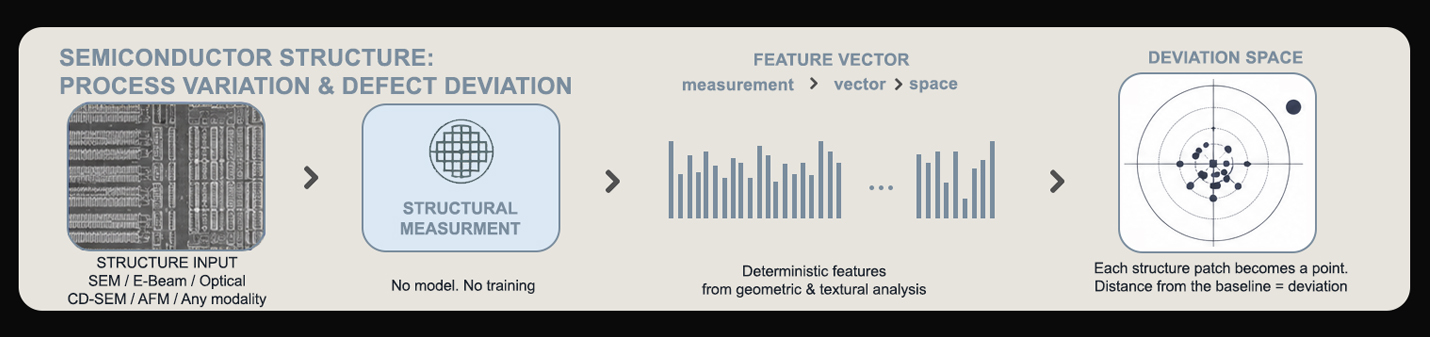
93.4% SEM balanced accuracy with no learned parameters. The same coordinates transfer across SEM, wafer maps and aerial lithography without retraining.
93.4% on production SEM and 94.9% on wafer maps with no retraining; coordinate dominance shifts with the physics of image formation.
Asks whether an organised pattern has stopped behaving like the structure it was expected to be, routed across geometry, pitch, material and contrast.
Seismic arrays · Ω structural agreement
Ω measures how many competing organisations a field supports at once, by asking physically independent reads whether they agree.
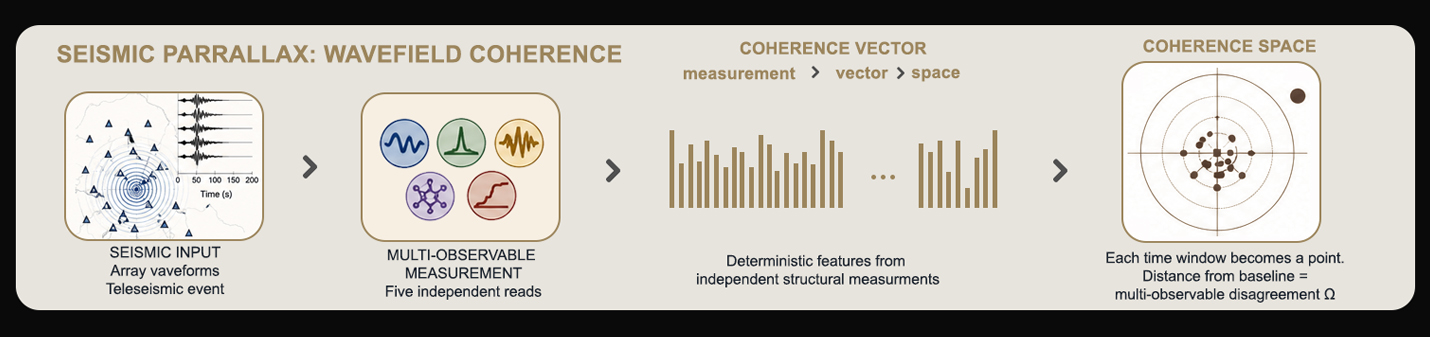
A 6.9× independence gain over correlated transforms; Cohen's d = 1.78 against the P-window; 15 FK beamforming failure cases documented.
Independent structural agreement as a field-coherence diagnostic: the pre-arrival Ω signal separates into a floor, and the layers above it.
A slowness-ratio diagnostic across three arrays, including an artifact peak 46° from the expected Tōhoku P arrival.
Precipitation observers · Structural collocation
Radar, infrared, microwave and rain gauges read the same rain field. Their disagreement about its geometry estimates each one's error, and shows when two of them share one, without ground truth.
Triple collocation on rain-field geometry over CONUS: the observer ranking depends on the triplet, and replacing either satellite with gauges reverses it.
A domain-qualification test that closed negative, and the collocation thread it opened, replicated on an unseen month with all six pre-registered predictions met.
A coarsening step that did not conserve mass gave independent observers correlated errors, and a finding built on it was withdrawn. The mechanism, the checks that would have caught it, and a checklist.
Materials microstructure · Structural Topology Kernel
A fixed descriptor asked to classify microstructure, predict a physical property and say how ambiguous its own labels are.
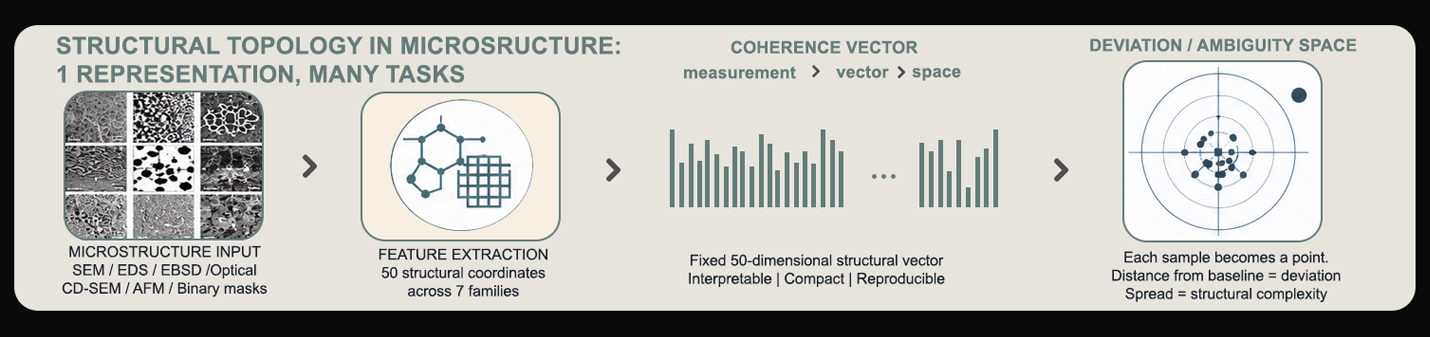
A fixed 50-coordinate descriptor: 0.832 AUC on microstructure classification and R² = 0.939 on 2D permeability, from a single representation.
Classification, taxonomy alignment, measurable label ambiguity, and a fair field-governed property test.
Embodied AI & robotics · Spatial Kernel & relational auditor
Checking whether a spatial instruction became a geometric fact, and keeping a learned judge from certifying what the pixels do not support.
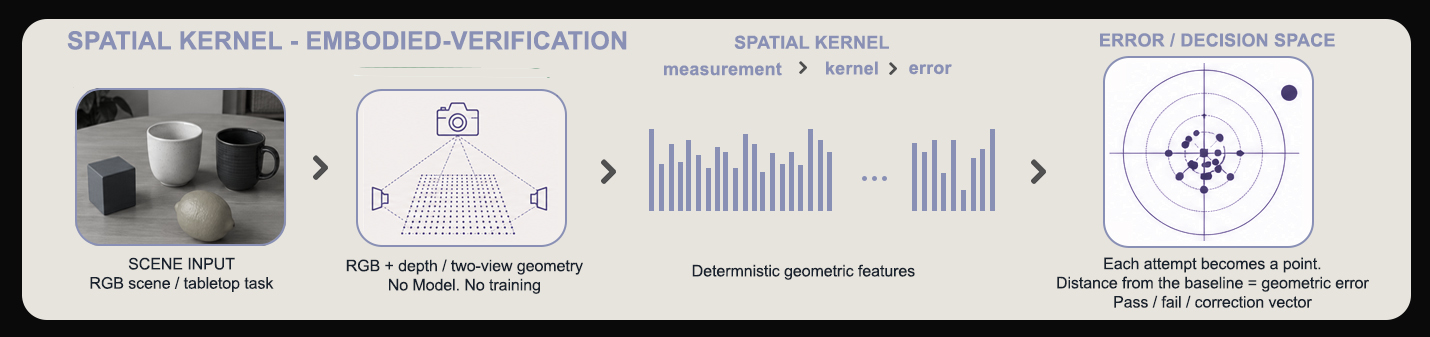
A two-view geometric check caught 10 flat printed decoys that a frontier embodied VLM certified as real 3D objects. 19 object types, real phone pixels.
On real photographs, a deterministic two-view check separates real 3D objects from flat printed decoys.
A frontier success judge returns confident false passes: an object's box moved 2.4% while its true visible extent moved 67.7%.
A pre-registered specification: which parts of the false-pass firewall are established, and the single experiment that would settle the rest.
The full record behind the auditor: existence proof, authority projection, boundary map, and results on real public pixels.
The backward trail: what it started with, what was wrong with it, what was built, and where it honestly loses.
Human movement · ZTOYBOX Biomechanical
Can organisational measurements reveal something about the body that produced them, beyond the complete conventional read? The computational phase closed without earning that claim, and says so.
552 trials from 28 participants and 29 linked questions, each attacked by an adversary. The physical claim is not earned; what remains needs a prospective physical experiment.
Financial markets · Ω, multi-family
A transfer test: does the seismic idea of independent structural reads carry over to the cross-section of stock returns?
A working manuscript: frozen Stage 1 evidence plus a pre-registered Stage 2 characterisation of economic magnitude.
The transfer test in full, including the failed first construction and an adversarial audit that corrected a hasty "non-replication".
An interactive terminal arguing for an AI-free stock market as a protected space for judgment, dissent, apprenticeship and accountability.
Credit & provenance · Patch ledger
A generator built so every output carries an exact record of what it drew on, and what that means for paying contributors.
Every number is read programmatically from the saved results; each finding is labelled by the strength of its evidence. Version 2 lists what changed since the first draft.
Also: First draft
The study record: a generator whose every output pixel is an exact, owner-labelled blend of training pixels, after Kamb & Ganguli's patch-mosaic result.
How far can steering move a contributor's expected credit while every receipt stays honest? A per-contributor bound passed a frozen test in 95% of pairs; a simulated $10,000 settlement moved $266.89, and the largest single loss stayed inside its stated exposure.
Why this pixel? Rebuild a damaged face from source portraits and explicit rules, then remove any one and see what changes. An exact-duplicate test shows that a large matching weight does not mean a source was necessary.
Six experiments in what "similar" means: move, shuffle and recolor an image, then see which scores notice. A second lab trains a small diffusion model in the browser and traces outputs back to images and patches.
What "credit" can mean, formally and in plain language, across transformer and diffusion stacks, with small-model controls. Toy quantities, not production influence or legal allocations.
Eleven linked chapters over sixteen synthetic images: watch a toy denoiser draw on an indexed source memory, with exact, estimated and logged quantities kept apart.
Lifecycle, lineage, toy influence methods, observability and accounting schemas, with lineage and influence kept as separate questions.
An exact, owner-labelled generator and an instrument for taking a source out. The October run tested whether a collection's creditability can be predicted from its make-up: neither predictor could, and under pixel error exact credit came out nearly uniform.
A picture from an exact generator trained on six public-domain draughtsmen and a pool of museum paintings. Remove an artist, see what changes, and compare who gets paid under exact Shapley, usage and leave-one-out.
A mathematical response proposing an exact observation law for a learned attention block, with two propositions, proofs, numerical checks and a testable programme. Draft for technical review.
II · Made
Tools for painters and draughtsmen, instruments for the ear, and games that make an idea walkable. Each is built on a measurement from Part I.
Drawing & painting · Studio tools
Making systems where every move is recorded and a critic argues back, plus pocket looking devices for the gallery and the easel.
Making systems
An experimental practice for machine drawing and visual critique, moving between mark-making instruments, generators and source material.
Generators, a learned charcoal hand, an eraser and a critic built from the lens. A drawing stops only at an argued Hold.
Reads a brief before any picture exists, lays out a wall of studies, argues a choice and hands it to a painting simulator.
A drawing partner. You make a mark; it answers a few marks at a time, in one of seven learned hands, and you decide what belongs.
Edit the relationships, not the points: open an artwork as addressable parts and change it while keeping its possibilities.
A composition editor where decisions persist: change emphasis, frame, arrangement or spacing, drag to propose a position, then see the conflicts and choose how to resolve them.
Before, after, and a declaration of what was allowed to change: a reproducible receipt of what an SVG edit actually touched. The final code flagged all 4 edits reviewers called material and none of the other 20.
Move a painting's color center while locking hue-family chroma, lightness and a protected region. 22 of 42 requests solved under the full contract; the other 20 refused as infeasible, with a check for each refusal.
Recolor one layer and move the fewest others to keep the composition's color center: 9.6% fewer collateral layer changes than a strong baseline, for 2.9% more movement, across 48 Photoshop requests.
A drawing hand that can only learn new marks from what it looks at: nine views of Mont Sainte-Victoire, then yours.
Learned drawing hands as files, and a studio that draws with them and says whose marks made each drawing.
A picture that remembers: retained source-derived marks whose origins travel with the material.
Composition as attention: masses average toward each other and disagreement provably shrinks. Anchors hold a composition open.
Looking devices for phone and tablet
Point the camera and a master's learned hand draws what it sees, stroke by stroke.
A viewfinder that reads the picture instead of drawing a grid on it: a value squint, visual weight and crops with receipts.
Every picture is drawn twice, by light and by colour. Separates the edges a grey value study keeps from those that exist only as colour.
Take the receding plane out, and see what stands off the ground.
Can this box of paint mix that picture? Choose the tubes and see what is out of reach, with a recipe for any colour you tap.
Your pile is almost right. Say what it needs by eye and see what to add, how much, and what else it will do; it learns your tubes, scales the batch, and shows the geometry underneath.
Squint at a reference, cut it into a few value masses, and get one pile per mass from a short shared palette, each checked so it stays in its value; with accents kept and a sheet to print for the easel.
Eight paints and a world between them. Find a starting mixture, see which way it leans, and make it your own; studies and reference images stay in your browser.
Tap a colour in a painting or your own photo and get an estimated oil-paint recipe from the paints you actually have. Adjust it, push it lighter, warmer or quieter, and save the mixes worth keeping.
Photograph a painting session by session, straighten it, and see what changed.
A working notebook for painters: find a way into an image through line, mass, value and colour studies, keep a direction, and follow the painting through its sessions.
Thumbnail sketching on the go: pages of frames for a phone in a gallery or an iPad with a pencil.
Sound instruments
Noise machines after Russolo, and rigs that let you hear an image or a measurement.
A painting heard in the order the eye walks it: each fixation a note, each saccade a glide. Where the field collapses, silence.
Russolo's six families of noise from 1913, rebuilt and extended with six more: sirens, electrical, granular, motors, crowd, radio.
A noise beat maker: pads, a sequencer, and controls that reshape the same sounds.
A living music box. Five voices, six seeds, endless little returns. Touch a sound; leave a little future.
A tone built to climb forever tells you almost nothing about where it is. This rig reads back what it can.
A score for human and machine. A machine counts; you interrupt; the interruption becomes another rule.
A playable appendix answering Russell Foltz-Smith's irreverence in a computer. Load a tape, change one recorded decision, and hear both versions.
Games & thought experiments
Games and small machines built on real mathematics: holonomy, evidence, eigenmodes, reaction and diffusion.
A book of stairs that do not close. Walk, build and break Penrose stairs on a real lozenge tiling.
Also: The Unfinished City
A town with no ground, and a Mill that wants it. A turn-based town builder drawn in pen and ink, where anything that loses its path to an anchor falls.
A detective game about object permanence. Looking tells you nothing; only acting does. You're scored on how honest your belief is.
Peek at real combinations of six artists, split 100 coins, then see the exact answer. In every round and under every measure, paying by usage or by leave-one-out scores worse than splitting evenly.
A shadow mystery in twelve rooms. Choose where to shine the light on a hidden sculpture, rule out the forms that don't fit, and learn when light alone cannot decide.
Interactive habitats for observing, learning and testing what changes a decision.
The vibration modes of a folded sculpture. Blend eigenfunctions, trace nodal lines, reshape its spectrum.
A copper loop that makes sense at every point and climbs all the way around, yet arrives where it started. The depth it gains is what the picture cannot hold.
Three sculptural studies in knots, linked ribbons and single-sided surfaces: an interactive geometry atelier.
An interactive notebook about what changes when "same" changes: geometry, perception, topology, symmetry, averages.
Fifty frozen ecology runs, and an answer-blind search that tries to reach the verdict from the record.
Two chemicals, one rule, iterated until something forms. Draw to seed it.
Your camera image breaks into a grid of moving cells. Each cell measures its own motion and stretches its piece of you along it; the more you move, the further the mirror comes apart.
A machine that does not work. It clots: flow becomes obstruction, obstruction becomes medium.
Also: First version
Growth tips navigate the page reading local ink density: heavy contour at the frontier, fine hatching within.
Also: One teacher
A contradiction instrument after Foltz-Smith: a clock made of words becomes a machine for measuring where the measurements refuse to agree.
One field counted three ways, drawn as lights on paper and sonified so the three counts beat against each other.
The layer the GPT-chip deletes: an external audit loop set against a closed loop that only validates itself.
Form without content.
Nothing matches that. Clear the filters